Clear Sky Science · en
Genome-resolved metagenomic survey of 500 samples from 56 hot springs across the Western US
Why hot springs matter
Hot springs are not just scenic pools in volcanic landscapes. They are intense natural laboratories where life has adapted to scalding temperatures, unusual chemistry and long isolation from the outside world. These conditions make hot springs ideal places to search for microbes that work in ways we have never seen before, and whose enzymes may one day help improve everything from DNA testing to green industry.
Exploring hidden worlds in remote pools
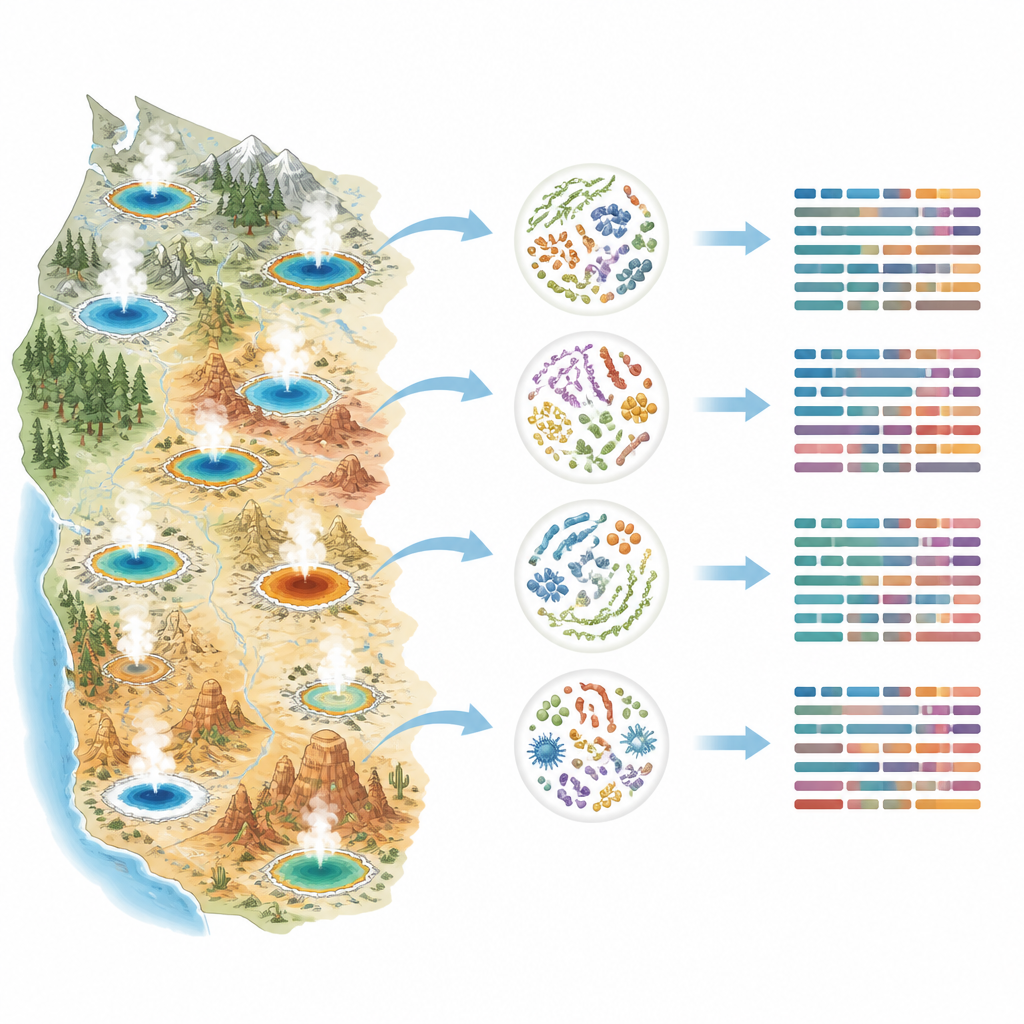
Across the Western United States, thousands of hot springs bubble up through fractured rock. Apart from the famous sites in Yellowstone, we know surprisingly little about the tiny organisms that live in most of them. In this study, researchers undertook a wide survey of 56 remote, mostly untouched hot springs scattered across the Great Basin and Yellowstone regions. They returned to many of these springs year after year, collecting 500 separate samples from source pools and nearby outflow streams that covered a wide range of temperatures, acidity levels and mineral contents.
Reading the DNA of whole communities
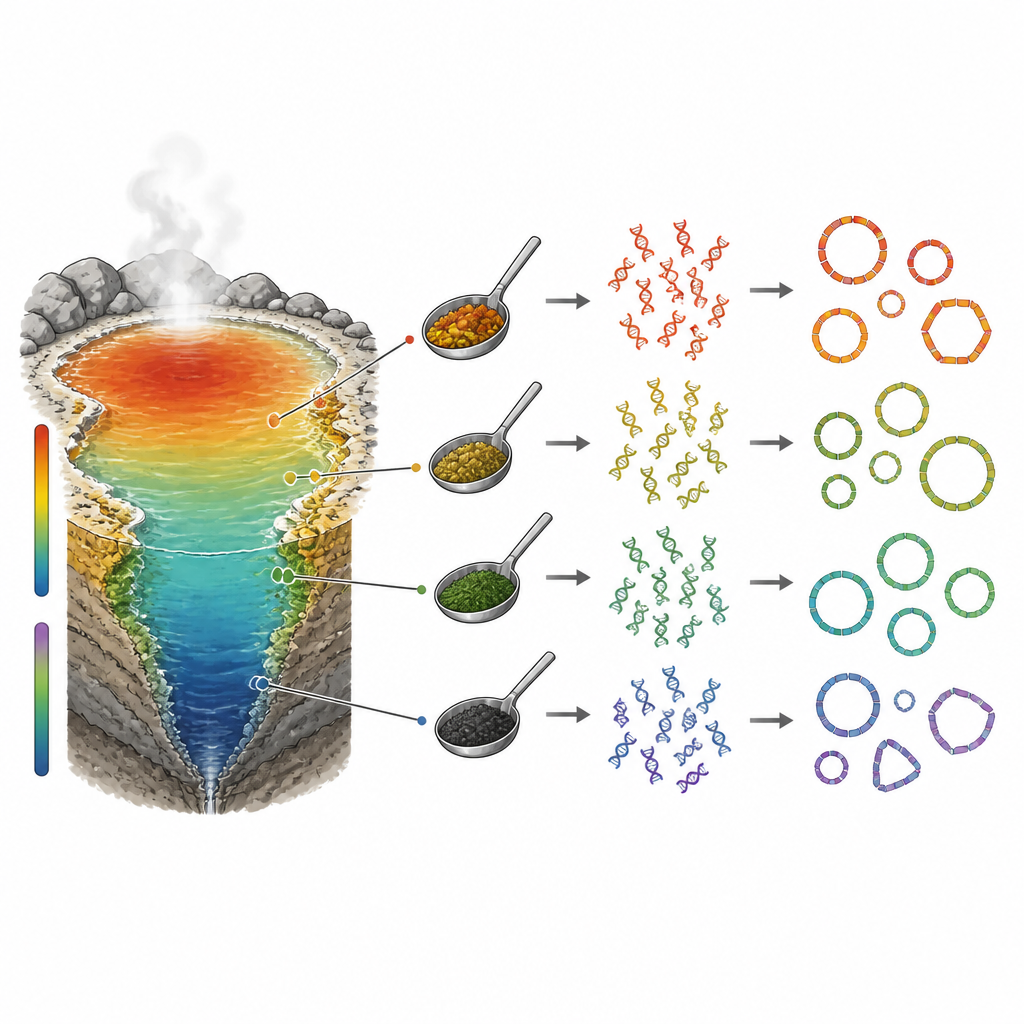
Instead of trying to grow each microbe in the lab, which often fails for unfamiliar species, the team used a strategy called metagenomics. They scooped up thin layers of microbial mats, filaments, sediments and mud from each site, then extracted and sequenced all the DNA present in those mixtures. Powerful computers stitched billions of short DNA fragments into longer stretches, and then grouped those stretches into draft genomes that represent individual kinds of bacteria and archaea. This approach allowed the scientists to study both who is there and what they are capable of doing, without needing to culture them.
Revealing a rich cast of heat loving microbes
From this large DNA trove, the researchers reconstructed 780 fairly complete microbial genomes, including 680 bacterial and 100 archaeal genomes. Many belonged to groups already known to thrive in hot settings, such as lineages that perform photosynthesis in bright shallow pools or that harvest energy from sulfur and hydrogen in deeper or darker zones. Yet a striking fraction of the genomes did not fit neatly into existing branches of the microbial family tree. Some could only be linked to a known genus or family, and a few seem distant from any well studied group, suggesting that they may represent entire families or even higher ranks of life that have never been grown in the lab.
Tracking function, not just family trees
Because the study covered many springs with very different temperatures and water chemistry, and for some springs multiple years, it offers a broad picture of how hot spring communities are built and maintained. By mapping genes to known metabolic roles, the team showed that these communities are powered by a blend of processes, including oxygen based breathing, fermentation, light driven energy capture and the use of nitrogen and sulfur compounds as fuel. The genomes also span a wide variety of genome sizes and GC contents, which hints at different strategies for surviving heat, scarcity of nutrients and chemical stress. The fact that only about one eighth of all DNA reads could be tied back to the recovered genomes suggests that there is still a great deal of undiscovered diversity waiting to be explored.
Why this resource matters for the future
This work does not attempt to answer every ecological question about hot springs. Instead, it delivers a carefully documented public resource: hundreds of deep DNA datasets, hundreds of reconstructed genomes and detailed information on when and where each sample was taken. For non specialists, the key message is that many remote hot springs harbor unique forms of microbial life that may disappear as geothermal development expands. By making these data widely available, the study provides a foundation for future research on early Earth like environments, microbial evolution across isolated pools and the search for new heat stable enzymes that could support high temperature biotechnology.
Citation: Korchagina, M.V., Mullin, C.E., Soufi, H.H. et al. Genome-resolved metagenomic survey of 500 samples from 56 hot springs across the Western US. Sci Data 13, 782 (2026). https://doi.org/10.1038/s41597-026-07139-w
Keywords: hot springs, extremophile microbes, metagenomics, microbial diversity, microbial genomes