Clear Sky Science · en
A large-scale acoustic dataset of a passerine with spatially variable vocal behavior: fine-scale annotations of song and call types
The hidden language of a shy songbird
Across the Spanish shrublands, a small and secretive bird fills the pre-dawn darkness with sound. This study turns those elusive notes into data, offering anyone interested in nature, sound, or conservation a window into how wild birds communicate and how that knowledge can help protect them.
Why scientists listen to birds
Bird voices are more than pleasant background noise. They reveal clues about how birds find mates, defend territories, care for young, and respond to danger. Songs and calls can signal who is healthy, who is breeding, and how different groups are connected across a landscape. Because sound travels farther than researchers can see, listening to birds has become a powerful, non-invasive way to track wildlife and detect early signs of environmental change.
A new library of bird voices
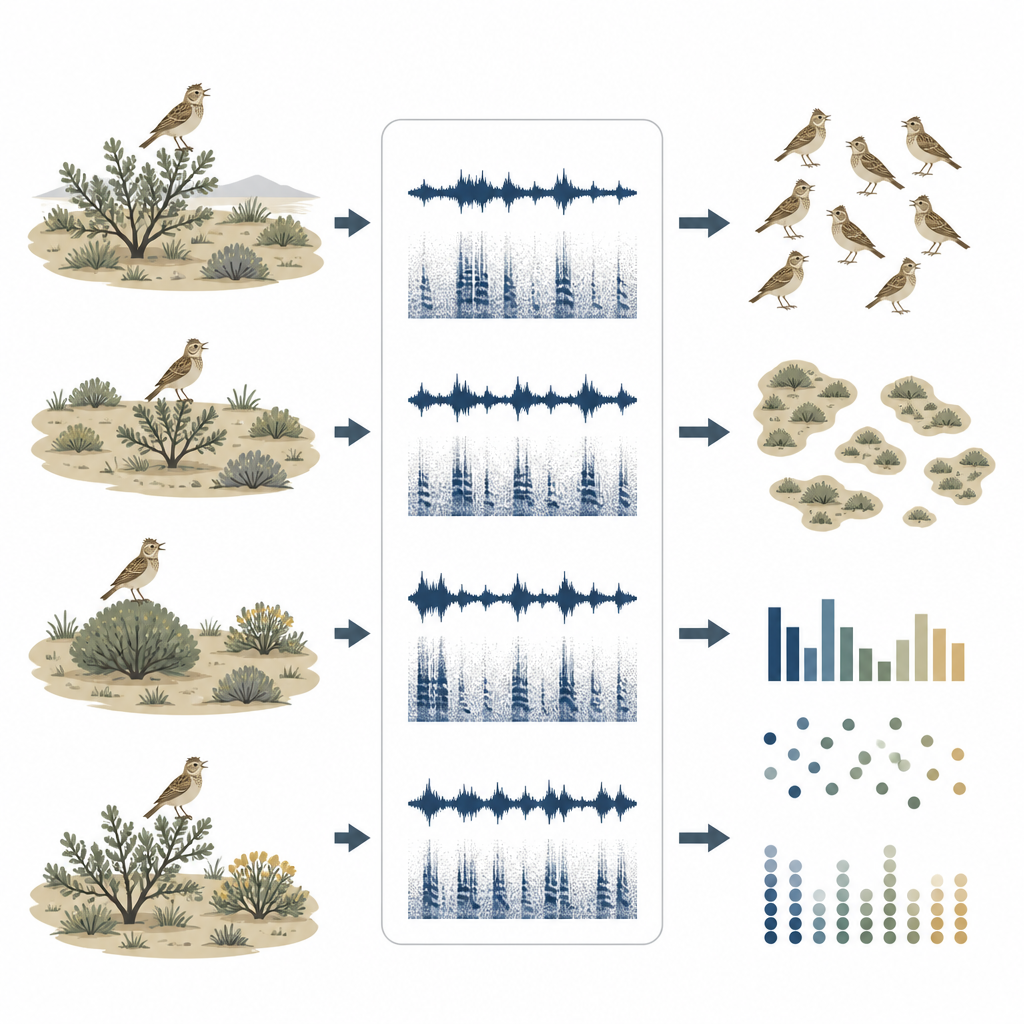
The authors created one of the most detailed sound collections ever assembled for a single bird species: the Dupont’s lark, a rare steppe bird with an unusually rich and locally varied voice. They recorded males at dawn in 20 separate habitat patches across Spain, focusing on two main kinds of sounds: complex songs and shorter territorial calls. In total, they carefully annotated 4,297 songs from 191 males, grouped into 401 song types, and 795 calls from 97 males, grouped into 80 call types. Each sound type was identified by closely inspecting its pattern on a sound diagram and listening for its shape, timing, and pitch.
From field recordings to reusable data
To make the dataset as useful as possible, the team followed a strict and consistent protocol. Birds were recorded with the same high-quality equipment, at similar times of day, and under calm weather. An expert ornithologist then went through every recording with specialized audio software, marking the precise start and end of each vocalization and its pitch range. These annotations were saved in simple text formats that work with common, freely available audio programs. Additional files link each sound to its approximate location, date, and population, and summarize which song and call types each male uses, as well as how far apart different males live.
What the patterns in the voices reveal
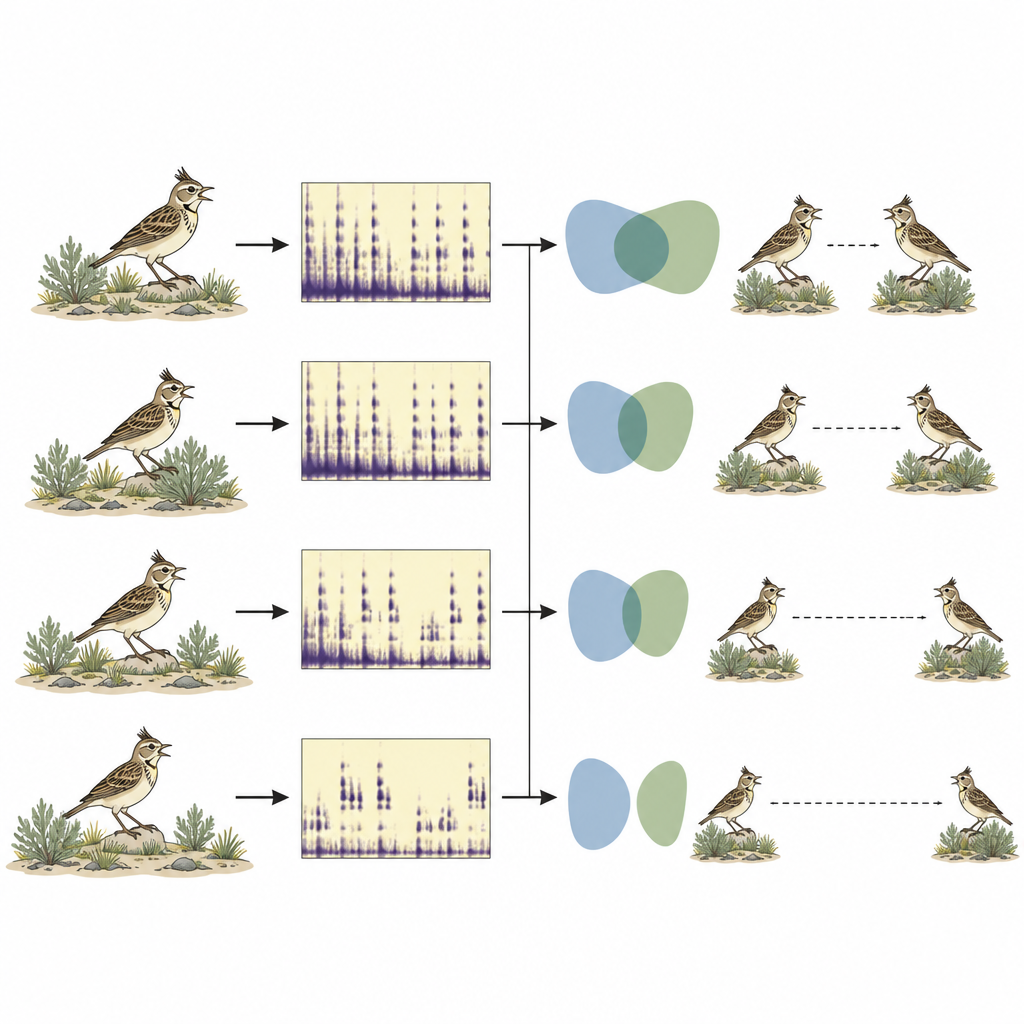
Using the new dataset, the authors tested how similar the songs and calls of different males are, and how that similarity changes with distance. By comparing which sound types each male uses, they found that neighbors sharing the same patch often have quite similar vocal repertoires, while birds in different patches share very few types at all. Calls tended to remain more similar over distance than songs did. These patterns match previous work on Dupont’s lark, confirming that the new dataset captures real biological signals rather than noise or recording bias.
How this sound atlas can help conservation
The resulting open-access “sound atlas” offers a rich resource for future research. Scientists can use it to study regional dialects, track how habitat fragmentation changes vocal sharing between groups, or refine acoustic methods to estimate population size and breeding activity. Because every sound is tied to place and behavior, this dataset can also be combined with other ecological information to understand how changes in land use or climate affect a threatened bird that is hard to see but easy to hear.
The bigger message in a small bird’s song
In simple terms, this work turns thousands of early-morning bird notes into a carefully labeled library that anyone can explore. By showing how the voices of Dupont’s larks vary from place to place, it gives researchers new tools to follow population links, detect isolation, and monitor the health of fragile steppe habitats. For a species that prefers to stay hidden in low shrubs, its songs and calls may now speak more clearly than ever about the state of its world.
Citation: Pérez-Granados, C., Alonso-Moya, C.D., Barrero, A. et al. A large-scale acoustic dataset of a passerine with spatially variable vocal behavior: fine-scale annotations of song and call types. Sci Data 13, 770 (2026). https://doi.org/10.1038/s41597-026-07131-4
Keywords: bird song, bioacoustics, Dupont’s lark, acoustic monitoring, habitat fragmentation