Clear Sky Science · en
Chromosome-level genomes of hard clams Meretrix lamarckii (Deshayes, 1853) and Meretrix meretrix (Linnaeus, 1758)
Why clams on the beach matter
Hard clams are familiar shellfish on Asian mudflats and menus, but they are also living archives of environmental change. This study decodes, in fine detail, the genetic instruction books of two common edible clams, offering new tools to tell lookalike species apart and to manage wild and farmed stocks more wisely.
Clams that look alike but live different lives
The Venus clams of the genus Meretrix inhabit estuaries and coastal waters across the Indo Pacific. They support local fisheries and aquaculture, yet many natural populations are under pressure from industrial harvesting, recreational digging and habitat loss. To make matters harder, several Meretrix species are so similar in shape and color that they are easily confused. Previous work using short snippets of DNA had already revealed hidden diversity and even new species within this group, showing that appearances can be misleading when it comes to clams.
Reading the full genetic instruction book
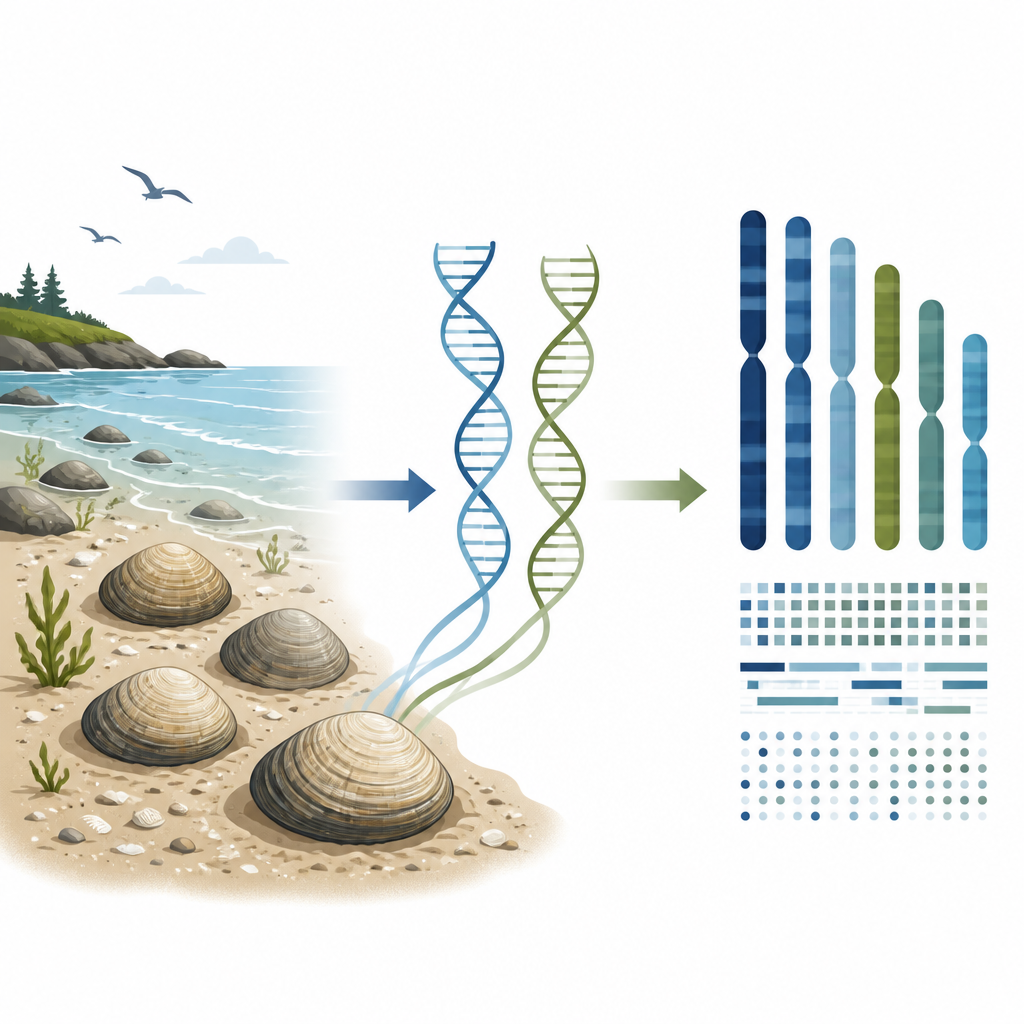
To move beyond scattered DNA markers, the researchers set out to build near complete genomes for two species, Meretrix meretrix and Meretrix lamarckii, collected from Hong Kong. They extracted very long strands of DNA from clam tissues and sequenced them with high accuracy. A second technique captured how pieces of DNA are physically linked inside the cell, helping to order and join the fragments into full chromosomes. The result is two large genetic maps, each close to 850 to 900 million DNA letters in length, with almost all of the sequence neatly arranged into 19 chromosome like units for each species.
Checking quality and finding repeated patterns
High level genetic maps are only useful if they are accurate, so the team ran several checks. They screened the data to remove stray microbial DNA and compared the clam sequences to large reference sets of essential animal genes. Both species contained almost all of these benchmark genes, a sign that the genomes are highly complete. They also catalogued repeated DNA elements, such as mobile genetic pieces that copy and paste themselves. These repeats, often overlooked, turned out to make up nearly half of each genome, shaping the overall size and structure of the clam genetic code.
Comparing chromosomes across clam relatives
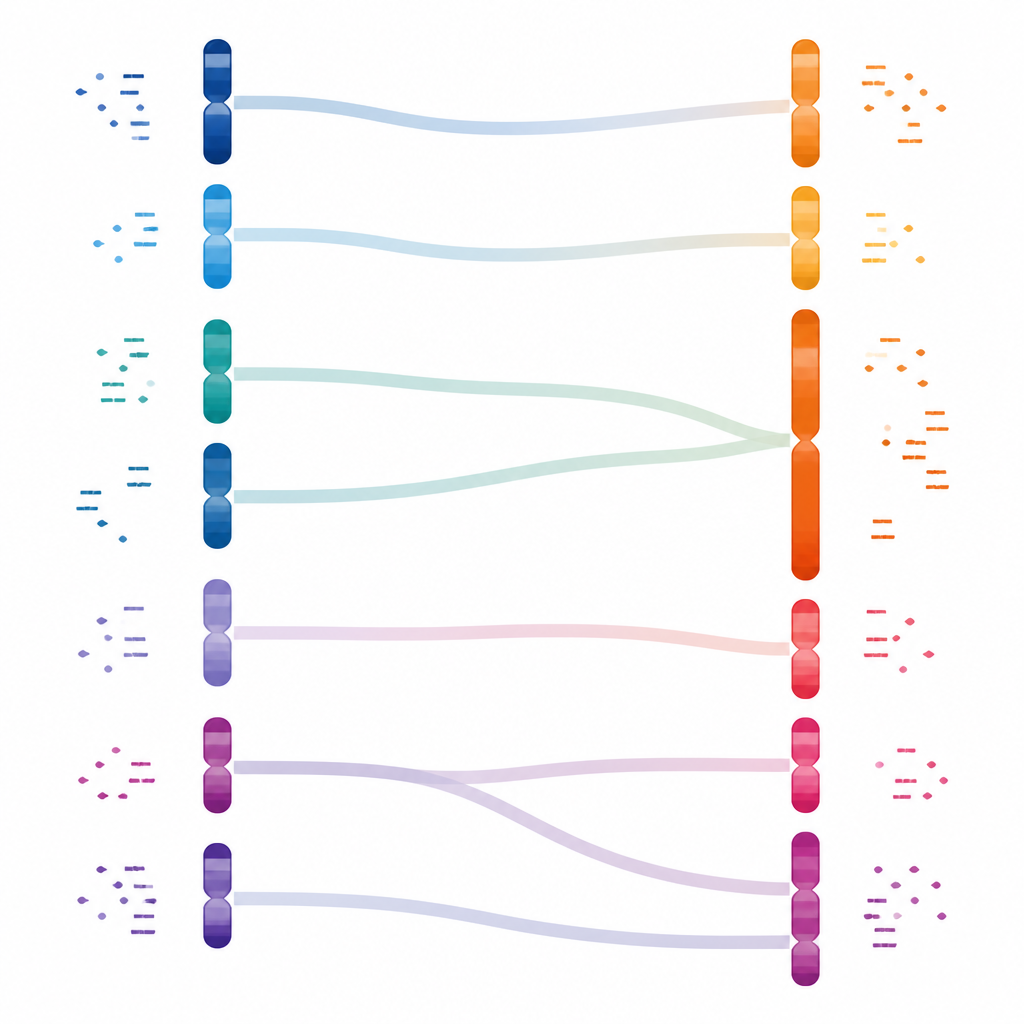
With full genomes in hand, the authors could align genes across Meretrix species and other bivalves to reconstruct family relationships. The new data support a tree in which M. meretrix forms a distinct branch close to other sequenced Meretrix clams. When they compared chromosomes between species, they found that most large segments match well, revealing a conserved backbone of gene order. One striking difference appears in M. meretrix, where one chromosome corresponds to two separate chromosomes in M. lamarckii, implying past fusion or splitting events in their evolutionary history.
What this means for clams and coasts
For non specialists, the key message is that we now have detailed genetic blueprints for two important edible clam species. These reference genomes will help scientists tell similar looking clams apart, trace how populations are connected along coastlines and study how they adapt to changing environments and human pressure. In the long run, such knowledge can support more precise conservation plans and more sustainable shellfish farming, keeping both the clams and the coastal communities that rely on them healthier.
Citation: Law, S.T.S., Nong, W., Au, M.F.F. et al. Chromosome-level genomes of hard clams Meretrix lamarckii (Deshayes, 1853) and Meretrix meretrix (Linnaeus, 1758). Sci Data 13, 760 (2026). https://doi.org/10.1038/s41597-026-07119-0
Keywords: hard clam genomes, Meretrix meretrix, Meretrix lamarckii, bivalve genetics, chromosome evolution