Clear Sky Science · en
Charting the Landscape of Oxygen Ion Conductors: A 60-Year Dataset with Interpretable Regression Models
Powering Clean Energy with Moving Oxygen Atoms
From solid oxide fuel cells to air sensors and gas separating membranes, many clean energy devices rely on a quiet hero inside their ceramic parts: oxygen ions that can slip through a solid almost as easily as through a liquid. This article brings together sixty years of scattered experiments on such materials into one consistent, searchable map, and uses simple mathematical models to show what atomic features make oxygen flow more easily.
Why Oxygen on the Move Matters
In solid oxide fuel cells and related technologies, performance and efficiency hinge on how fast oxygen ions can travel through a solid. Over decades, researchers have tested hundreds of different crystal structures, from perovskites to bismuth based oxides and silicates, hoping to find faster conductors that also work at lower temperatures. Yet the results were spread across many papers and measured in slightly different ways, making it hard to compare materials directly or to distill simple design rules for making better ones.

Building a Trustworthy Long Term Dataset
The authors systematically combed the scientific literature using several scholarly search engines, then traced both older references and newer citing papers to capture as many studies as possible that reported oxygen ion conductivity at several temperatures. They focused on data where the oxygen contribution was clearly separated from any electronic conduction, discarding cases where that could not be done reliably. A key step was correcting a common mistake in how many earlier papers plotted conductivity against temperature. By re reading figures and tables and re plotting at least a few data points for each material with the proper equation, they recalculated two core quantities: the activation energy, which reflects the size of the energy barrier an ion must climb, and the prefactor, which relates to how often ions attempt to move.
What the Landscape of Materials Looks Like
The final collection covers 483 different oxides reported over 60 years, grouped into 14 structural families. For each entry, the dataset records not only activation energy and prefactor but also rich background information such as chemical formula, crystal class, measurement method, temperature range, and whether the values describe the whole sample or only the bulk interior. When materials showed different behavior at low and high temperatures, both regions were included with the temperature that separates them. Comparing repeated measurements of the same material from different groups showed that the key parameters agree reasonably well, suggesting that the curated numbers are robust enough for careful analysis and future model testing.
Learning Simple Rules from Complex Crystals
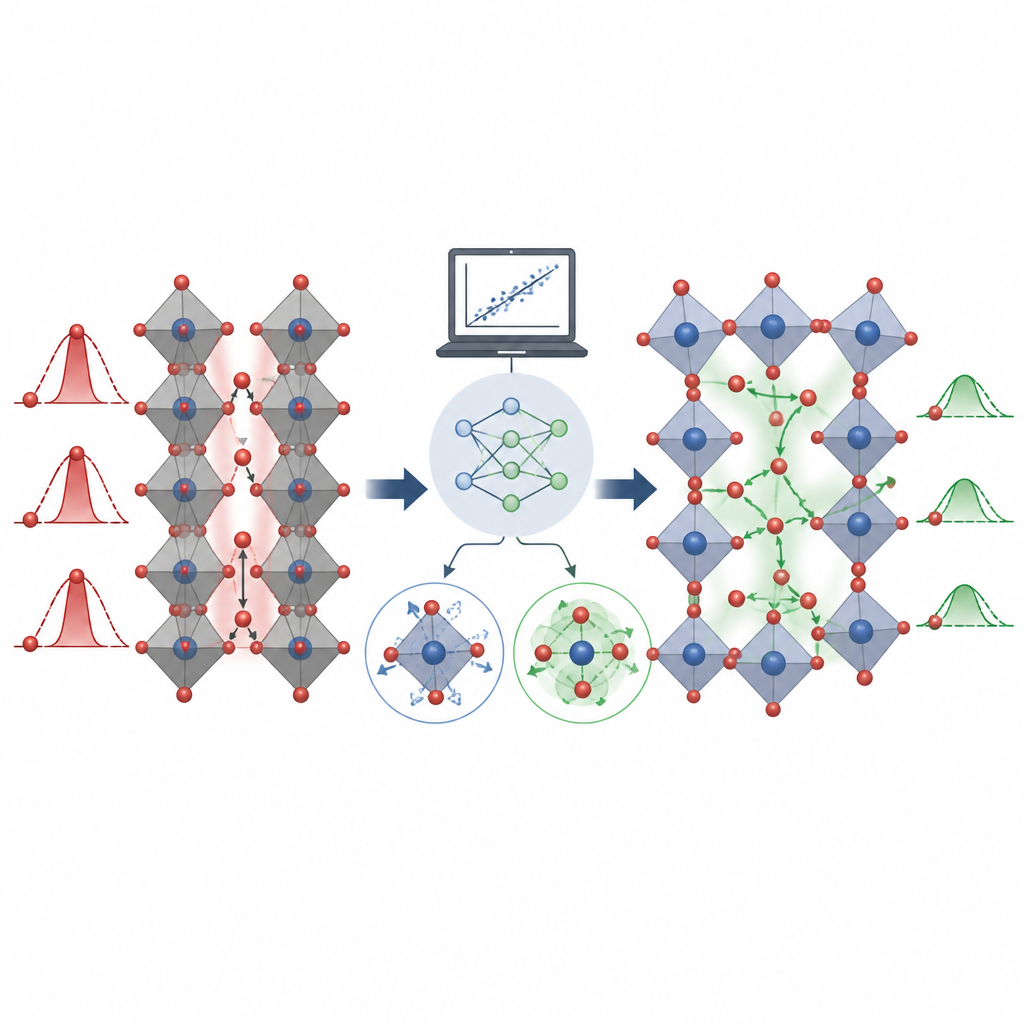
To see what controls oxygen movement across this broad landscape, the team used symbolic regression, a technique that searches for concise equations linking material features to measured properties. For the activation energy, the most influential combination involved how many oxygen atoms typically surround each metal ion in the crystal and how oxygen rich the overall composition is. Structures where metal ions are surrounded by more oxygen neighbors and where the lattice contains relatively more oxygen tend to ease the passage of ions, likely because repulsion between nearby oxygen atoms pushes open and softens the paths they can take. For the prefactor, and thus how often ions attempt to hop, the dominant ingredients were the average size of the metal ions and their average charge, which together set how strongly the crystal holds onto oxygen.
Guiding the Search for Better Conductors
Armed with these interpretable equations, the researchers explored how swapping elements or fine tuning compositions might lower barriers and raise ion hopping rates at the same time, which is crucial for high conductivity at moderate temperatures. As a concrete example, they propose a slightly altered apatite type silicate in which changing the rare earth content is predicted to substantially reduce the activation energy and boost the prefactor compared with a known material. In simple terms, the study shows that local crowding of oxygen atoms and the strength of attraction between metal and oxygen act like two knobs that can be tuned to open smoother highways for ions.
From Past Data to Future Materials
For a non expert, the key message is that decades of measurements, once cleaned up and brought together, can reveal clear and intuitive patterns about how atoms arrange themselves to let oxygen flow. The open dataset and the simple equations extracted from it provide a shared reference for scientists designing new ceramics for fuel cells, sensors, and related devices, and a solid testing ground for emerging machine learning models. Rather than guessing among countless compositions, researchers can now use this map to navigate toward structures that give oxygen ions a smoother ride through the solid.
Citation: Jang, SH., Kiyohara, S., Takamura, H. et al. Charting the Landscape of Oxygen Ion Conductors: A 60-Year Dataset with Interpretable Regression Models. Sci Data 13, 778 (2026). https://doi.org/10.1038/s41597-026-07100-x
Keywords: oxygen ion conductors, solid oxide fuel cells, ionic conductivity, materials database, symbolic regression