Clear Sky Science · en
EKHI: an open database of optical and thermal radiative properties of solid materials
Why hot materials and hidden data matter
From jet engines to solar power plants and even spacecraft, many advanced technologies rely on how materials glow, reflect, and transmit heat. Yet much of the most valuable experimental data on these behaviors has been locked for decades in old printed tables and plots. This article describes how researchers have carefully rescued, digitized, and organized that scattered information into EKHI, an open online database that makes it far easier for scientists and engineers to find and reuse trustworthy data about how solid materials interact with light and heat.
Unlocking a century of measurements
For more than half a century, engineers have measured how metals, ceramics, and coatings emit, reflect, absorb, and transmit thermal radiation over wide ranges of temperature and color (wavelength). These measurements are essential for predicting how hot a spacecraft surface will get, how efficiently a solar absorber will work, or how a high temperature coating will age. But the results are inherently complex: they depend at the same time on temperature, wavelength, and viewing direction, as well as on microscopic details like surface roughness and porosity. Because of this complexity, experimental results were usually published as dense tables and plots, accompanied by detailed notes about how each sample was prepared and how the measurements were made. Until now, those records have been difficult to search or reuse in modern computer models.
Building on a classic reference collection
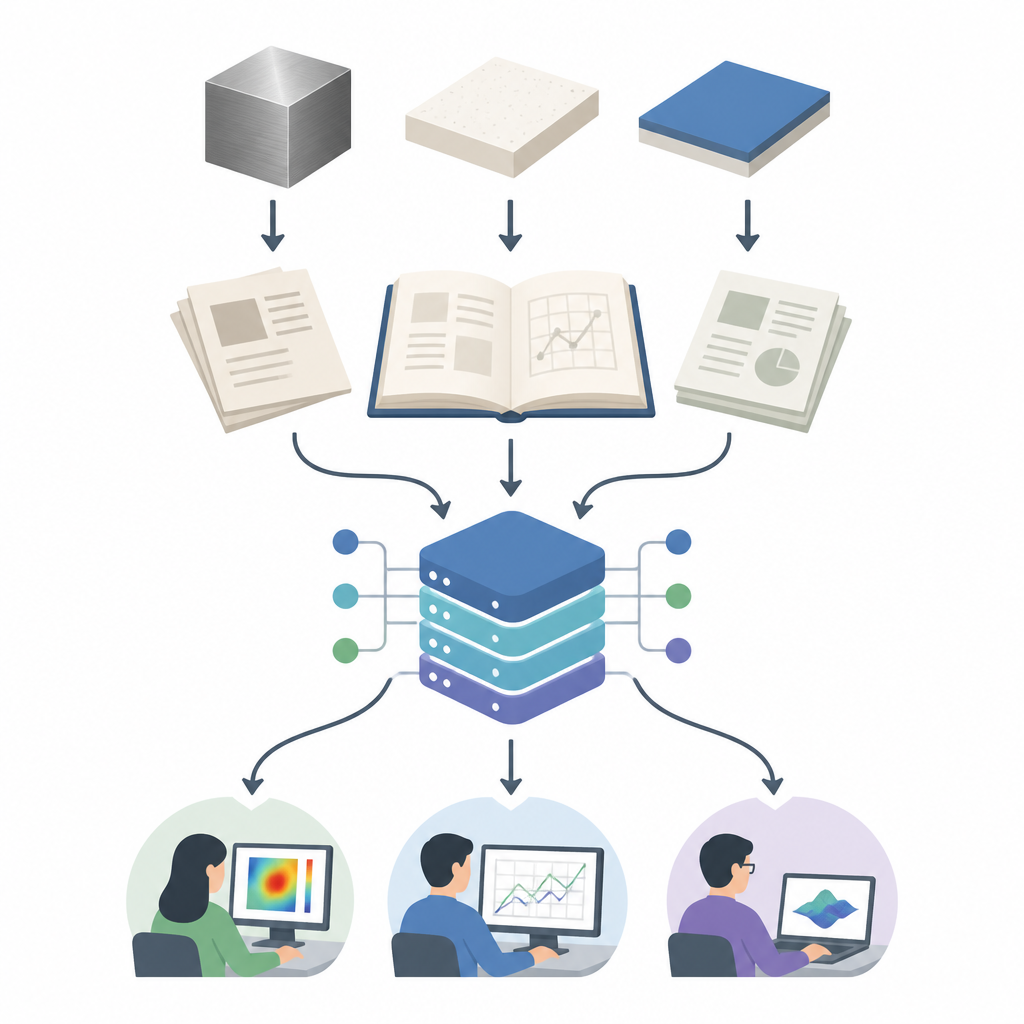
A major starting point for this effort is the Thermophysical Properties of Matter TPRC Data Series, a set of reference volumes from the 1970s that gathered radiative property data from hundreds of original studies published between 1900 and 1970. These books remain widely cited because they critically evaluated and organized data for metallic elements and alloys, nonmetallic solids, and coatings. However, they only existed as scanned pages. The authors of the present study obtained the digital facsimiles of the TPRC volumes from a US government technical reports archive and treated them as the main source documents. Their goal was to bring the richness of these classic compilations into the digital age, while respecting modern expectations that scientific data should be easy to find, access, combine with other datasets, and reuse reliably.
From scanned pages to structured files
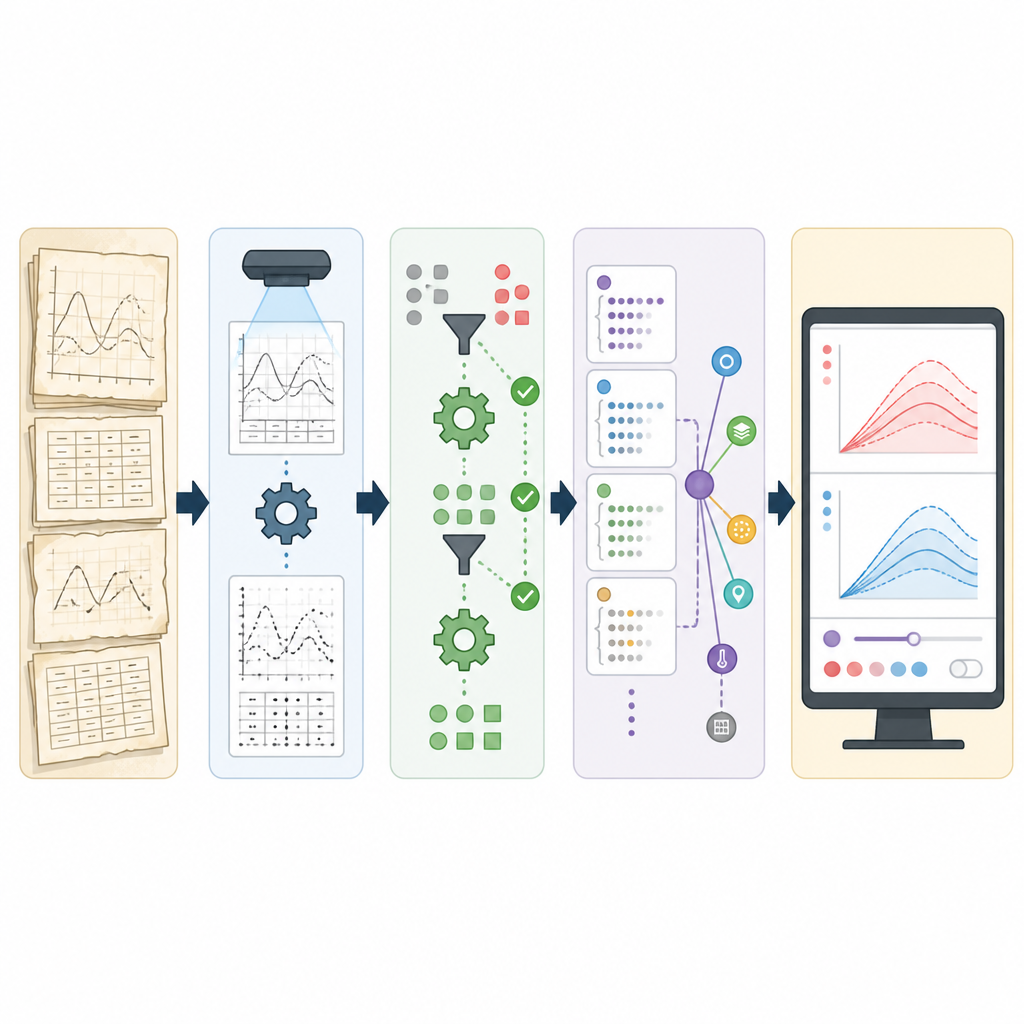
The team designed a stepwise workflow to turn the scanned books into machine readable files. First, they converted the lists of references, the detailed description tables, and the numerical data tables into text using a mix of Python tools, optical character recognition, large language models, and careful manual checks. Next, they used an online indexing service to look up each original paper, confirm its full citation, and test whether it could still be accessed. Only data traced to a currently reachable primary source were kept in the initial release, favoring quality and traceability over sheer volume. Then, using identifiers printed in the books, they linked each curve of numbers to its matching description of the experiment and specimen, and to the corresponding publication. Finally, they grouped all of this information into standardized digital records.
What the EKHI dataset contains
The resulting dataset holds 1,251 curves with nearly 19,000 numerical values drawn from 167 accessible original studies and 171 different solid materials. It covers four main types of radiative behavior: how much a material emits, reflects, transmits, or absorbs thermal radiation, subdivided into specific cases such as normal or hemispherical viewing conditions. The data span temperatures from near absolute zero to melting points and wavelengths from the ultraviolet to the far infrared, with especially broad coverage for nonmetallic solids. Reflectance makes up more than half of the entries, followed by emittance and transmittance, while absorptance data are scarcer. Each record is stored in a widely used text based format called JSON and includes the raw numbers, units, a description of the sample and measurement setup, and the full publication details, all arranged so that computers can check and interpret the structure automatically.
Checking reliability and sharing the tools
Because the original measurements were made decades ago, the authors do not attempt to re judge their scientific quality but instead focus on preserving and validating the digitization. They manually verified that each referenced article can be reached, that its bibliographic details match, and that the copied tables and notes agree entry by entry with the printed books. Suspect points were flagged and visually inspected through the EKHI website, which lets users browse materials and properties and see curves plotted interactively. The team also ran automatic checks ensuring that every JSON file follows a predefined pattern. Alongside the dataset, they released the scripts used to process the data and the formal description of the file structure so others can reproduce the work, extend it, or apply the same approach to new sources.
What this means for future research
In plain terms, this article shows how a large, hard to use pile of old but valuable measurements has been turned into a clear, searchable, and reusable resource. EKHI does not replace fresh experiments, and it does not claim to give the final word on the best values for any property. Instead, it makes it much easier for researchers to compare different studies, spot unusual results, and feed realistic radiative properties into simulations or data driven models. By pairing numerical values with rich context and ensuring that every curve can be traced back to its original paper, EKHI offers a sturdy foundation for future work on how solid materials handle heat and light.
Citation: Gabirondo-López, J., Sainz-Menchón, M., Tolosa-Lecea, I. et al. EKHI: an open database of optical and thermal radiative properties of solid materials. Sci Data 13, 740 (2026). https://doi.org/10.1038/s41597-026-07083-9
Keywords: thermal radiative properties, optical data, materials database, emittance reflectance, FAIR data