Clear Sky Science · en
A whole rock geochemical dataset for magmatic rocks drilled on the mid-Norwegian margin
Rocks at the Edge of a Splitting Continent
When continents begin to tear apart, huge volumes of molten rock rise from deep inside Earth and spill across the seafloor. These ancient outpourings helped shape the Atlantic Ocean and may even have influenced past episodes of rapid global warming. This article presents a detailed chemical record of such rocks drilled off mid-Norway, giving scientists a shared reference to explore how continents break and how deep Earth and climate at the surface are connected. 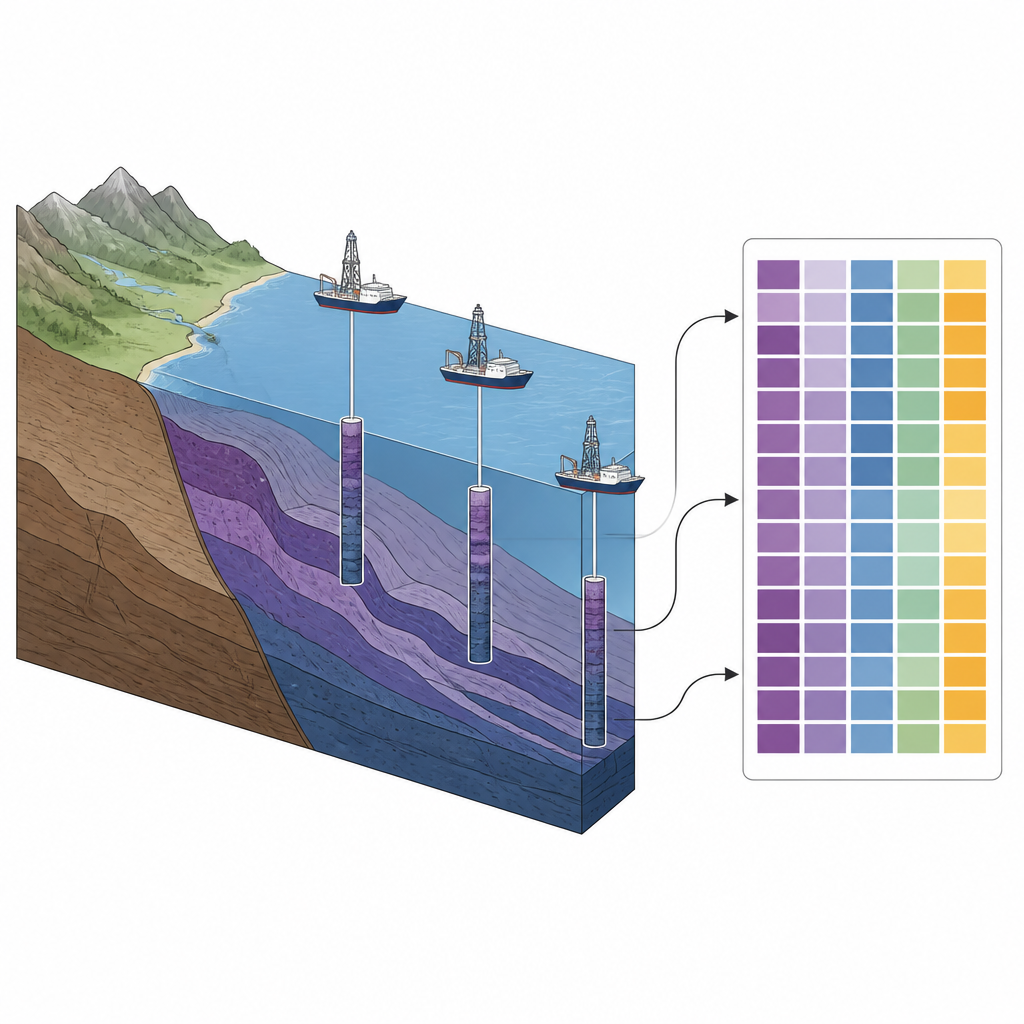
Where the North Atlantic Was Born
About 56 million years ago, the crust between Greenland and Norway began to stretch and split, opening the Northeast Atlantic. Along the mid-Norwegian continental margin, this activity built thick stacks of lava flows, ash layers, and underground sheets of hardened magma. Scientific and commercial drilling have recovered rock cores from 15 sites across this region. Together, these boreholes sample basaltic lavas, volcanic ash, intrusive sills, and more silica-rich rocks such as granites and dacites, preserving a three-dimensional slice through a volcanic rifted margin.
Turning Cores into Chemical Fingerprints
The authors describe how they transformed these rock cores into a unified geochemical dataset. Fresh pieces of core were carefully selected, cleaned, crushed, and milled into fine powders in several laboratories. These powders were then analyzed for major rock-forming elements and a wide suite of trace elements using X-ray fluorescence, optical emission, and mass spectrometry. In parallel, scientists used a handheld analyzer directly on the split core surfaces to collect many rapid measurements, allowing them to map chemical changes along the cores at much higher spatial detail than is practical with traditional lab analyses. 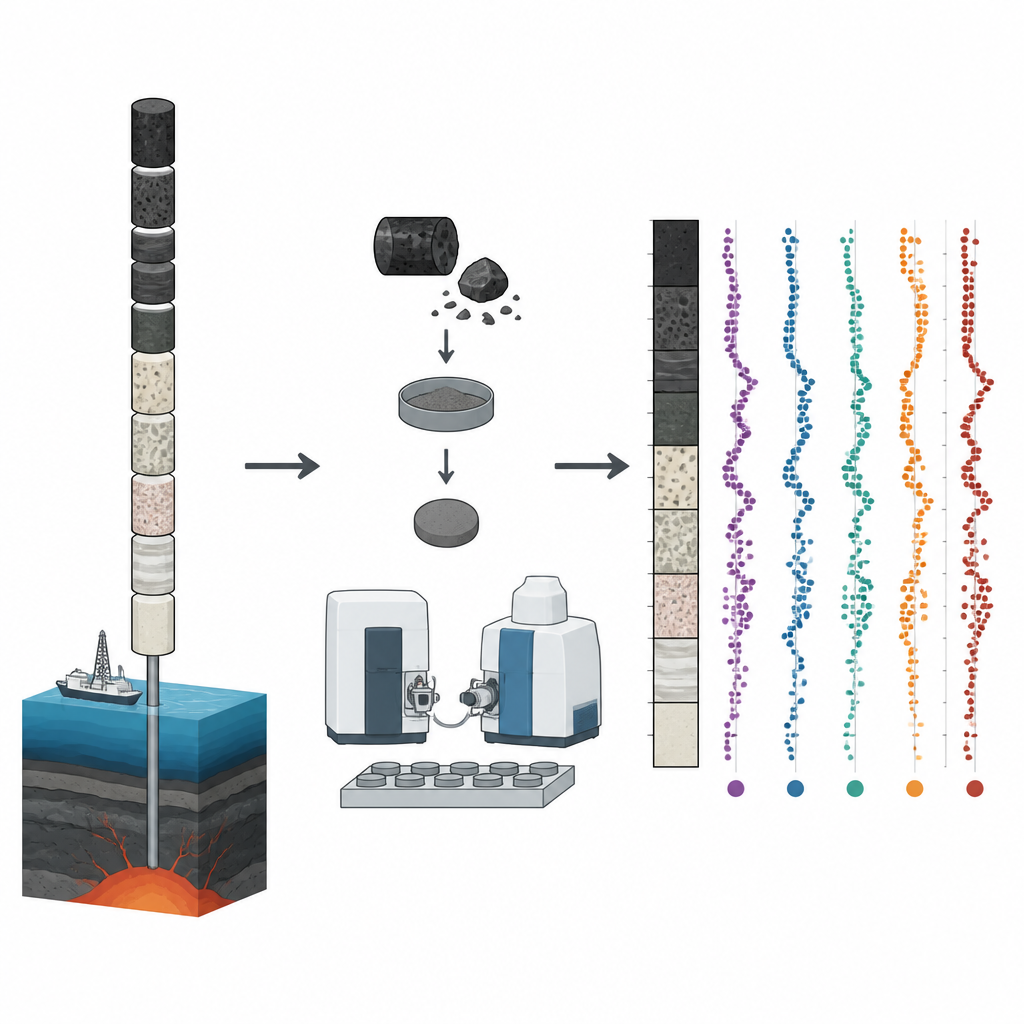
Checking Data Quality and Rock Preservation
Seafloor volcanic rocks can alter over time as they react with circulating seawater, so the team assessed how well the original compositions were preserved. They used a simple measure called loss on ignition, which reflects water and other volatile components gained during alteration. Most samples show low values, suggesting the majority still record their primary make-up. The researchers also compared their results on international reference materials against established values and cross-checked the handheld measurements with lab-based data. These tests show good agreement, giving users confidence in both the quality and consistency of the dataset.
What the Rocks Reveal About Ancient Magma
Viewed as a whole, the dataset shows that most of the drilled rocks are subalkaline basalts, similar to lavas found at mid-ocean ridges, with a smaller but significant group of more silica-rich rocks, including dacite, rhyolite, and granite. Simple chemical plots indicate that the basalts largely share a common style of magmatism, while the presence of evolved rocks at several sites points to episodes of magma storage and reworking in the crust. High-resolution profiles from handheld measurements highlight subtle chemical layering within lava sequences, such as zones where lavas become more primitive upward, hinting at changes in magma supply and chamber dynamics over time.
Why This Matters for Earth History
The compiled dataset is not a single new theory but a shared foundation for future work. With 563 rock analyses and hundreds of handheld measurements, scientists can now more rigorously test ideas about why some continental margins generate excess magma, how mantle composition and crustal thinning interact during breakup, and how pulses of volcanism may link to past global warming events. For non-specialists, the key message is that by carefully decoding the chemistry of ancient volcanic rocks, we gain a clearer window into how oceans open, how Earth’s deep interior behaves when continents part ways, and how those deep processes may ripple up to influence climate at the surface.
Citation: Tegner, C., Guo, P., Chatterjee, S. et al. A whole rock geochemical dataset for magmatic rocks drilled on the mid-Norwegian margin. Sci Data 13, 731 (2026). https://doi.org/10.1038/s41597-026-07073-x
Keywords: volcanic rifted margin, mid-Norwegian margin, igneous geochemistry, North Atlantic opening, ocean drilling cores