Clear Sky Science · en
Rheological evolution of a trachybasalt from Mt. Etna under slow cooling
Why the way lava stiffens matters
When a volcano like Mt. Etna erupts, glowing rivers of lava do not just cool down; they gradually stiffen and can even fracture as tiny crystals grow inside them. How fast this stiffening happens helps determine how far lava flows will travel, how thick they become, and which communities or infrastructure lie in their path. This study examines, in unusual detail, how a Mt. Etna lava changes from a runny liquid to a sluggish, crystal‑rich paste under slow, realistic cooling, providing data that can make lava‑flow forecasts more reliable. 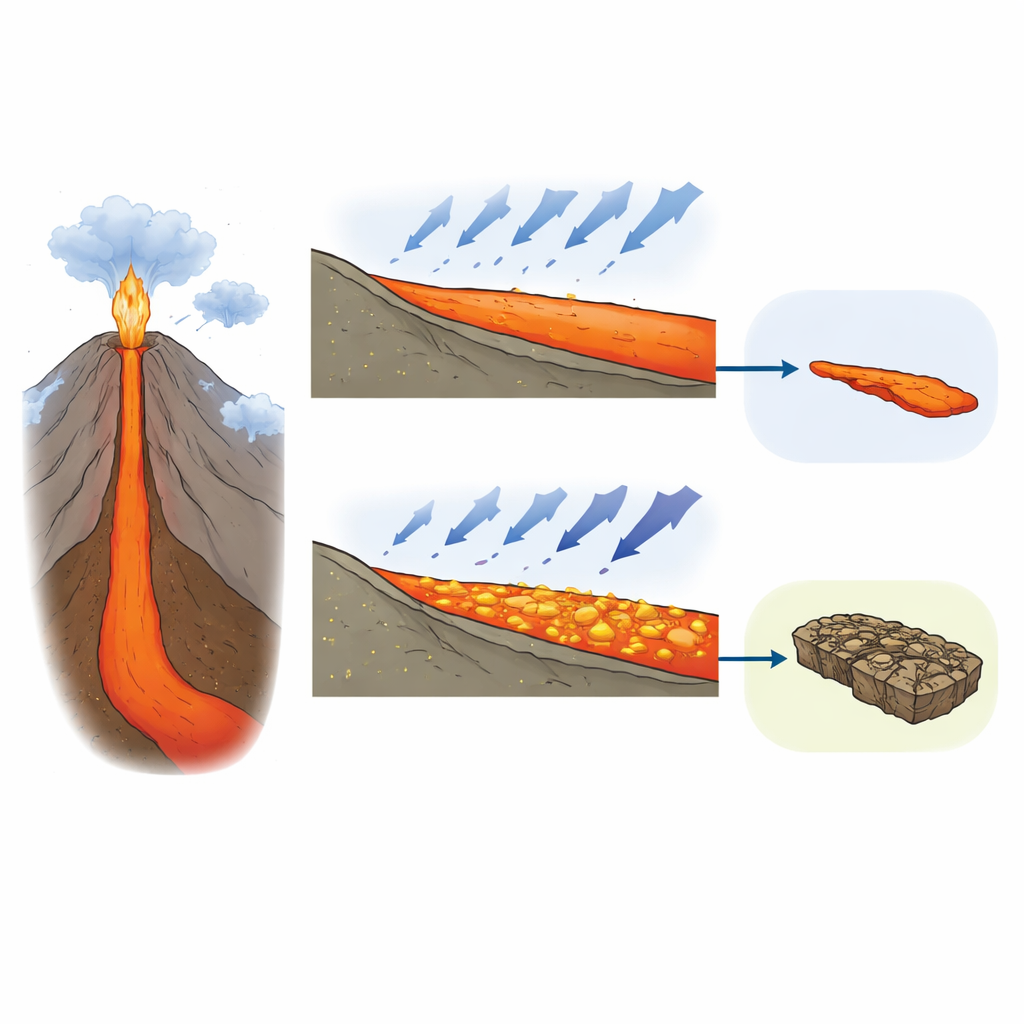
A closer look at a lava from Mt. Etna
The researchers focused on a specific type of runny volcanic rock, a trachybasalt erupted by Mt. Etna in 2001. They first crushed and remelted pieces of this lava to obtain a bubble‑free glass that faithfully matches the original composition. High‑precision chemical measurements before and after the experiments confirmed that the material stayed essentially unchanged, so any shifts in flow behavior could be traced to temperature and crystal growth, not to unwanted chemical drift.
Recreating lava flow conditions in the lab
To mimic what happens as lava moves through shallow conduits or spreads across the ground, the team used a rotational device called a concentric‑cylinder rheometer. A small crucible of molten lava was held at 1400 °C, stirred until completely uniform, and then cooled at very slow, controlled rates of 0.1 or 0.5 °C per minute—similar to the temperature drop real lava can experience as it radiates heat to its surroundings. At the same time, the melt was sheared at different constant rates, representing the internal stirring and stretching lava experiences as it flows. The instrument continuously tracked how difficult it was to keep the lava moving, a direct measure of how its resistance to flow evolved as crystals began to form. 
How tiny crystals change the flow
At high temperatures, well above the point where crystals can exist, the lava behaved like a simple liquid: as it cooled, its resistance to flow rose smoothly and predictably. Once the temperature slipped below the point where crystals can start to appear, there was a "silent" incubation phase in which the measured flow resistance still followed the pure‑liquid trend. Only when enough crystals—just a few percent by volume—had formed did the lava’s behavior diverge sharply, with resistance to flow shooting up by orders of magnitude. Under some conditions, the material eventually failed in a ductile way, with flow localizing into narrow zones and the bulk behaving more like a deforming solid than a simple liquid.
The competing roles of cooling and stirring
By comparing runs at different cooling and shear conditions, the study shows that how fast the lava is cooled is the main factor that controls when crystallization starts to affect flow. Slower cooling lets crystals form closer to the theoretical equilibrium temperature, so the onset of stiffening approaches the calculated liquidus as cooling rates become very low. The imposed stirring plays a secondary but clear role: stronger shear tends to trigger crystal effects at slightly higher temperatures and can promote episodes of internal reorganization, where elongated crystals align with the flow and produce brief, noisy fluctuations in measured resistance before the material suddenly stiffens or ruptures.
From laboratory numbers to hazard forecasts
Bringing together these new slow‑cooling experiments with earlier, faster‑cooling data, the authors show that the temperature at which lava begins to stiffen follows a systematic, curved relationship with cooling rate. This relationship means that as real lava cools more gently, its crystallization behavior approaches the limits set by basic thermodynamics, while still reflecting the influence of flow. Because the entire dataset—including raw time‑series of temperature and viscosity—is openly shared, it can be plugged directly into computer models of lava‑flow advance. In practical terms, these findings help transform idealized pictures of "runny" lava into more realistic descriptions of how and when it actually slows, thickens, and stops, refining forecasts of how far a future flow from Mt. Etna or similar volcanoes might go.
Citation: Di Fiore, F., Vona, A. Rheological evolution of a trachybasalt from Mt. Etna under slow cooling. Sci Data 13, 704 (2026). https://doi.org/10.1038/s41597-026-07048-y
Keywords: lava flow, magma viscosity, crystallization, Mt Etna, volcanic hazards