Clear Sky Science · en
100 Normative Gait Profiles with 5-year fall tracking: Benchmark Dataset for Southeast Asian Movement Science
Why How We Walk Matters as We Age
Most people take walking for granted, but in later life the way we walk can quietly reveal a great deal about our future health. Doctors already use quick walking tests to judge how well older adults are doing, yet these simple timing checks ignore the rich detail in every step. This study from Singapore turns an everyday 10‑meter walk into a high‑definition snapshot of movement, building a benchmark dataset of how healthy older adults walk fast and how that walking pattern relates to the chance of future falls.
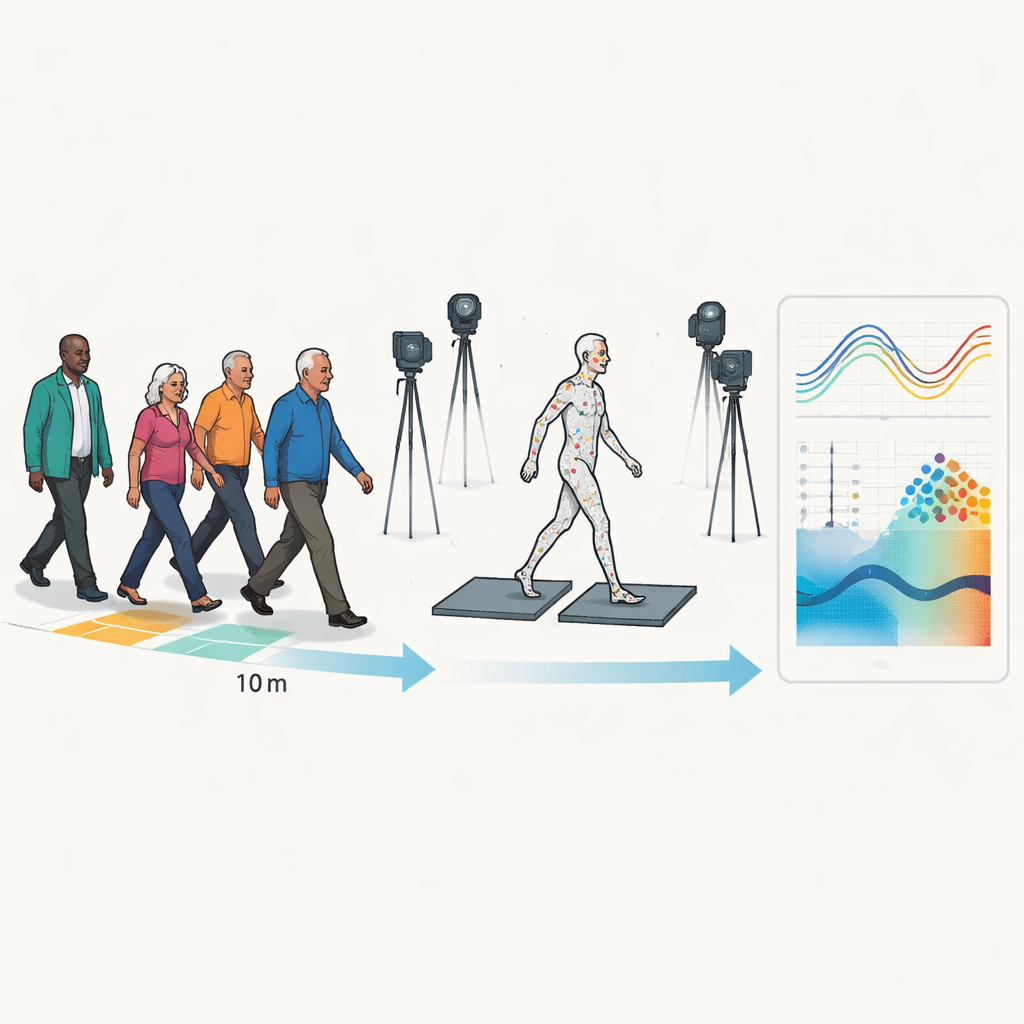
Turning a Simple Walk into a High-Definition Test
The researchers focused on the 10‑meter walk test, a standard clinic tool where a person is timed as they walk along a short walkway. Instead of using only a stopwatch, they combined the test with a sophisticated motion capture system similar to those used in animation and sports science. Tiny reflective markers were placed on key points of the body, and multiple cameras and floor sensors tracked how the body moved and how hard the feet pushed against the ground. Participants were asked to walk barefoot at a self‑chosen “fast but safe” pace, and only the middle six meters of the path were used for speed calculations, to avoid the speeding up and slowing down at the ends.
Who Was Studied and What Was Collected
The dataset covers 100 community‑dwelling adults from Singapore, all between 50 and 75 years old and without conditions that would interfere with normal walking. They are part of a larger Asian‑centric movement study that recorded 12 everyday tasks. For each person, the team captured several fast‑walking trials, stored as detailed files that include three‑dimensional marker positions and forces under each foot. Additional spreadsheets describe each participant’s age group, sex, height, weight, and technical details of the recordings. Together, these records form a “normative” reference: a rich picture of how healthy older adults in Southeast Asia walk quickly when asked to push themselves a little.
From Raw Movement to Patterns Linked with Falls
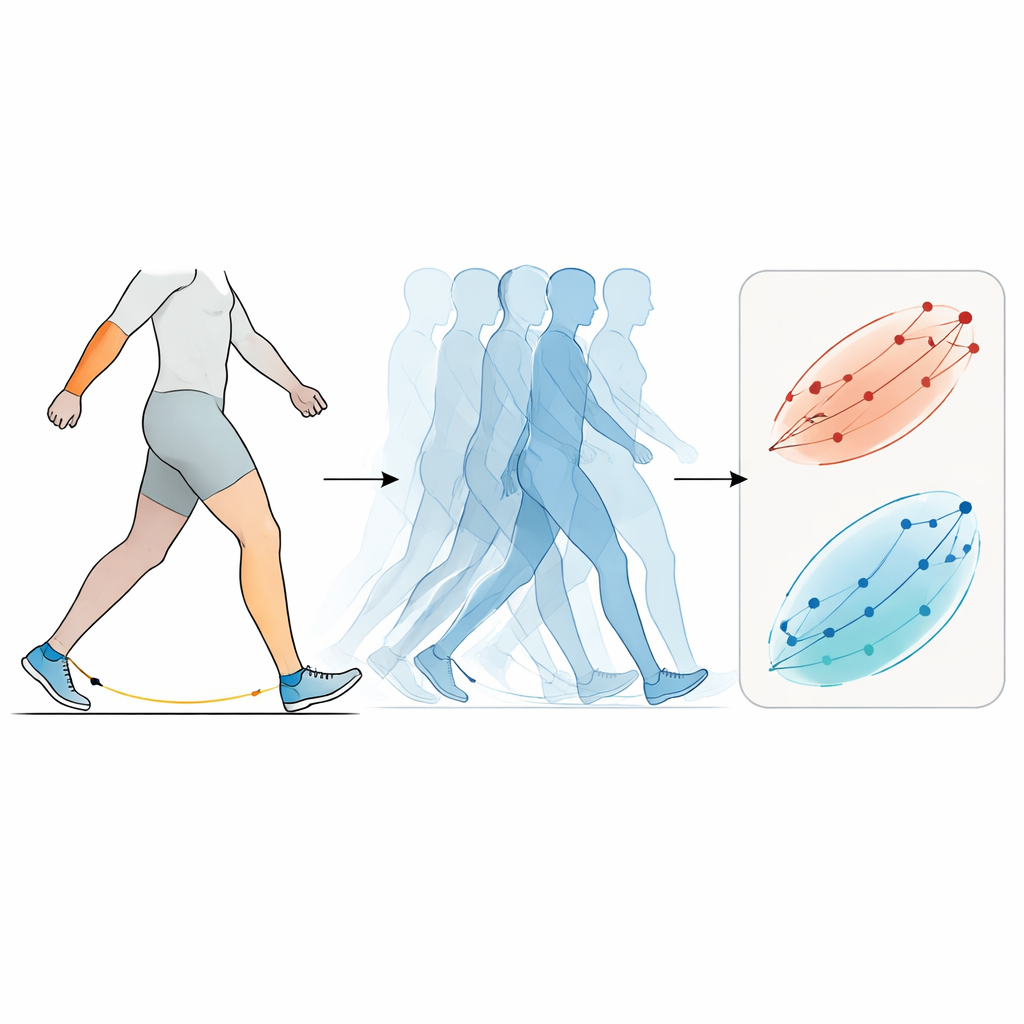
To turn the raw recordings into understandable patterns, the team used specialized software to identify each step in the walking cycle and compute dozens of measurements. These included basic items like walking speed and stride length, and more subtle features such as how much the ankle bends and how consistent each step is. Five years after the initial tests, researchers contacted participants again using online forms and phone calls. They asked simple screening questions about whether people had fallen, felt unsteady, or worried about falling. Anyone who answered “yes” to at least one question was classified as having a higher fall risk, giving the scientists a way to link baseline walking patterns with later outcomes.
What the Step Details Revealed
Out of the 100 participants, just under half were later classified as lower risk and just over half as higher risk. Using statistical models, the researchers found that a combination of five features measured during the fast walk best separated these two groups. Faster gait speed, steadier stride length from step to step, and certain aspects of ankle motion were linked with lower risk, while larger arm swings showed a more complex, less intuitive relationship. When all five markers were combined, the model correctly distinguished higher‑risk from lower‑risk individuals far better than chance, though not perfectly. The team also ran careful checks to ensure that marker placement on the body was consistent across staff members and over time, showing that the measurements are reliable.
Why This Dataset Matters for Healthy Ageing
For a non‑specialist, the core message is that a simple short walk, if recorded in enough detail, can tell us much more about future fall risk than a stopwatch alone. This work delivers the first large, high‑quality reference dataset of fast walking in older adults from Southeast Asia, made openly available for other scientists and clinicians. It can be used to design better screening tools, train new motion capture systems that work without markers, and compare patients with stroke, joint disease, or amputation against a well‑defined “healthy norm.” While the fall‑risk model needs to be tested in other groups before guiding medical decisions, the study shows how everyday movement can become a powerful early warning sign for problems that might otherwise only be noticed after a serious fall.
Citation: Roberts, O., Cruz Gonzalez, P., Kaliya-Perumal, AK. et al. 100 Normative Gait Profiles with 5-year fall tracking: Benchmark Dataset for Southeast Asian Movement Science. Sci Data 13, 694 (2026). https://doi.org/10.1038/s41597-026-07042-4
Keywords: gait, fall risk, older adults, motion capture, mobility