Clear Sky Science · en
Chromosome-level genome assembly of the teak defoliator Hyblaea puera Cramer (Lepidoptera: Hyblaeidae)
A Tiny Moth with a Big Impact
Along tropical coasts and in plantation forests, a small brown moth can leave towering trees bare in a matter of days. This insect, known as the teak defoliator, strips leaves from teak and mangrove trees, threatening valuable timber and the natural barriers that protect shorelines from storms. The study described here delivers a complete genetic blueprint of this moth, giving scientists a powerful new tool to understand why it spreads so quickly and how it might be controlled in smarter, more precise ways.
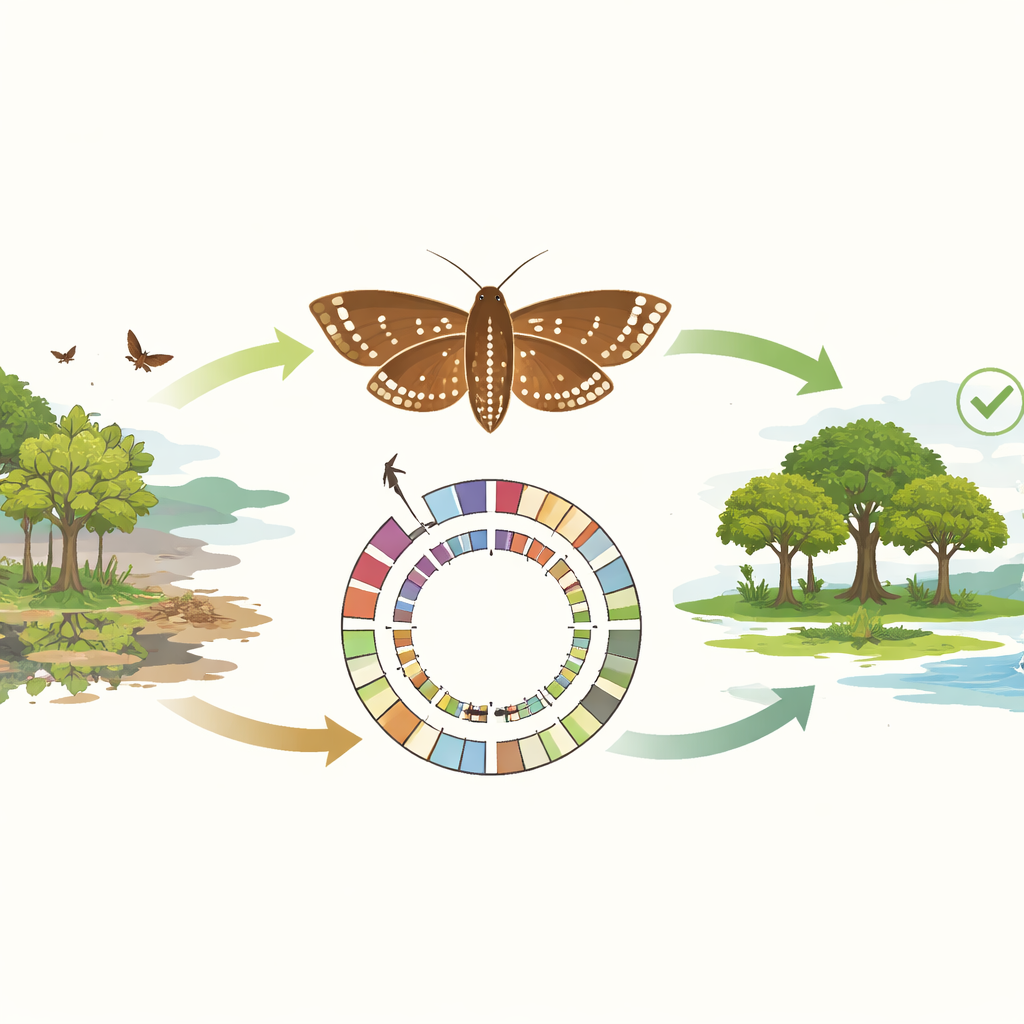
Forests Under Pressure
The teak defoliator, Hyblaea puera, has quietly expanded from its home range in South and Southeast Asia to at least 34 countries across Asia, Oceania, Central America and Africa. Its caterpillars feed on young leaves and shoots of teak and mangrove trees, slowing growth and even killing trees during severe outbreaks. In China, the insect was first noticed in teak plantations in the 1970s, but since 2015 it has repeatedly flared up in coastal mangrove forests of Guangxi and Guangdong provinces. These mangroves are more than just collections of trees: they protect shorelines from erosion, buffer storm surges and provide habitat for wildlife. When waves of caterpillars strip their foliage, the stability and protective roles of these ecosystems are put at risk.
Why This Moth Is Hard to Stop
The moth’s life history makes it a particularly troublesome pest. Female moths can produce large numbers of eggs, leading to rapid population booms. Adult moths can fly 10 to 20 kilometers to find fresh food when nearby leaves are exhausted or become less nutritious. Together, these traits produce sudden and explosive outbreaks that are difficult to predict and manage. Until now, scientists lacked a complete reference genome for this species, limiting efforts to uncover the molecular reasons for its adaptability, feeding habits and movement. Without that genetic roadmap, it has been harder to design long-term, targeted strategies that go beyond broad pesticide use.
Building the Genetic Blueprint
To fill this gap, the researchers collected laboratory-reared moths from a Chinese population and set out to assemble the entire genome—the full set of DNA instructions. They combined several cutting-edge sequencing approaches: short, accurate DNA fragments; extra-long reads that span complex regions; and Hi-C sequencing, which captures how pieces of DNA are arranged alongside one another inside the cell nucleus. By weaving these data types together, they produced a chromosome-level assembly about 395 million DNA “letters” long, arranged into 31 pseudo-chromosomes that match the insect’s observed chromosome number. Quality checks showed that nearly all expected core insect genes are present and intact, placing this genome among the more complete and continuous assemblies for moths and butterflies.
What the Genome Reveals
Beyond simply listing the DNA, the team identified 15,364 genes that code for proteins and were able to assign likely functions to nearly 87 percent of them using multiple biological databases. About a quarter of the genome consists of repeated elements, such as mobile DNA segments that can move around the genome and influence how genes evolve. The scientists also catalogued thousands of non-coding RNA genes involved in protein production and gene regulation. By comparing this genome with those of 14 other insects, they found that H. puera forms a distinct branch that split from its relatives roughly 110 million years ago. Some gene families have expanded significantly in this lineage, hinting at genetic changes that may have helped the moth adapt to its hosts and environments over evolutionary time.

A New Tool for Protecting Trees
In practical terms, this chromosome-level genome is a foundation rather than a finished answer. It gives researchers a detailed parts list for the teak defoliator, allowing future studies to focus on the genes that shape its reproduction, feeding preferences, flight ability and responses to control measures. Over time, such knowledge could support more precise pest management: for example, biological controls that exploit the moth’s weaknesses, or monitoring tools that detect genetic signs of emerging outbreaks. For forest managers and coastal communities, the new genome is an investment in understanding a small insect whose behavior can have outsized consequences for both economic forestry and the health of mangrove coasts.
Citation: Wang, Z., Kong, D., Liu, Y. et al. Chromosome-level genome assembly of the teak defoliator Hyblaea puera Cramer (Lepidoptera: Hyblaeidae). Sci Data 13, 679 (2026). https://doi.org/10.1038/s41597-026-07022-8
Keywords: teak defoliator, mangrove pest, insect genome, chromosome assembly, forest protection