Clear Sky Science · en
A dataset of 120 GHz millimeter-wave radar vital signals with synchronized reference recordings
Why contact-free heart and breathing checks matter
Hospitals and homes increasingly rely on machines to keep quiet watch over our hearts and lungs. Yet many monitoring tools still need sticky electrodes on the skin or tight cuffs on the arm, which can disturb sleep, irritate delicate skin, and make long term tracking uncomfortable. This article presents a new openly shared dataset that could help scientists build radar based systems to measure vital signs from a distance, potentially making health monitoring more comfortable and adaptable in everyday settings.
A new way to listen to the body
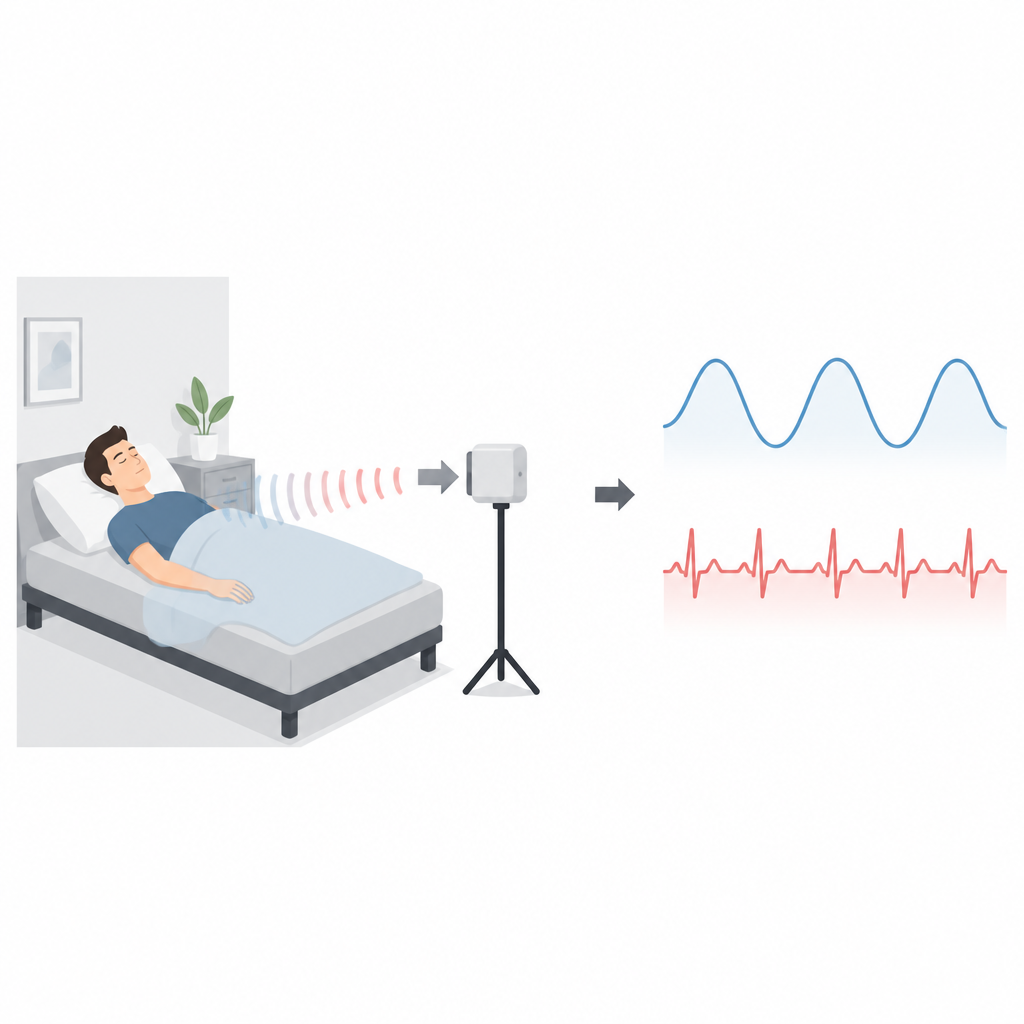
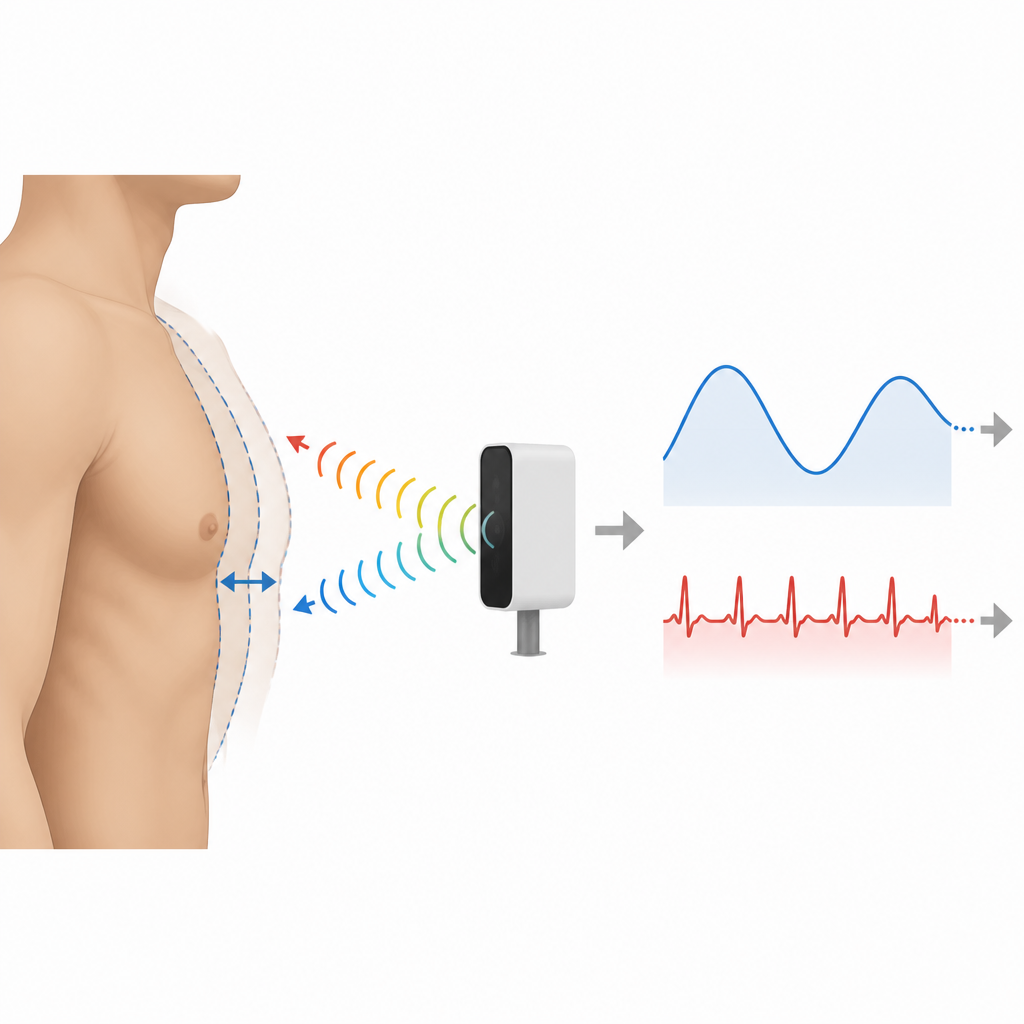
The researchers focus on millimeter wave radar, a technology more often seen in car safety systems than in hospital rooms. Instead of touching the body, the radar sends out very high frequency radio waves that bounce off the chest and return with tiny changes that reflect breathing and heartbeat motion. By carefully analyzing these returning signals, computers can infer how the heart and lungs are working without wires, patches, or light sensors on the skin. This noncontact approach is especially appealing for newborns, burn patients, people in isolation, or anyone who needs to be monitored while moving freely at home or in a vehicle.
Building a clear reference for future tools
To move from concept to reliable devices, engineers need high quality data that link what the radar sees to trusted medical measurements. The team created such a resource by recruiting 24 healthy adults with a range of ages, body sizes, and both sexes. During each session, a custom built radar operating around 120 gigahertz watched a small point on the chest while standard hospital equipment recorded electrocardiograms for heart activity, breathing traces from chest impedance, pulse waveforms from a fingertip clip, and blood pressure from an arm cuff. All systems were time synchronized so that every radar wiggle aligns with the matching medical signal.
How the measurements were carried out
Each volunteer lay on a stretcher facing the radar, which aimed at the lower chest using laser pointers for precise alignment. After a short rest to let the body settle, the team recorded two main conditions lasting about two minutes each. In the resting condition, subjects breathed normally while the radar and monitors quietly collected baseline data. In the apnea condition, subjects followed a simple pattern of normal breathing, brief breath holds, and recovery. This mix of steady and disrupted breathing gave the dataset richer variety, capturing both calm and stressed patterns in the chest motion and heart signals.
Checking that the radar truly follows tiny motions
The dataset is only useful if the radar and reference devices agree on timing and subtle movement. The authors validated synchronization by comparing how closely the radar breathing pattern lined up with the medical breathing trace, finding that typical time differences were only a few thousandths of a second. They also pointed the radar at a loudspeaker driven with simple vibration patterns to mimic chest motion. The radar tracked submillimeter movements and rapid changes without noticeable distortion, suggesting it can faithfully capture both slow breathing and much smaller heart related motions on the chest.
What this means for future health monitoring
In the end, the article does not introduce a finished medical gadget but rather a detailed, openly accessible dataset designed for others to explore. By combining high frequency radar recordings with matched medical grade signals and clear documentation, the authors provide a testbed for new algorithms that can separate heartbeat from breathing, filter out body movements, and better interpret radar reflections from living people. For a lay reader, the takeaway is that we are one step closer to health monitors that quietly watch over us from across the room, offering comfort and flexibility while still being grounded in careful, validated science.
Citation: Wu, R., Miro, L., Aguasca, A. et al. A dataset of 120 GHz millimeter-wave radar vital signals with synchronized reference recordings. Sci Data 13, 741 (2026). https://doi.org/10.1038/s41597-026-07016-6
Keywords: millimeter wave radar, vital sign monitoring, contactless sensing, heart and breathing signals, biomedical dataset