Clear Sky Science · en
Bounding the costs of electric vehicle managed charging—supply curves for scenarios from 2025 to 2050
Why Timing Your Car Charge Matters
Electric vehicles are multiplying on roads across the United States, and every one of them needs electricity. If most drivers plug in at the same time, that demand can strain the power grid and force utilities to build expensive new equipment or power plants. This study looks at a different path: carefully managing when EVs charge so they help the grid instead of stressing it, and calculating how much it will cost to run those programs between 2025 and 2050.
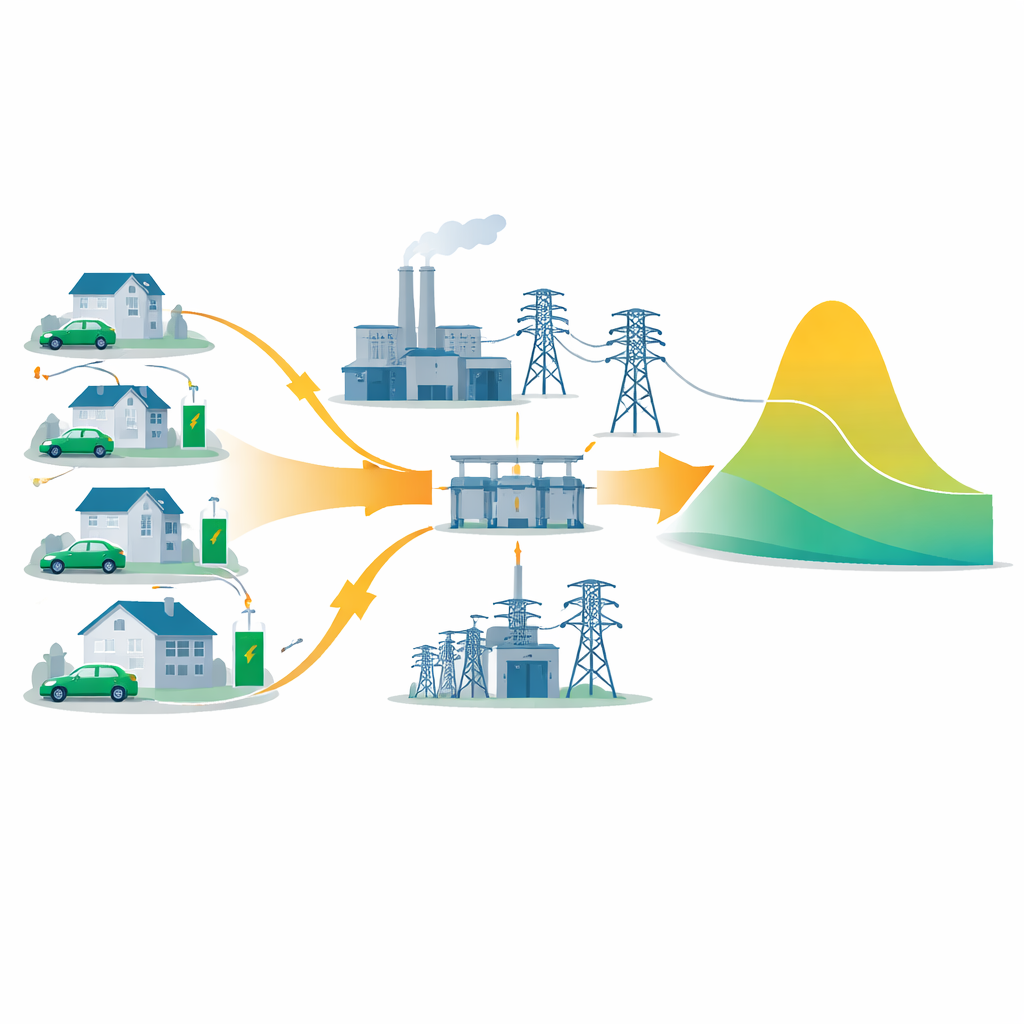
Different Ways to Steer EV Charging
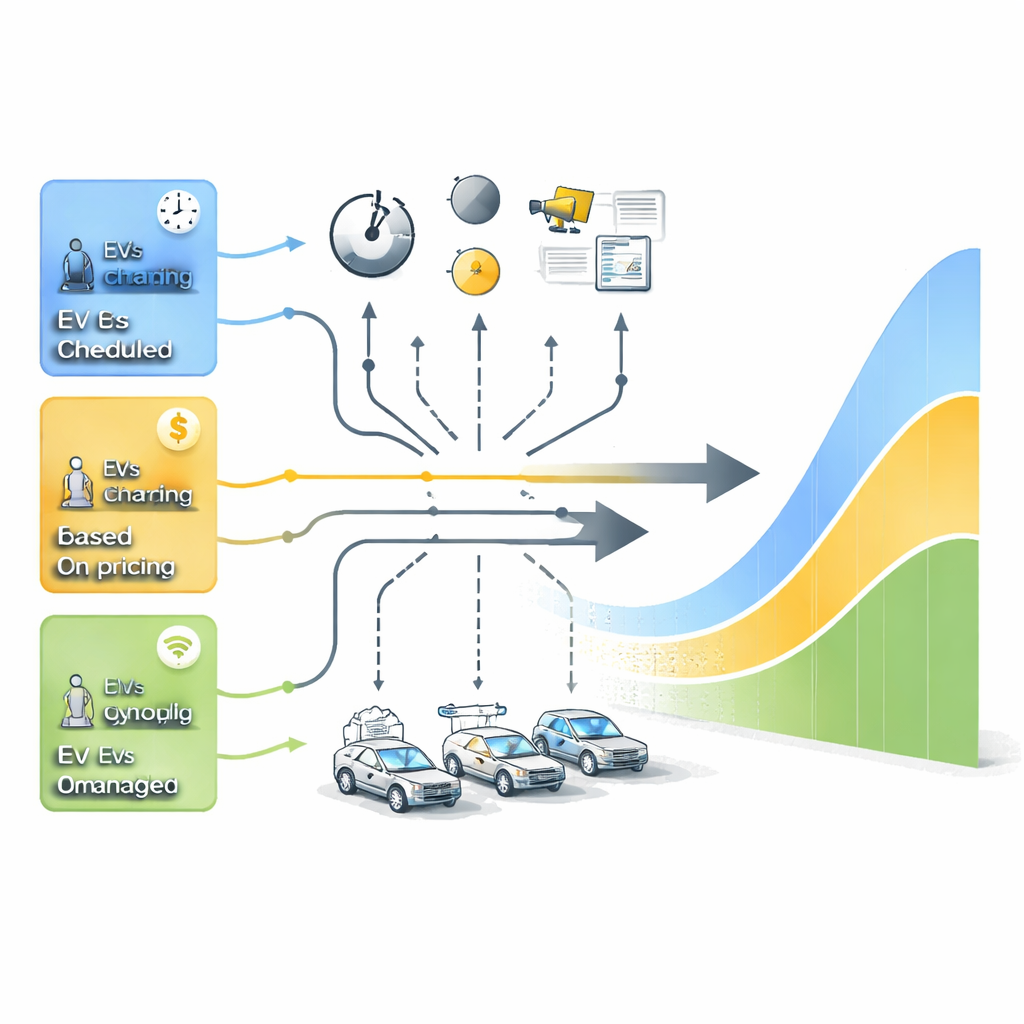
The authors focus on three main approaches utilities can use to influence when drivers charge. In direct control programs, the utility or an aggregator can remotely start, stop, or slow charging within limits the driver sets, such as a desired departure time. Real-time price programs instead send changing prices that encourage drivers or smart chargers to favor cheaper hours. Time-of-use plans are simpler: they keep prices low during set off-peak periods and higher during peak hours. Each approach offers a different balance of control, driver comfort, and communication needs, and these differences shape both how many people sign up and what it costs per vehicle.
Looking Ahead with Scenarios
Because EV technology, charging habits, and software will change over the next few decades, the researchers build four future storylines, or scenarios. A “High Flexibility” future imagines widespread smart chargers, smooth communication, and routine scheduled charging, which make it cheap and easy for many drivers to participate. A “Low Flexibility” world assumes limited smart charging technology and reluctant customers, so utilities must spend more on incentives and administration to get the same response. A “Mid Flexibility” case lies between those extremes, while a “Flat” scenario assumes slower, more spread-out charging at lower power levels to keep spikes on the grid small. Together, these scenarios provide upper and lower bounds on what managed charging might cost.
Breaking Down the Real Costs
To turn these storylines into numbers, the team gathers the latest data from utility filings, pilot programs, surveys, and expert interviews. They separate program expenses into four main buckets: one-time setup and enrollment tasks, ongoing operation and administration, payments or rebates that persuade customers to participate, and marketing to make drivers aware of the programs. For some customers, especially early on, joining a direct-control program may require buying a new smart charger, which raises the needed incentive. The authors then model how participation grows as incentives or marketing spending rise, using a curve that climbs quickly at first and then flattens as the most interested customers are already enrolled.
From Individual Drivers to Supply Curves
Using these relationships, the study builds “supply curves” for managed charging: for each year from 2025 to 2050, and for light-duty and medium- or heavy-duty vehicles, the curves show the cost per vehicle for reaching a given participation level. They distinguish between new customers, who often cost more to enroll, and recurring customers, whose yearly costs mainly reflect running the program and continuing incentives. Across most scenarios, per-vehicle costs fall over time as operations become more efficient, more chargers are smart by default, and incentives can shrink. However, in the Low Flexibility case, costs and achievable participation change little, reflecting a world where technology and customer habits do not improve much.
Comparing Program Types and Future Paths
The curves also reveal how the three program types stack up. Direct control typically delivers the most precise grid support but is often the most expensive per vehicle, especially at high enrollment, because it demands reliable two-way communication and faces more customer hesitation. Real-time pricing can reach higher participation for less cost, using price signals instead of direct control. Time-of-use rates are usually cheapest to administer at low participation but, without automation, may attract fewer drivers. In more optimistic scenarios with abundant smart chargers and better customer familiarity, all three methods become cheaper and more powerful tools for shaping EV demand, while in pessimistic scenarios they remain costlier and more limited.
What This Means for Drivers and the Grid
For non-specialists, the bottom line is that when and how EVs charge can have as much impact on the grid as how many EVs there are. This work provides planners, regulators, and utilities with detailed, forward-looking cost estimates so they can compare managed charging against building new power plants or wires. If programs are designed well and technology continues to improve, shifting EV charging in time can be a relatively low-cost way to keep lights on, bills down, and more clean vehicles on the road. If not, the grid may face higher expenses to keep up with unmanaged demand.
Citation: Matsuda-Dunn, R., Hale, E., Estreich, E. et al. Bounding the costs of electric vehicle managed charging—supply curves for scenarios from 2025 to 2050. Sci Data 13, 651 (2026). https://doi.org/10.1038/s41597-026-07008-6
Keywords: electric vehicles, managed charging, demand response, power grid planning, energy pricing