Clear Sky Science · en
Peatland Mid-Infrared Database
Why Wet Soils Matter for the Climate
Hidden beneath mosses and sedges in bogs and fens lies one of Earth’s largest natural storehouses of carbon: peat. Although peatlands cover only a small slice of the planet’s land surface, they lock away more carbon than all the world’s forests combined. When these waterlogged soils are drained or warmed, that carbon can leak back into the atmosphere as greenhouse gases. This article introduces a new global database that gathers a special kind of chemical fingerprint from peat, making it easier for scientists to understand how these fragile ecosystems work and how they might respond to a changing climate.
Seeing Peat Through Invisible Light
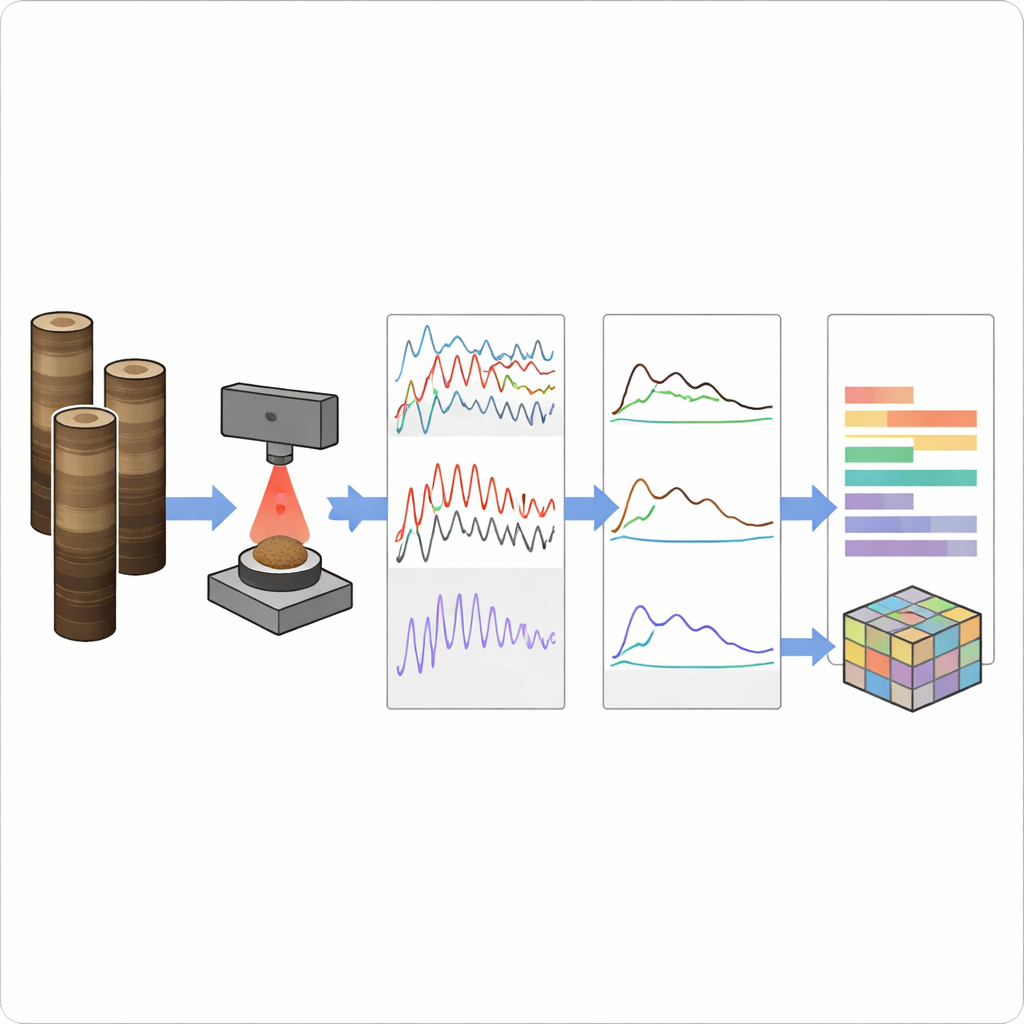
Instead of digging up large amounts of soil and running many separate lab tests, researchers can shine mid‑infrared light on a tiny peat sample and record how the light is absorbed. The resulting pattern, called a spectrum, reflects the mixture of organic molecules, minerals, and water in the peat. These patterns can reveal how decomposed the peat is, how much carbon and nitrogen it holds, and even hints about its past environment. Over the last decades, many teams around the world have collected such spectra from peat cores, peat‑forming plants, and dissolved material in peat water—but the data were scattered across projects, formats, and institutions.
Building a Shared Library of Peat Fingerprints
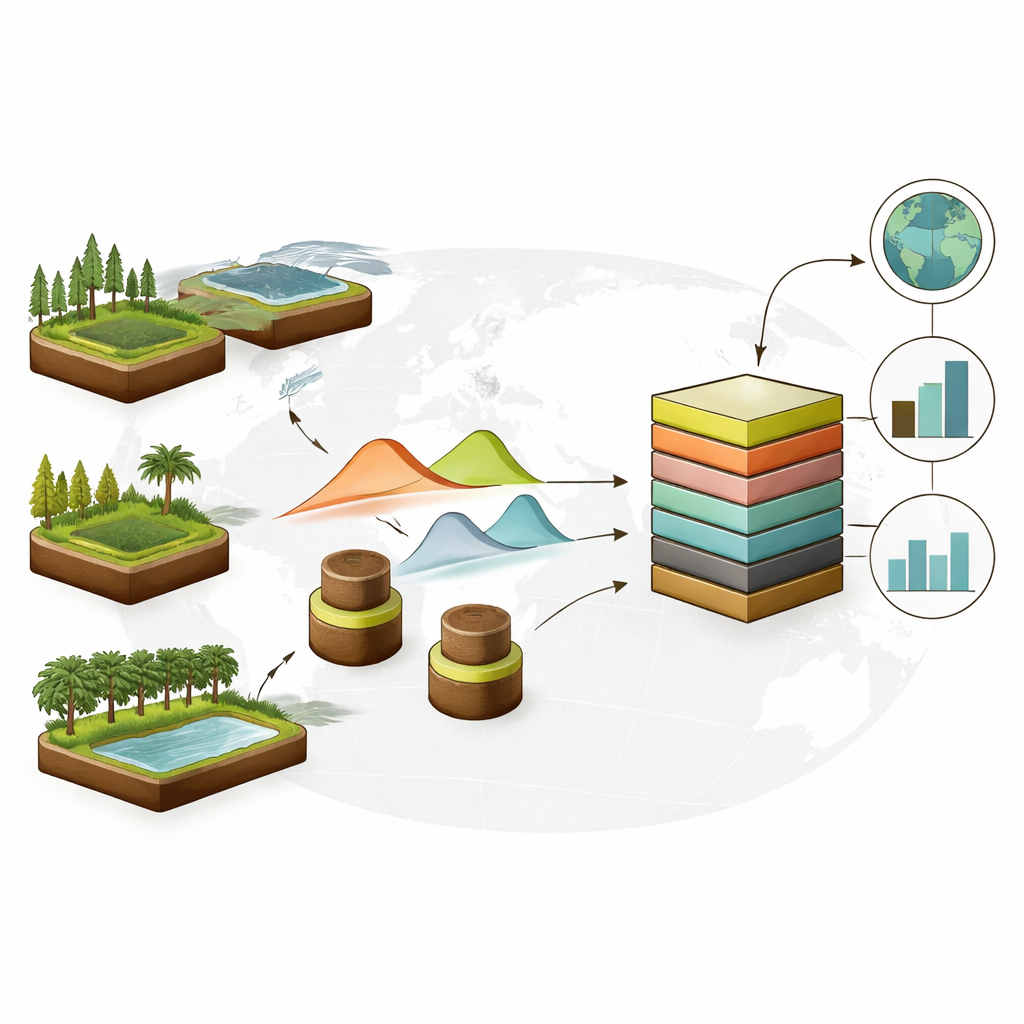
The Peatland Mid‑Infrared Database, or “pmird,” brings together 3,877 spectra from 26 studies into one organized resource. Most samples come from northern bogs, with fewer from southern and tropical regions, and include not only peat but also nearby vegetation and dissolved organic matter. Alongside each spectrum, the database stores information on where and when the sample was taken, what type of landscape it came from, and dozens of measured properties such as carbon and nitrogen content, bulk density, pH, trace metals, and age estimates. All of this is stored in a structured relational database that links datasets, samples, and individual measurements, and is accessible through open‑source software, especially an R package tailored to work with the system.
Cleaning Up Complex Signals
Infrared spectra are sensitive not just to peat but also to the air and instruments used to measure them. Traces of water vapor and carbon dioxide in the laboratory can leave tell‑tale spikes in the signal, and random noise can blur important details. Because the pmird collection draws on legacy data from many different devices and procedures, the authors developed simple quality checks that they apply uniformly across the database. They use reference spectra of pure water vapor and carbon dioxide to estimate how strongly each sample’s spectrum is affected by the atmosphere, assess how much random noise is present, and detect whether a spectrum has already been baseline‑corrected or remains in raw form. These quality flags help future users decide which spectra are suitable for delicate analyses and which may need extra cleaning.
From Raw Light Patterns to Peat Insights
Once spectra and their companion measurements are assembled, scientists can train “spectral prediction models” that learn how particular shapes in a spectrum correspond to properties like carbon content, degree of decay, or the ability of peat to accept or donate electrons in chemical reactions. The new database allows such models to be built on many more samples than any single study could provide, increasing their reliability. It also lets researchers fill gaps in older datasets: where a spectrum exists but some lab measurements are missing, well‑tested models can estimate those missing values. The authors show how to connect to the database, load spectra, preprocess them, calculate simple indices of peat decomposition, and run existing prediction models using freely available R tools.
Looking Ahead for Peat Research
The pmird project is meant as a starting point rather than a finished product. By making both the data and code openly available, the authors hope to encourage researchers to add new peat spectra, especially from under‑sampled regions such as tropical peatlands and fens, and to work toward shared standards for how spectra and metadata are collected and reported. Better harmonized methods and open libraries should reduce duplicated effort in the lab and help scientists build more accurate pictures of how peatlands store and release carbon. For non‑specialists, the key message is that a carefully curated library of invisible light fingerprints can deepen our understanding of these soggy but crucial landscapes and improve how we predict their role in the climate system.
Citation: Teickner, H., Agethen, S., Berger, S. et al. Peatland Mid-Infrared Database. Sci Data 13, 538 (2026). https://doi.org/10.1038/s41597-026-06986-x
Keywords: peatlands, infrared spectroscopy, soil carbon, open data, climate change