Clear Sky Science · en
A high-quality chromosome-level genome assembly of the endangered species Magnolia amoena
Why the Story of One Magnolia Matters
Magnolia amoena is a graceful tree known for its red, pink, and white blossoms and for flower buds long used in traditional Chinese medicine. Yet in the wild, this tree is in trouble: its mountain forests are fragmented, and overharvesting threatens its ability to bounce back. In this study, researchers decoded the full genetic blueprint of Magnolia amoena at chromosome level, creating a powerful new tool to understand how it evolved, how it survives in its environment, and how best to protect it for the future.
A Rare Tree Under Pressure
Magnolia amoena grows only in eastern China, scattered across mountain slopes between 200 and 1,200 meters. Its showy flowers make it attractive for gardens, and its buds have long been harvested for traditional remedies. These human uses, combined with habitat loss, have pushed the species into the Vulnerable category on both global and national red lists. Until now, science knew relatively little about this tree beyond basic surveys of its distribution, some chemical studies of its fragrance, and small-scale genetic tests. Without a full map of its DNA, it was hard to probe how the tree adapts to different habitats or how its unique flowers and useful compounds arose.

Reading a Genome from Leaf to Chromosome
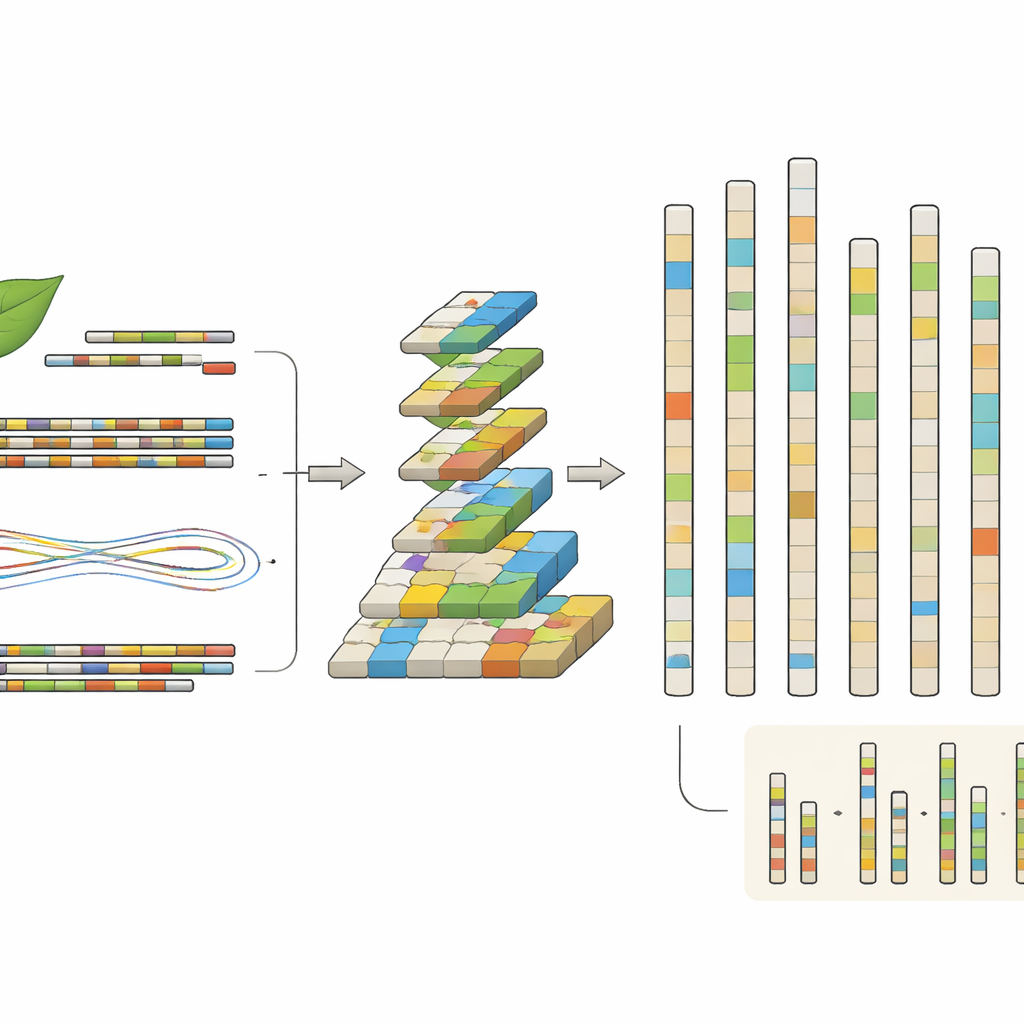
To fill this gap, the team started with a single, carefully chosen Magnolia amoena tree growing in a botanical garden. They collected young leaves for DNA and a range of tissues—leaves, shoots, flower buds, and fruits—for RNA, which captures which genes are active. Using several cutting-edge sequencing technologies, they read the tree’s DNA in different ways: short, highly accurate snippets; long, continuous stretches; and special contact maps that reveal which pieces of DNA sit near each other in the cell nucleus. By combining these data, they assembled the genome into 1.87 billion DNA letters and then arranged 95.73% of that sequence onto 19 large chromosome-like pieces, mirroring the tree’s actual chromosomes. Careful checks showed the assembly is both highly complete and accurate, giving researchers a solid foundation to build on.
Inside the Genetic Blueprint
The finished genome reveals a landscape dominated by repeats—stretches of DNA that occur many times. About 80% of the Magnolia amoena genome consists of such repetitive elements, especially a type called long terminal repeats, along with DNA segments that can move or copy themselves. Among this backdrop, the researchers identified 39,739 protein-coding genes, the working units that help build and run the tree. Most of these genes could be matched to known functions in global databases, and the team also cataloged thousands of small non-coding RNA elements that fine-tune gene activity. This detailed parts list offers clues to how Magnolia amoena produces its characteristic flowers, responds to stress, and manufactures medically interesting compounds.
Tracing Family Ties and Ancient Splits
To place Magnolia amoena in the broader tree of life, the scientists compared its genes with those of 11 related magnolia-line plants. They grouped the genes into families and pinpointed sets shared across species as well as 1,905 families unique to Magnolia amoena. Using hundreds of single-copy genes that change slowly over time, they reconstructed evolutionary relationships. The results show that Magnolia amoena forms a tight branch with several other Magnolia species and is especially close to Magnolia biondii, with which it likely shared a common ancestor about 18.5 million years ago. The study also supports a close relationship between the magnolias and the tulip tree genus Liriodendron, whose lineage split from Magnolia around 48 million years ago.
New Tools for Saving a Living Heritage
By delivering a high-quality chromosome-level map of Magnolia amoena’s genome and making all data publicly available, this work turns a once obscure ornamental and medicinal tree into a well-characterized model for magnolia research. Conservationists can now use this blueprint to track genetic diversity in wild and cultivated populations, identify genes linked to resilience or reproduction, and design more informed recovery plans. At the same time, evolutionary biologists gain a key reference for probing how early flowering plants diversified. In short, the genome of Magnolia amoena is more than a technical feat—it is a new lens for understanding, and ultimately safeguarding, a fragile but culturally and biologically important species.
Citation: Liu, Y., Liu, XJ., Hu, K. et al. A high-quality chromosome-level genome assembly of the endangered species Magnolia amoena. Sci Data 13, 591 (2026). https://doi.org/10.1038/s41597-026-06973-2
Keywords: Magnolia amoena, plant genome, endangered species, chromosome assembly, conservation genetics