Clear Sky Science · en
A dataset of soundscapes from Polynesian altiphotic, mesophotic and rariphotic zones
Listening to Hidden Reef Worlds
When we think of coral reefs, we often picture a riot of color and movement—but these underwater cities are also full of sound. Snapping shrimp crackle, fish drum and grunt, and distant whales rumble past. This study opens a new window onto those underwater soundscapes by compiling a large, publicly available library of reef recordings from French Polynesia, stretching from sunlit shallow reefs down into dim, little-known deep zones. For anyone curious about how scientists can “listen” to ocean health, this dataset is a powerful new way to explore life below the waves.
Many Layers of Life Beneath the Waves
Coral reef environments are stacked in layers, from bright shallow zones where most corals grow, through deeper mesophotic reefs bathed in faint light, down to a rariphotic zone where corals disappear but fish and other creatures remain. Each of these layers hosts its own community of animals and, with them, its own blend of sounds. Until recently, most acoustic work in French Polynesia focused on the shallow, well-lit reefs. The deeper regions—and higher-pitched sounds or mass background choruses—were largely a mystery. This project set out to fill those gaps, capturing the full vertical and horizontal range of reef soundscapes to understand how life is distributed in space and time.
How Scientists Recorded the Reef Choir
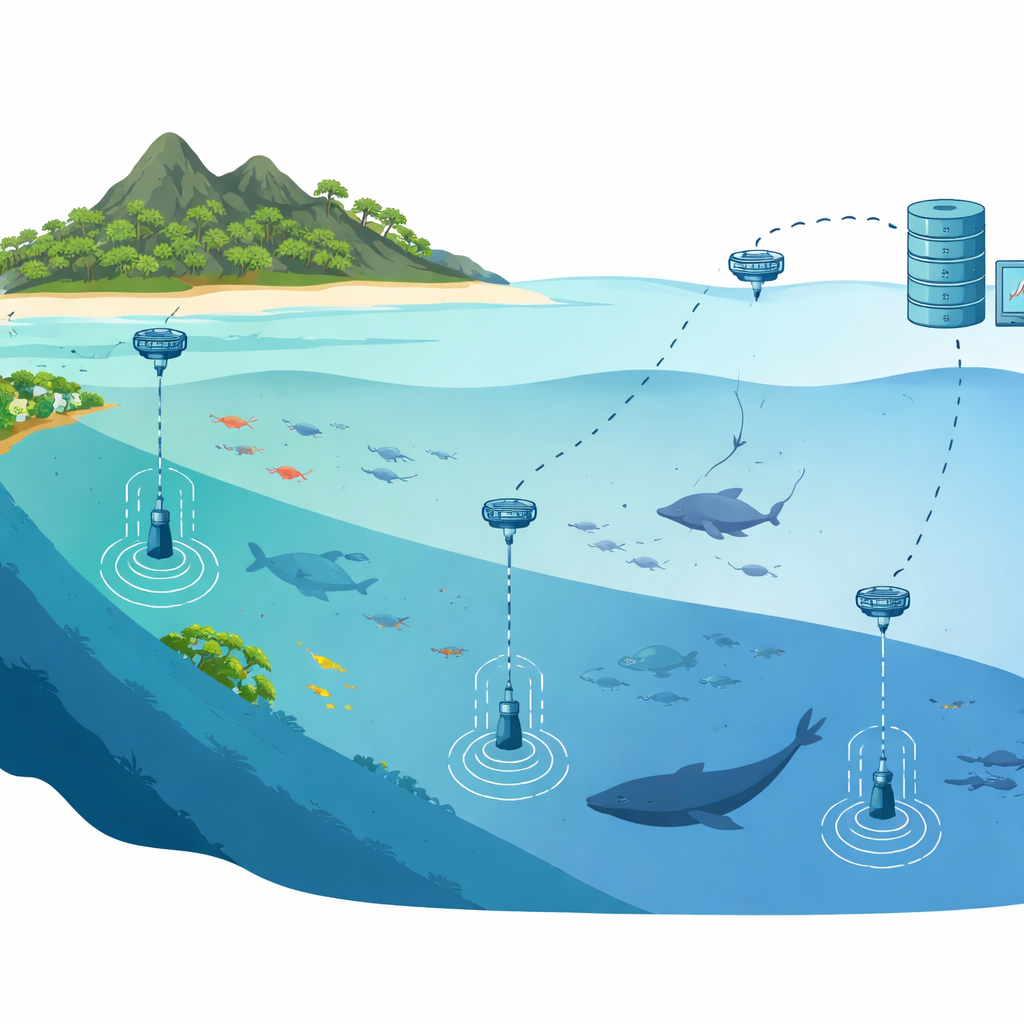
To build the dataset, the team deployed underwater microphones, called hydrophones, around several Polynesian archipelagos. They sampled both low-lying coral atolls and high volcanic islands, always along the outer, ocean-facing reef slopes where marine life is especially rich. Some recording units were fixed in place on poles or tripods at set depths, while others were attached to drifting surface antennas that rode currents from the reef crest out into the open ocean. The devices captured uncompressed audio day and night, either continuously or in regular short segments, at standard sampling rates. Careful calibration and consistent placement ensured that recordings from different sites and years could be reliably compared.
From Raw Noise to Meaningful Patterns
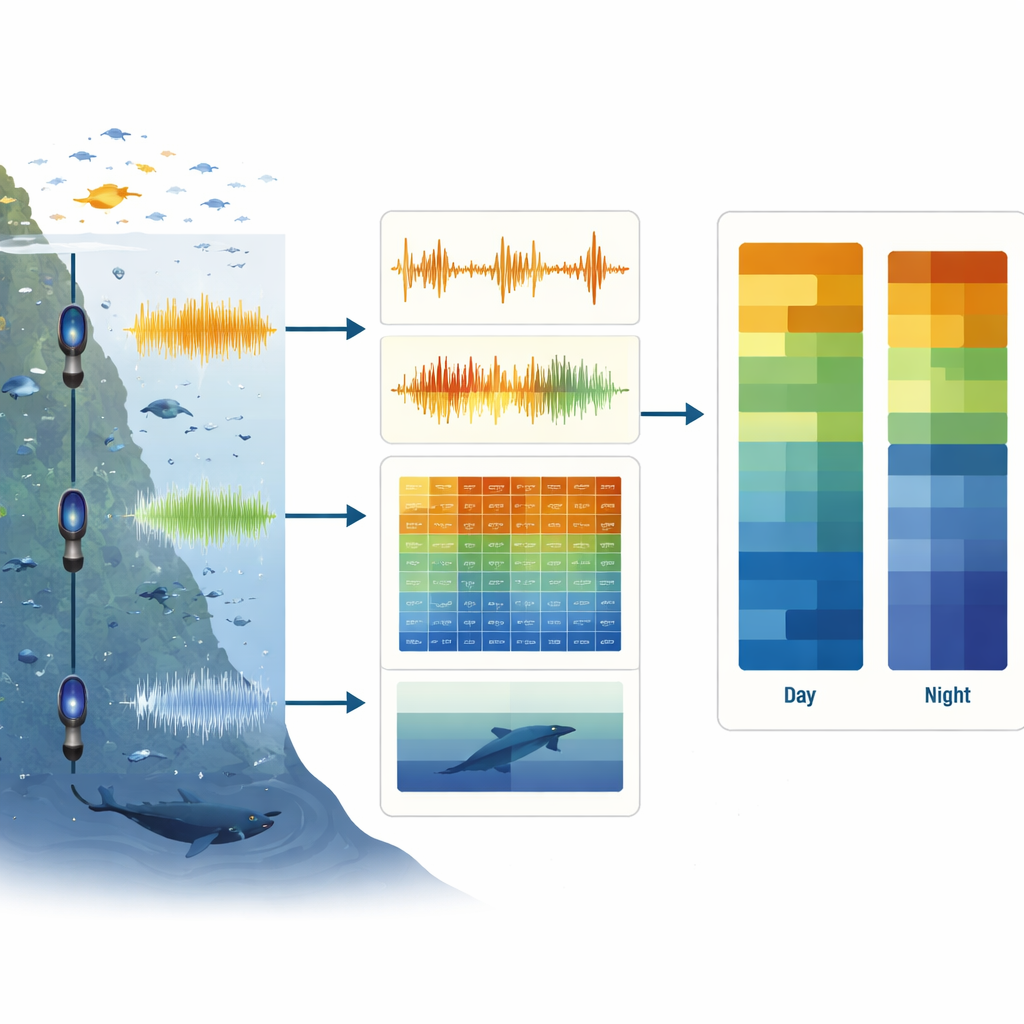
Back in the lab, the raw voltage signals from the hydrophones were converted into views of sound over time and frequency, using tried-and-true mathematical tools. Short slices of each recording were transformed into spectrograms—color-like maps that show which pitches are present and when. Researchers then scrolled through these visual soundscapes to isolate examples of fish calls, invertebrate snaps, and other biological sounds, as well as waves, wind, and boat noise. They created a library of low-pitched clips, mainly from fish, and even developed a simple identification key to help others recognize different sound types. Throughout, they documented technical details such as sensor sensitivity, depth, and deployment schedules so future users can interpret the data correctly.
What the Reef Sounds Reveal
The recordings show that reef soundscapes vary in multiple directions at once—outward from shore, sideways along the reef, with depth, and over time. Sounds from shallow reefs can travel tens of kilometers into the open ocean, though real distances depend on species, weather, and human noise. Horizontally, differences in seafloor cover, such as coral versus algae, shape which animals are present and how loudly they call. Vertically, both fish and invertebrate sounds are stacked by depth, with distinct communities and calling patterns in shallow, mid-depth, and deep mesophotic habitats. Daily rhythms also change with depth: in upper reefs, invertebrates tend to be louder at night but more numerous by day, while deeper communities show weaker or more irregular patterns, punctuated by bursts of broadband clicks in the evening that may come from particular species.
Building a Shared Resource for Ocean Stewardship
By gathering, cleaning, and organizing this wealth of recordings into open Zenodo repositories, the study offers far more than a one-time snapshot. It provides a foundation for many future projects, from tracking how fish and invertebrate communities respond to coral bleaching, to evaluating the benefits of marine protected areas, to studying dolphins and whales that pass through these waters. With clear usage notes and metadata, scientists and conservation managers worldwide can now tap into this dataset to develop new acoustic indicators of reef health. In simple terms, the work turns the ocean’s natural “music” into a shared tool for understanding and protecting some of Earth’s most diverse—and increasingly threatened—marine ecosystems.
Citation: Raick, X. A dataset of soundscapes from Polynesian altiphotic, mesophotic and rariphotic zones. Sci Data 13, 620 (2026). https://doi.org/10.1038/s41597-026-06964-3
Keywords: coral reef soundscape, underwater acoustics, French Polynesia, marine biodiversity, ecoacoustics