Clear Sky Science · en
A dataset of fine-grained zebrafish interactions in health and disease
Why watching fish fights can help human health
At first glance, two small fish circling and lunging at each other may seem like a simple animal squabble. But hidden in those rapid twists and chases are clues to how brains control social behavior, how disorders change movement, and how we might better test new treatments. This paper introduces a large, carefully recorded dataset of zebrafish fights and standoffs, captured in three dimensions and at very high speed, offering a new resource for biologists, physicists, and artificial intelligence researchers alike. 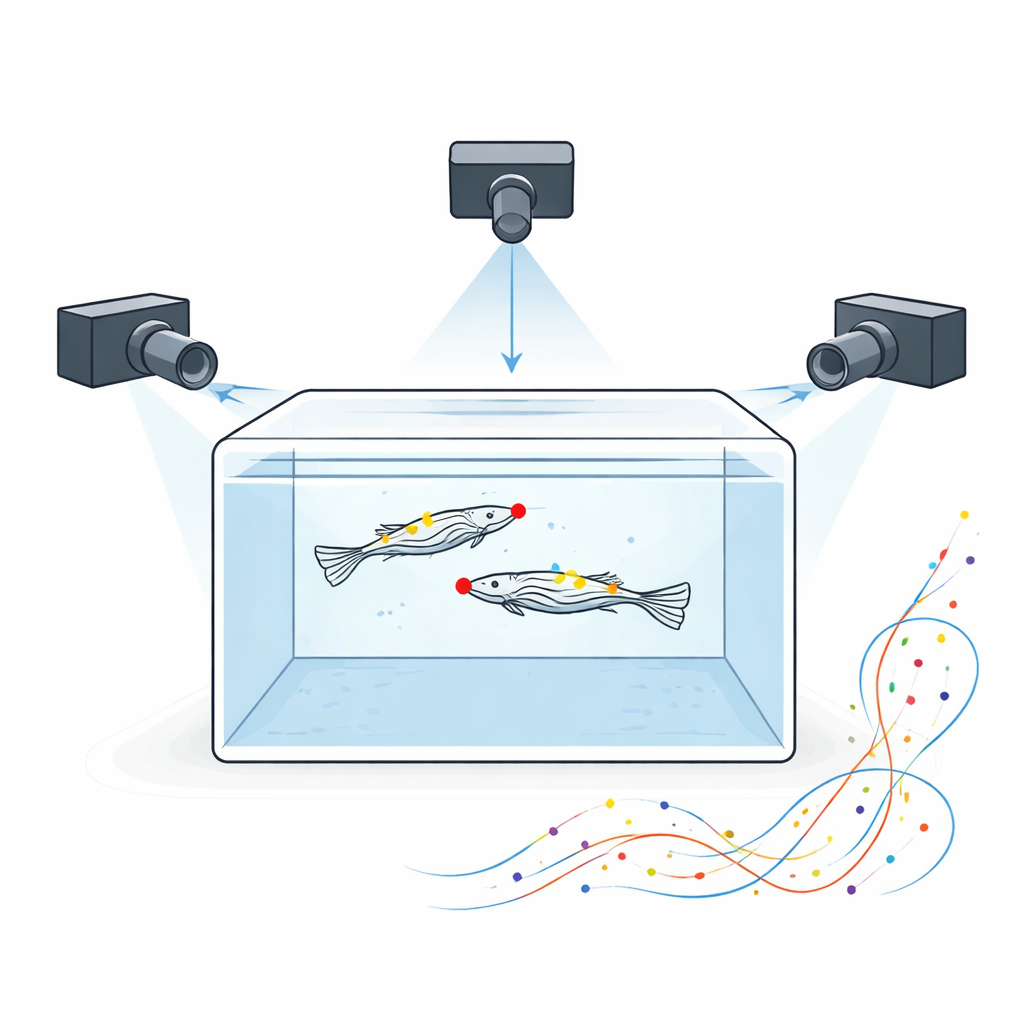
Fish duels as a window into social behavior
Zebrafish have become a favorite species for brain and behavior research because they are small, easy to breed, and share many genes with humans. They also show rich social behaviors, including fierce contests over dominance, especially between males. Until now, most studies have used low-detail tracking, following each fish as a single dot in a flat, two-dimensional view. That approach misses the subtle bends of the body and changes in posture that can reveal whether an animal is threatening, fleeing, or submitting. The authors set out to build a dataset that captures these fine details over long periods, in both healthy animals and fish carrying mutations linked to human-like brain disorders.
Building a high-speed 3D fish arena
To do this, the team designed an experimental arena about ten fish-lengths wide in every direction, giving pairs of adult zebrafish space to chase, circle, and confront one another naturally. Three synchronized high-speed cameras—one above and two from the sides—filmed the fish at 140 frames per second for five hours at a time. Special lighting and transparent cage walls reduced reflections and shadows, while a custom grid of tiny beads allowed precise calibration so that positions in each camera view could be mapped back into real three-dimensional space. The result is a clear, high-resolution recording of every movement, from sweeping tail beats to subtle body tilts. 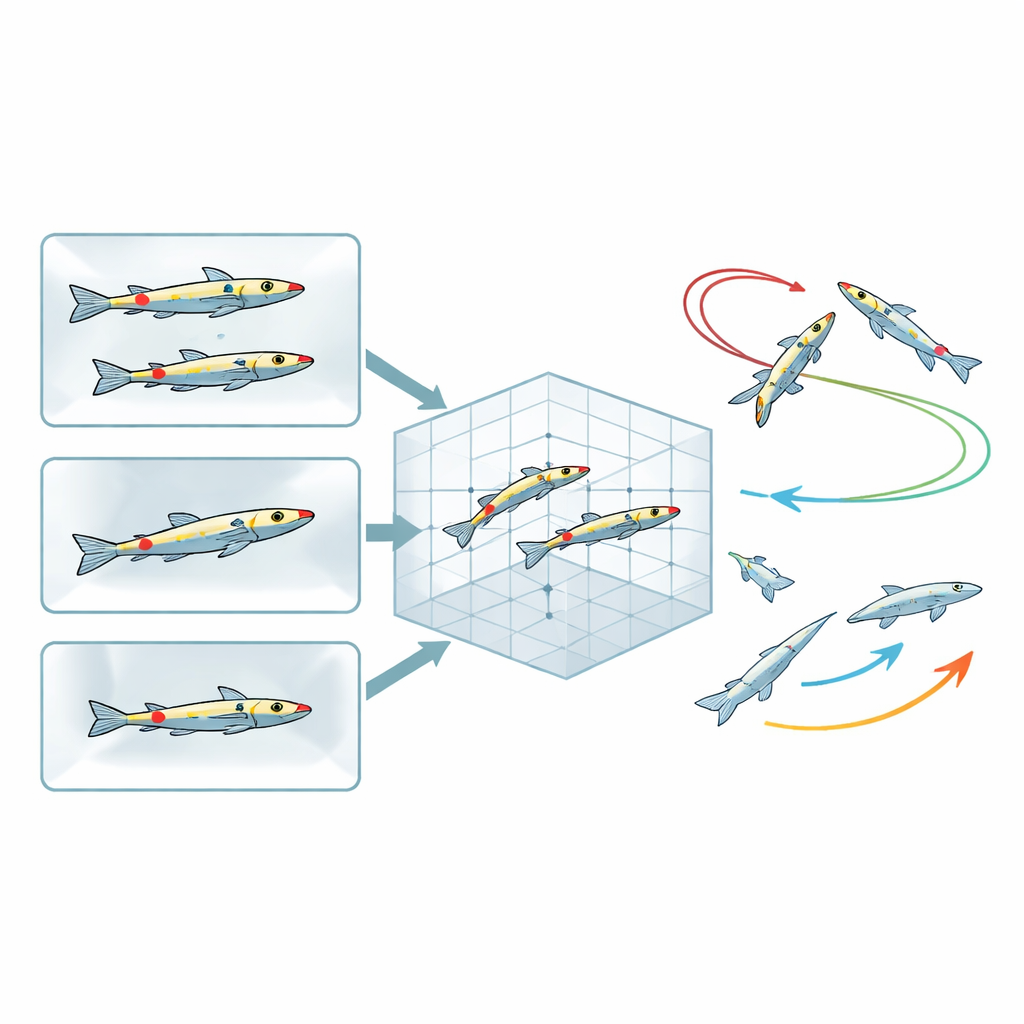
Teaching computers to follow every flick of a fin
The recordings alone would be overwhelming to analyze by hand, so the researchers turned to machine vision tools. One program (SLEAP) was trained to spot three key points along each fish’s body: the tip of the head, the center of the pectoral region, and the base of the tail. These three markers form a simple “skeleton” whose motion captures posture and direction. A second program (idtracker.ai) followed each fish’s overall shape to keep track of which individual was which over the course of hours. The team then combined information from all three cameras using their calibration model, checked for inconsistent assignments by measuring how well points reprojected across views, and threw out or interpolated any frames that appeared suspicious. This pipeline produced clean 3D posture traces for both fish, frame by frame, for nearly the entire recording.
What the dataset contains and how it can be used
The final collection includes 173 five-hour experiments, mostly healthy male–male pairs but also some female–female pairs and two types of mutants. One mutant models Rett syndrome, a human neurodevelopmental disorder, and shows altered movement; the other has a genetic change linked to unusually bold and aggressive behavior. For each experiment, the positions of the three body points on each fish are stored in simple table files, accompanied by metadata on sex, genotype, and arena shape. The authors show how these data can reveal subtle patterns by analyzing “gaze asymmetry”—how often one fish is oriented toward the other. In healthy pairs, this measure shifts over time as one animal gradually becomes the clear dominant, whereas in Rett-like mutants such a clean asymmetry fails to emerge.
Why these detailed fish movements matter
To a non-specialist, this work may seem like an exercise in overanalyzing fish squabbles. But the dataset is more like a high-speed microscope for social behavior. It provides a standard reference for normal and altered aggression in a widely used animal model, helping researchers spot subtle movement changes in disease models relevant to conditions such as Parkinson’s, Alzheimer’s, and Rett syndrome. It also offers a rich test bed for new algorithms in pose tracking and behavior analysis, and a way for physicists to search for hidden rules that govern social interactions. By making every tail flick and sideways glance of these fish publicly available in 3D detail, the authors give the scientific community a powerful new tool for understanding how brains, bodies, and social dynamics fit together.
Citation: Deligkaris, K., Neiman, R., Hiroi, M. et al. A dataset of fine-grained zebrafish interactions in health and disease. Sci Data 13, 583 (2026). https://doi.org/10.1038/s41597-026-06953-6
Keywords: zebrafish social behavior, 3D pose tracking, aggression and dominance, neurodegenerative disease models, behavioral datasets