Clear Sky Science · en
Chromosome-scale Genome Assembly of the Critically Endangered Blue-crowned Laughingthrush (Pterorhinus courtoisi, Leiothrichidae)
A rare bird and its hidden blueprint
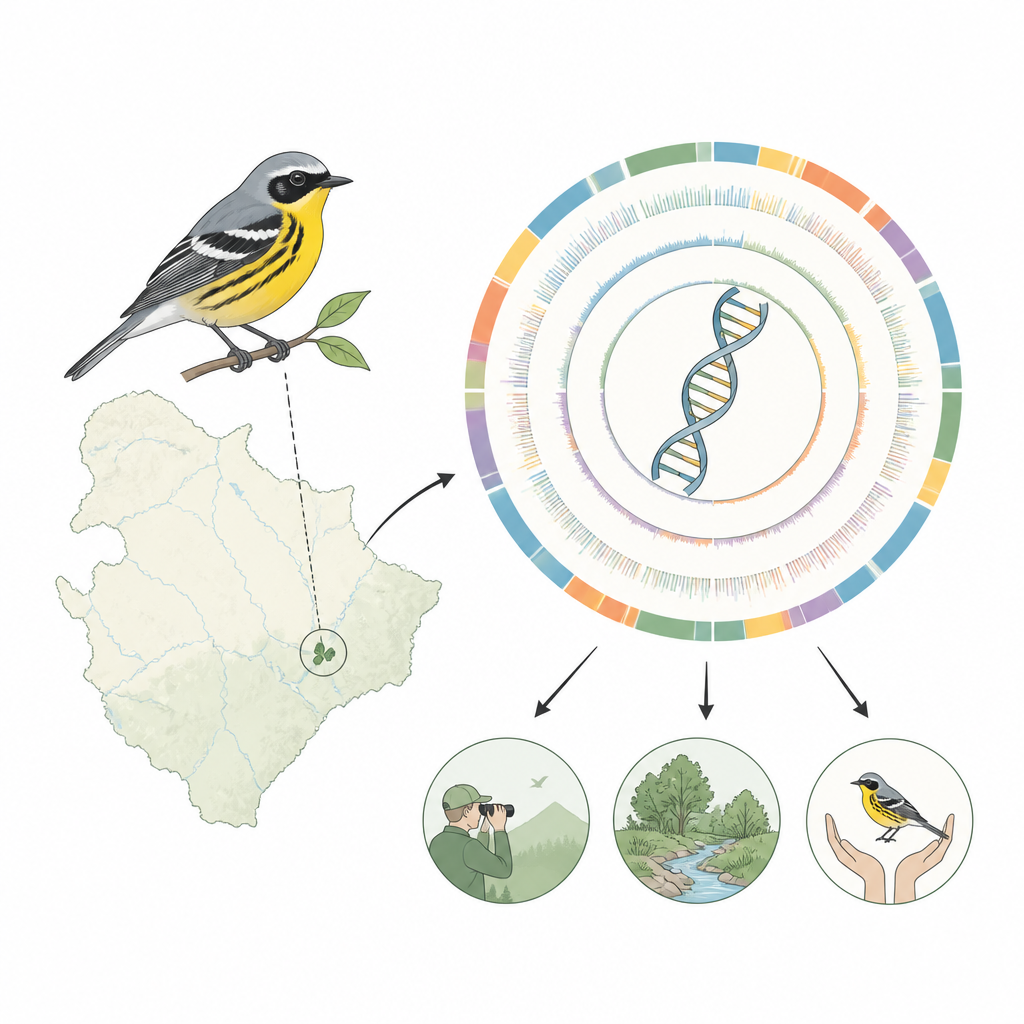
The Blue-crowned Laughingthrush is a striking songbird that now survives only in a small corner of China. With so few birds left, every detail about how it lives and survives matters. This study reads the entire DNA instruction book of the species at high resolution, creating a core resource that scientists and conservation managers can use to better understand its biology and support its survival in the wild.
Why this bird is on the edge
The Blue-crowned Laughingthrush has one of the smallest ranges of any bird, limited to parts of Jiangxi Province, and one of its subspecies has already vanished from the wild. It is formally listed as Critically Endangered, and as a top-level protected animal in China. Yet until now, researchers did not have a detailed view of its genes. Without that information, it is hard to see how inbreeding, past population crashes, or hidden weaknesses in its biology might be affecting its chances to recover.
Reading a full instruction book from one bird
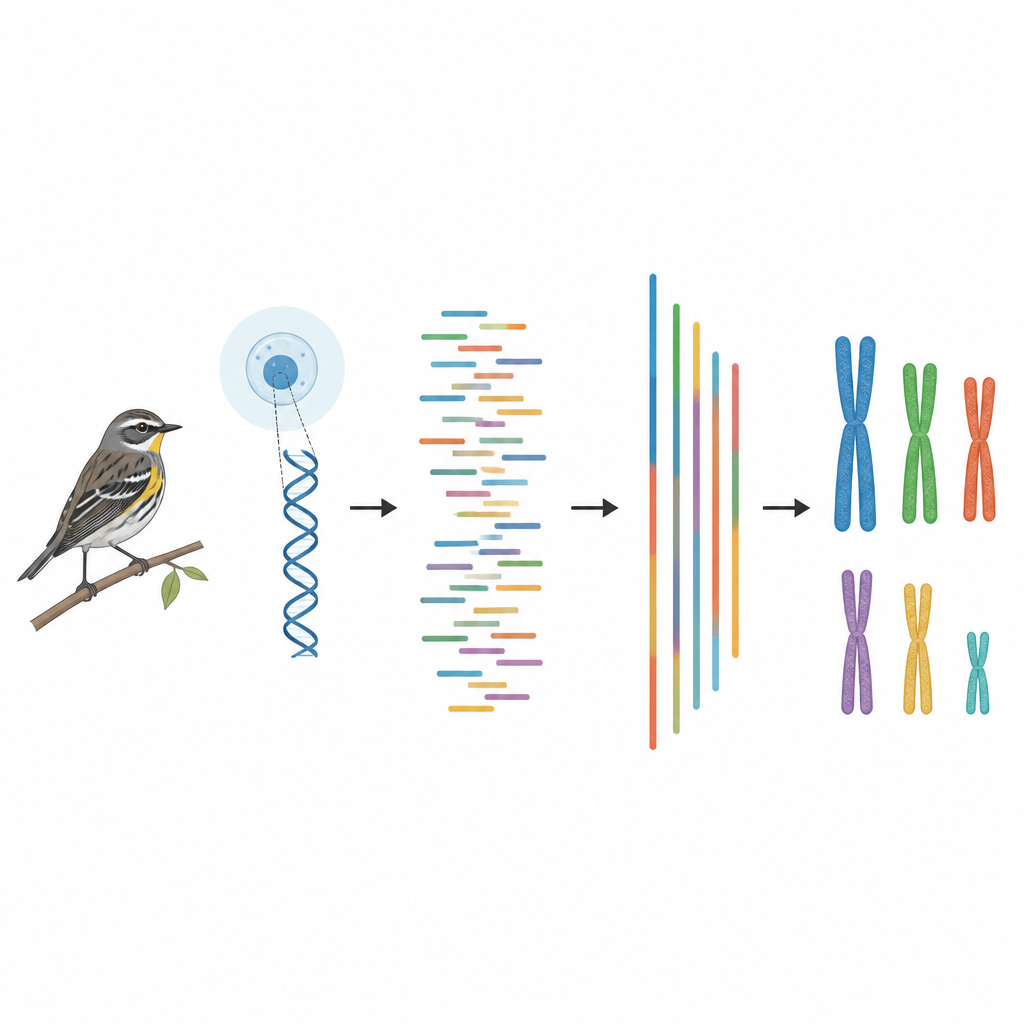
To tackle this gap, the team collected blood and tissue from a freshly deceased bird from the wild. They purified its DNA and sent it for several types of modern sequencing. Short stretches of DNA were read with one machine, while another produced much longer pieces that help bridge gaps. A third approach, called Hi C, captured how pieces of DNA sit next to each other inside the cell. By carefully combining all these data, the researchers stitched together a continuous, chromosome scale genome for the species, reaching 39 large DNA units that match its chromosomes.
Checking quality and spelling
Building a long DNA sequence is not enough; scientists also need to know how accurate it is. The authors checked their assembly in several ways. They looked for thousands of standard genes that should be present in most animals and found the great majority with complete structure. They mapped the original DNA reads back to the new genome and saw that almost all aligned cleanly, covering nearly the entire sequence. They also used a specialized method that estimates how many letters are likely to be wrong and found an error rate of only a few in one hundred thousand, a level classed as platinum grade for genome work.
Finding repeats and working genes
With this solid framework in hand, the team set out to mark the useful parts of the DNA. They searched for repeated stretches, such as mobile genetic elements, and found that about one quarter of the genome is made of such repeats, many of them a type called long terminal repeat retrotransposons. They then predicted where genes lie, using computer models, known genes from related birds, and RNA molecules from the laughingthrush’s own tissues. In the end they identified 16,807 protein coding genes and thousands of non coding RNAs, and were able to assign likely functions to more than 90 percent of the genes by comparing them with several large reference databases.
A new tool for saving a species
This work does not by itself rescue the Blue-crowned Laughingthrush, but it delivers a detailed genetic map that others can now explore. Future studies can scan this genome to measure how much genetic diversity remains, to spot harmful mutations, or to trace how the species has changed over time. Conservation plans, captive breeding, and reintroduction efforts can all be guided by such information. In short, the new genome turns a once mysterious bird into a species whose hidden biology is now open to careful study and smarter protection.
Citation: Ouyang, Y., Yang, L., Cheng, B. et al. Chromosome-scale Genome Assembly of the Critically Endangered Blue-crowned Laughingthrush (Pterorhinus courtoisi, Leiothrichidae). Sci Data 13, 725 (2026). https://doi.org/10.1038/s41597-026-06951-8
Keywords: Blue crowned Laughingthrush, genome assembly, conservation genetics, endangered birds, avian genomics