Clear Sky Science · en
A hand biomechanics dataset of kinematics, kinetics, electromyography, and imaging in healthy adults
Why How Our Hands Work Matters
Every time you turn a doorknob, open a jar, or play an instrument, your hands quietly pull off an engineering marvel. Yet scientists who build computer models of the hand, used to design better treatments, tools, and devices, have long lacked rich, modern data on how real people’s hands move, push, and hurt. This article introduces a new open database that brings together detailed measurements of hand strength, motion, muscle activity, and anatomy from hundreds of adults, creating a shared resource for researchers, clinicians, and designers who want to understand and improve hand function.
A Big-Picture Look at Many Hands
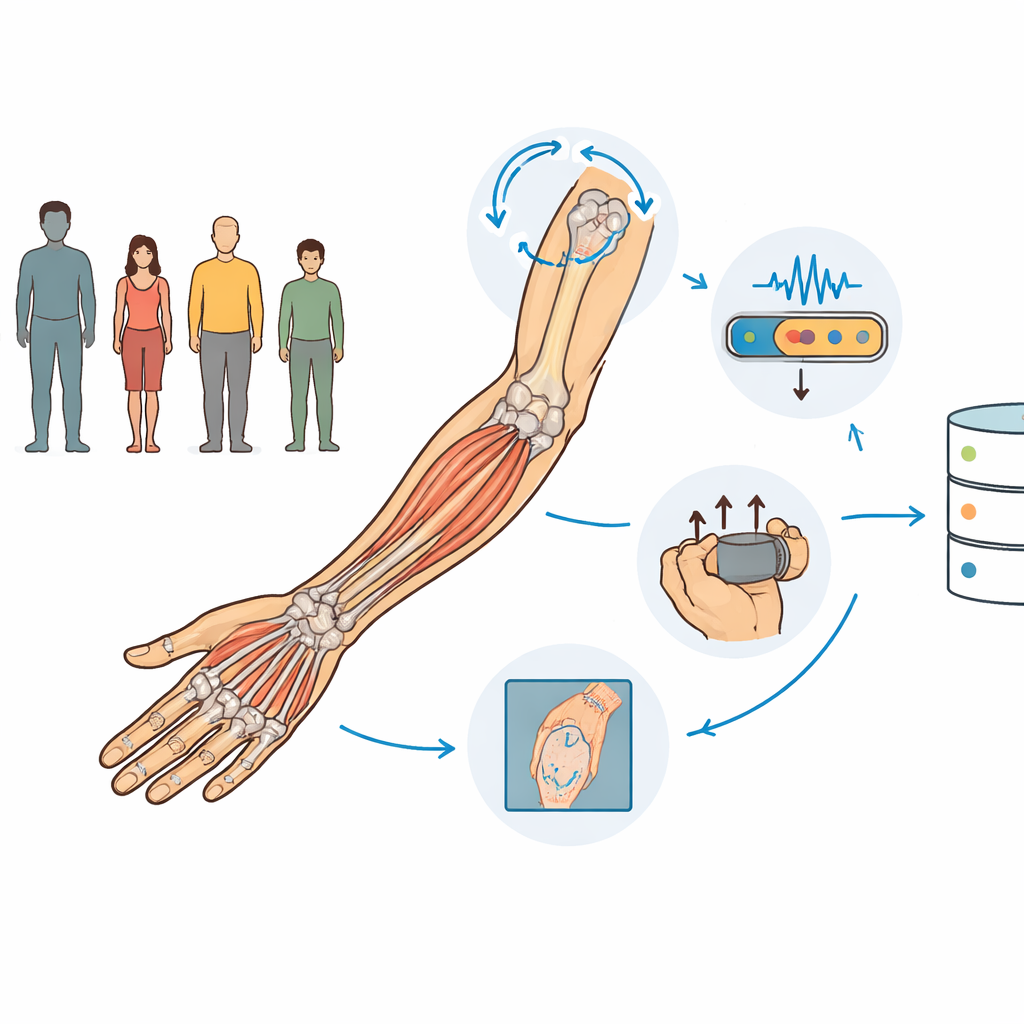
The project, called the Biomechanics Hand Modeling (BHaM) database, has two main parts. The first is a large “population” dataset from 726 healthy adults, aged 18 to 91, tested at universities, community sites, and a biomechanics conference. For each person, the team recorded basic demographics, self-reported hand function and pain using a standard questionnaire, grip and pinch strength, and detailed hand dimensions captured from photographs. This broad sample highlights how much hand size, strength, and comfort vary across age, sex, and other characteristics, and it offers an up-to-date comparison point to older reference data that many current hand models still rely on.
Zooming In on Motion, Muscles, and Forces
The second part is a smaller but much deeper “biomechanics” dataset from 30 of these adults, spanning young, middle-aged, and older participants with a wide range of grip strengths. These volunteers completed two lab sessions. In one, researchers measured elbow and wrist behavior while recording muscle activity from the forearm with surface electrodes and joint torques with a dynamometer chair. In the other, they focused on the hand and thumb, combining motion-capture markers, fine-wire electrodes in eight thumb muscles, and force sensors placed at the fingertips and on a jar-like object. Participants performed 19 different tasks, including pinching, grasping, twisting a lid, and moving the thumb through its main ranges of motion. A subset of 15 volunteers also underwent high-resolution MRI scans of the arm from shoulder to wrist so that individual muscle volumes and bone shapes could be mapped in 3D.
From Raw Signals to Meaningful Movements
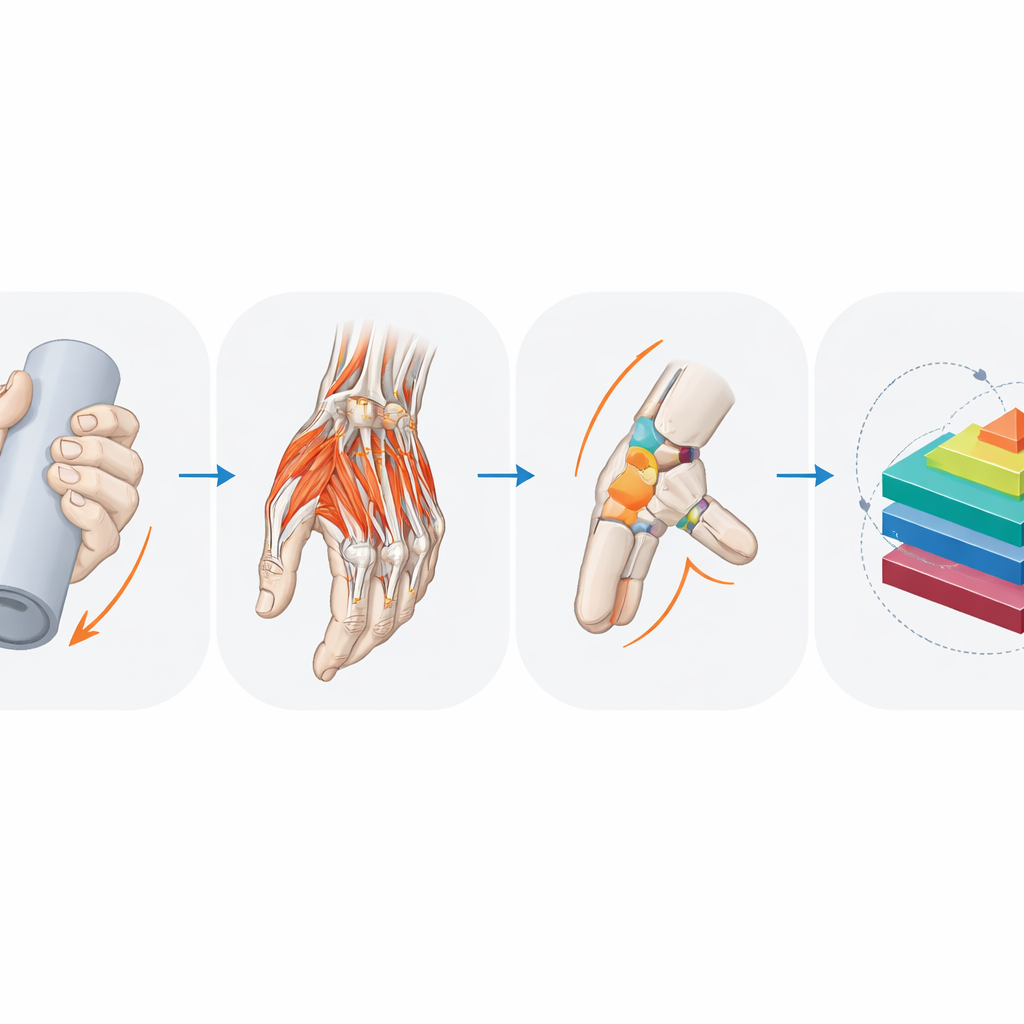
Collecting these measurements is only half the work; making them usable is the other half. The authors carefully processed the raw signals to clean noise from force sensors, standardize muscle activity, and turn marker positions into joint angles. They used established software to scale a generic arm-and-hand model to each person’s body, then solved how each joint must have moved to match the motion-capture data. They also developed automated methods to detect when a trial started and stopped in each recording, which helps other researchers quickly extract comparable time windows. While they provide processed versions of the data, they also share the raw recordings so that others can reanalyze them with new methods or alternative modeling choices.
Checking That the Data Make Sense
To show that the population dataset reflects real-world patterns, the team tested known relationships between hand pain, daily activities, and demographics. Using self-reported pain scores and questions about common tasks like opening jars or buttoning shirts, they found that higher pain generally went along with greater difficulty, as expected. Pain levels tended to be higher in women than men, in older adults compared with younger ones, and in some racial and ethnic groups compared with others, mirroring trends reported in earlier health studies. They also explored how participation in hand-intensive hobbies—such as playing instruments, crafting, or racquet sports—related to pain, and demonstrated that results could shift depending on whether people who reported zero pain were included, underscoring the importance of handling “floor effects” carefully in pain research.
What This Means for Our Hands and Their Future
Taken together, the BHaM database offers an unusually rich picture of how healthy hands are built, how strong they are, how they move, and how they feel across adulthood. By freely sharing measurements that link anatomy, muscle activity, joint motion, forces, and self-reported experience, the authors aim to give the musculoskeletal modeling community a common foundation for building and testing computer simulations of the hand. In practical terms, this resource should help researchers design better surgical plans, assistive devices, and even everyday objects that are kinder to our hands—so that turning a key, twisting a jar, or playing a favorite hobby remains possible and comfortable for as many people as possible.
Citation: Diaz, M.T., Benoit, A.R., Kearney, K.M. et al. A hand biomechanics dataset of kinematics, kinetics, electromyography, and imaging in healthy adults. Sci Data 13, 646 (2026). https://doi.org/10.1038/s41597-026-06939-4
Keywords: hand biomechanics, musculoskeletal modeling, grip strength, electromyography, hand pain