Clear Sky Science · en
CactEcoDB: Trait, spatial, environmental, phylogenetic and diversification data for the cactus family
Why a Database of Cacti Matters
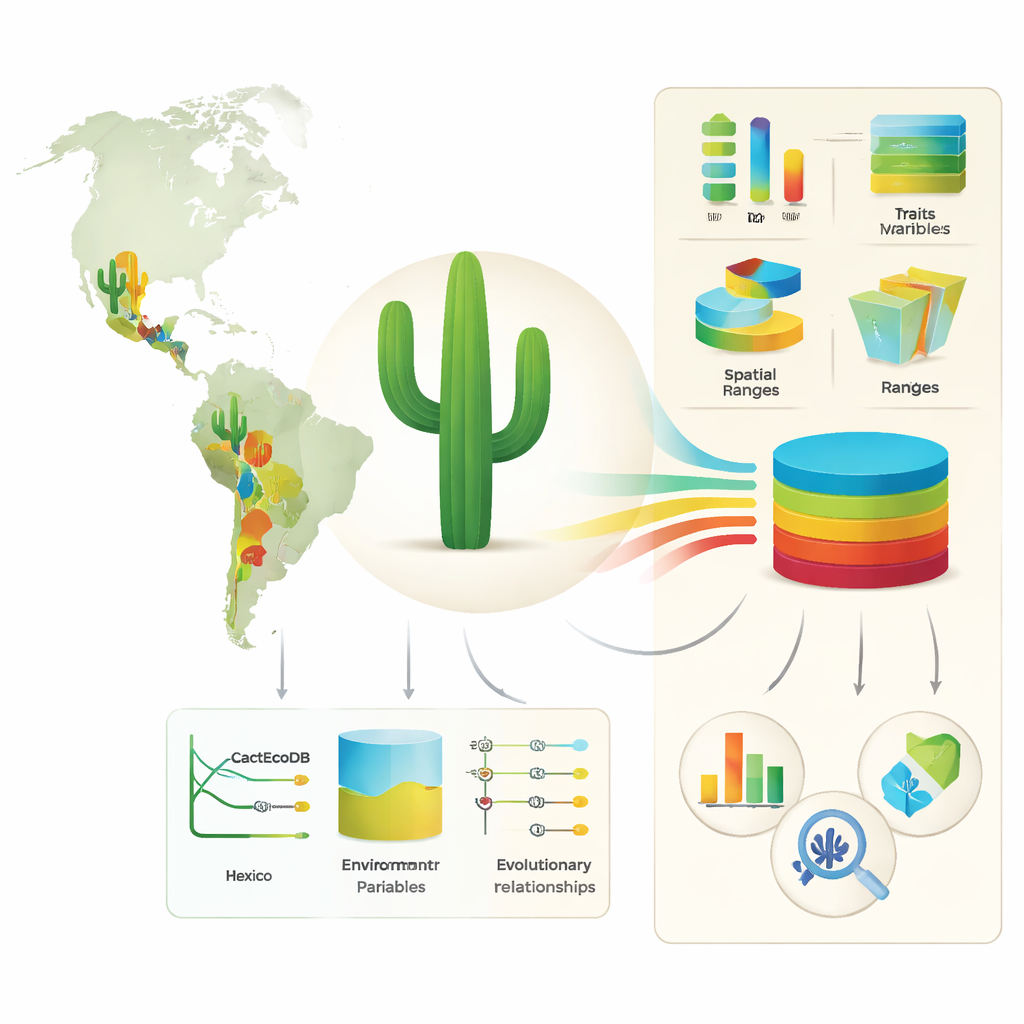
Cacti are among the most recognizable plants on Earth, from spiny desert globes to towering columnar giants. They are also some of the most threatened. Until now, researchers and conservationists wanting to understand how cacti evolved, where they live, and how they might cope with climate change had to piece together scattered information from many sources. This article introduces CactEcoDB, a large open database that gathers key information about more than a thousand cactus species into one place, aiming to support both basic science and real-world conservation.
A Family of Extremes
The cactus family includes roughly 1,850 species spread from southern Canada to Patagonia, with especially rich hotspots in Mexico, the Andes, and eastern Brazil. Cacti thrive in some of the harshest places on the planet, from hyper‑arid deserts to high mountain grasslands, thanks to special features such as water‑storing stems and night‑time carbon uptake. At the same time, they play important roles in human culture: as food, fodder, natural dye sources, and prized ornamentals. This popularity has a dark side. Habitat loss, climate change, and illegal collection for horticulture have pushed many species toward extinction, with earlier studies estimating that at least one third of cacti are threatened and many more may lose much of their range in the coming decades.
Bringing Scattered Information Together
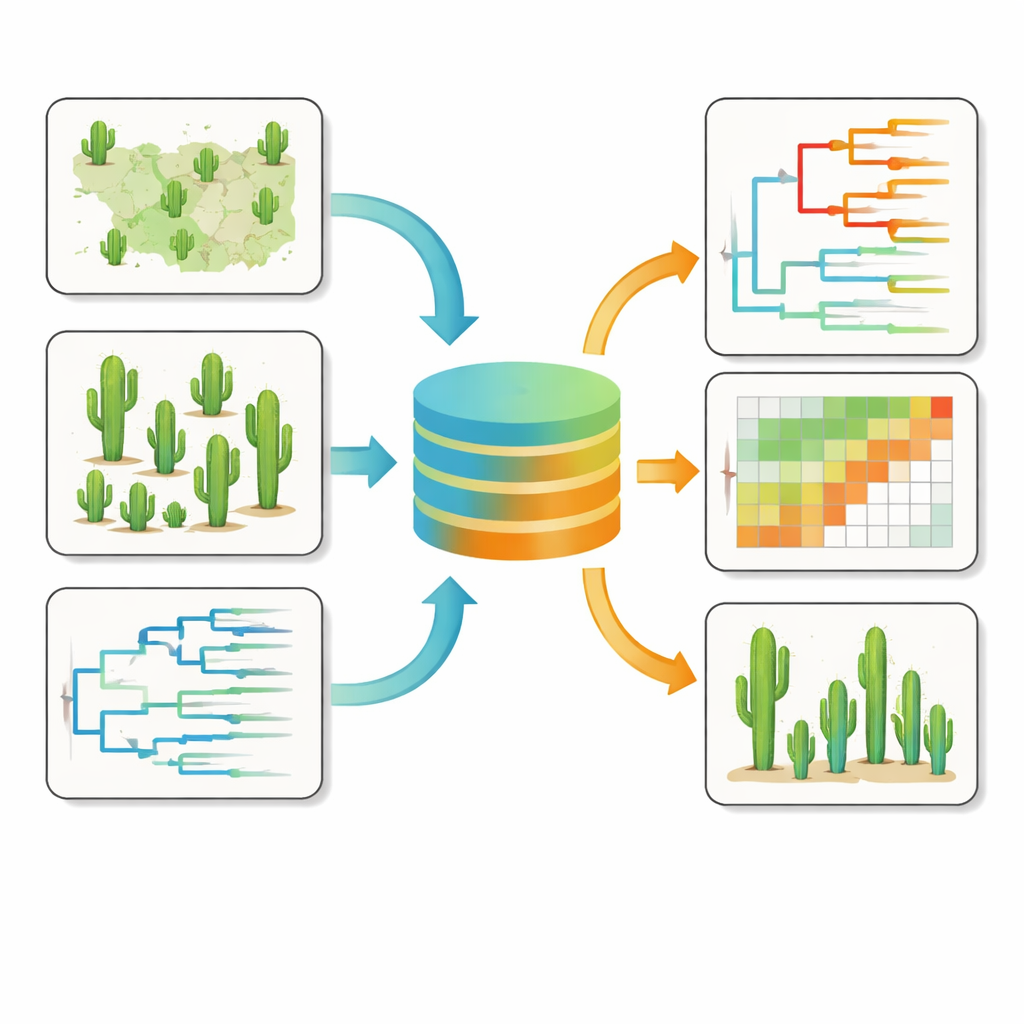
Understanding why some cacti are widespread while others are rare, or why certain groups have produced many species, requires combining several kinds of information: where species occur, what environments they occupy, what they look like, how they reproduce, and how they are related on the tree of life. Until now, such data for cacti were fragmented, incomplete, or inconsistent. CactEcoDB tackles this gap by assembling, cleaning, and standardizing multiple data types for over 1,000 species. It includes maps of species ranges, climate and soil conditions across those ranges, plant traits such as maximum height and growth form, pollination groups, chromosome counts, and large evolutionary trees dated through time. The authors also estimate how quickly each lineage has produced new species using several complementary methods, allowing users to explore links between environment, form, and diversification.
Measuring Form, Pollinators, and DNA
A major contribution of CactEcoDB is the refinement and expansion of trait data. Instead of a coarse split between small “compact” and tall “tree‑like” cacti, the team defines nine growth‑form categories, from low cushion‑forming species to globe‑shaped plants, shrubs, barrels, and tall columnar forms. Maximum plant size was carefully re‑checked and standardized, with errors and outliers flagged by statistics, literature review, and an expert grower with decades of field experience. Pollination information was upgraded from a simple ancestral‑versus‑derived code to detailed groupings that distinguish bats, bees, birds, moths, and other insects, capturing the rich variety of cactus flowers and their animal partners. Chromosome counts, drawn from a global database, record both typical values and within‑species variation, helping future studies connect genetic changes to the evolution of form and diversity.
Mapping Cacti and Their Environments
On the geographic side, the authors replace raw, often noisy occurrence records with expert‑drawn range maps from the IUCN Red List wherever possible, supplementing them with carefully cleaned museum and herbarium records when maps are unavailable. Within each range, they randomly sample locations in proportion to area, then overlay global grids of climate, topography, and soils. This approach yields both summary values (such as median temperature or rainfall for each species) and full distributions of environmental conditions across each range. The team shows that these new summaries closely match results from earlier methods while adding new variables, such as soil texture, and improving coverage for species with poor raw records. Together with the evolutionary trees, these spatial layers enable analyses of how cactus lineages have spread across the Americas and how local environments shape their traits and diversification.
Checks, Limits, and Future Use
Because no large compilation is perfect, the authors devote considerable effort to testing and documenting uncertainties. They compare different ways of estimating speciation rates, assess how robust the evolutionary timelines are in the absence of fossils, and cross‑check environmental summaries derived from different spatial workflows. Some data types, like pollinator records and chromosome counts, remain sparse and unevenly sampled, reflecting gaps in the original literature rather than errors in the database. The authors stress that the resource is best suited for broad comparative studies—such as asking which growth forms are most vulnerable to climate change—rather than for fine‑scale habitat mapping of single species.
What This Means for Cacti and Beyond
CactEcoDB does not claim to solve the conservation crisis facing cacti, but it gives scientists, land managers, and policymakers a powerful new tool. By putting traits, ranges, environments, and evolutionary history into a single open resource, it becomes possible to ask big questions about why cacti diversified when and where they did, how their unique forms relate to the climates they inhabit, and which lineages may be at greatest risk in a warming world. Just as important, the project serves as a model for similar efforts in other plant and animal groups, showing how careful data integration and validation can turn scattered observations into a foundation for both discovery and protection.
Citation: Thompson, J.B., Martinez, C., Avaria-Llautureo, J. et al. CactEcoDB: Trait, spatial, environmental, phylogenetic and diversification data for the cactus family. Sci Data 13, 623 (2026). https://doi.org/10.1038/s41597-026-06936-7
Keywords: cacti, biodiversity database, plant evolution, species conservation, climate change impacts