Clear Sky Science · en
Motion capture dataset of 137 post-operative total hip replacement patients performing activities of daily living
Why Everyday Movements Matter After Hip Surgery
For the hundreds of thousands of people who receive an artificial hip each year, success is ultimately measured not just by X‑rays or clinic tests, but by how comfortably they can walk, climb stairs, get out of a chair or kneel for hobbies and sports. The article describes a new open-access motion-capture dataset of 137 people living with a total hip replacement, recorded while they perform a wide range of everyday movements. By turning their motions into precise three-dimensional data, the dataset gives researchers, clinicians and engineers a powerful tool to improve rehabilitation, test implants more realistically and build smarter digital models of the human body.
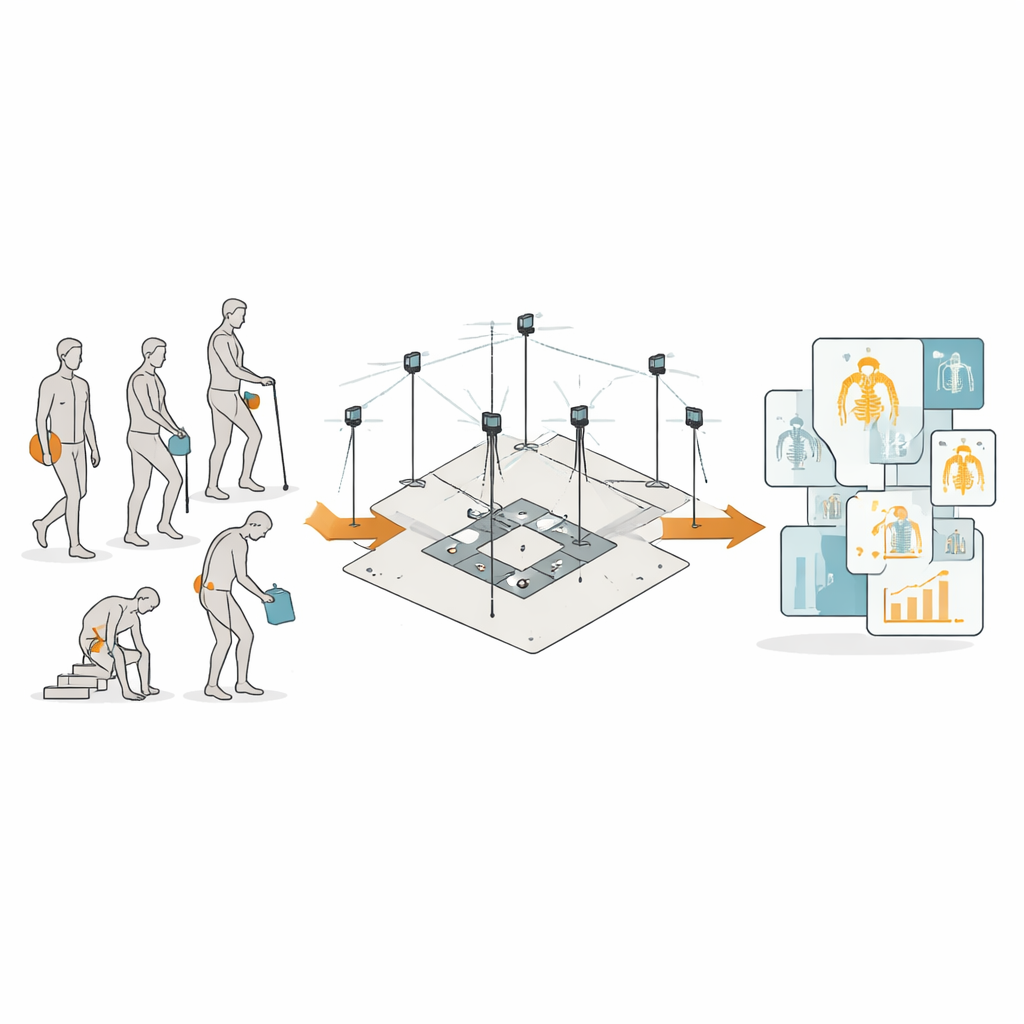
Tracking Real People Doing Real-World Tasks
The study brings together a single, relatively large group of patients who had a hip replacement between one and five years earlier and were free of pain and other major joint or nerve problems. These volunteers, on average in their early seventies, came to a specialist gait laboratory where their movements were captured with a ring of ten infrared cameras and two force-sensing plates set into the floor. Reflective markers placed on key points of the pelvis, legs and feet allowed the cameras to reconstruct how each bone segment moved in three dimensions, while the plates measured how hard each foot pressed on the ground and how those forces changed over time.
Everyday Actions Put to the Test
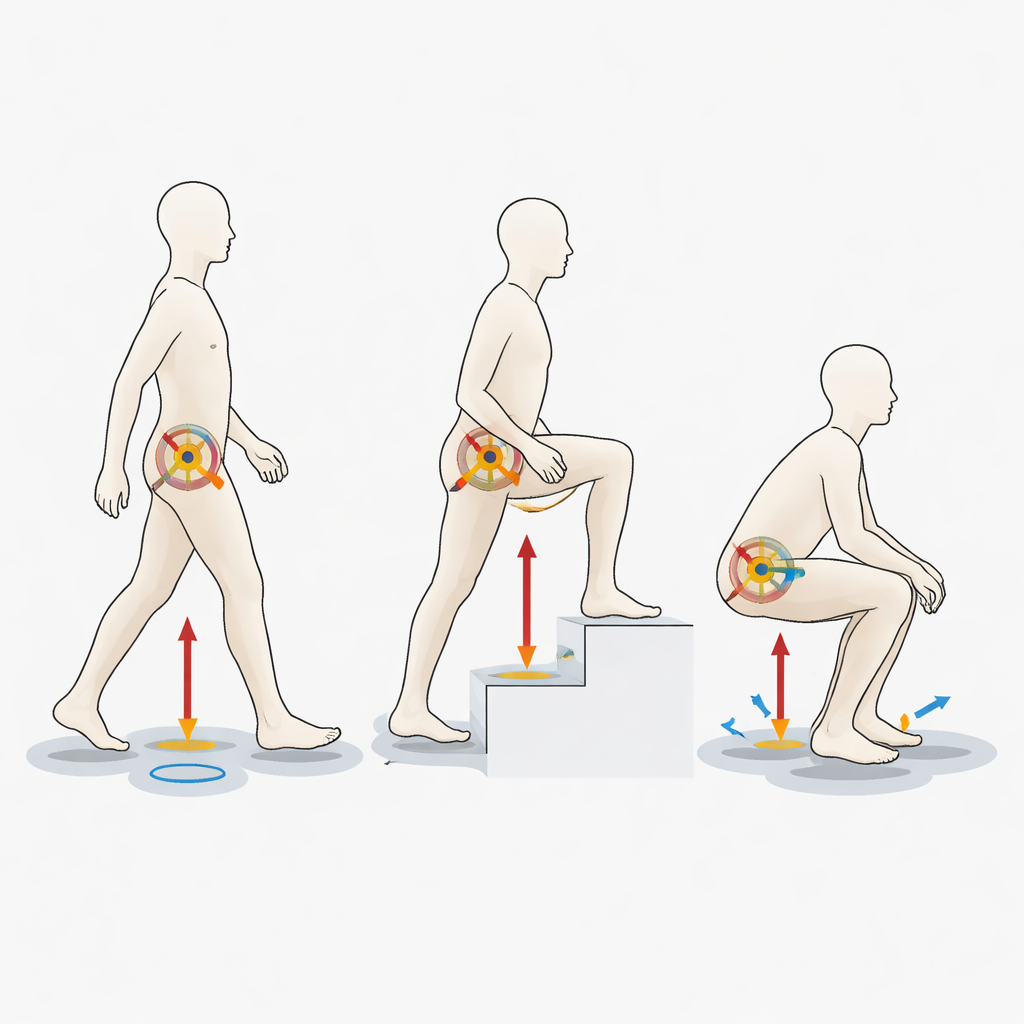
Unlike many existing collections that focus only on level walking or a single transition like standing up, this dataset covers eight different activities of daily living. Participants walked at a comfortable pace and at their fastest safe pace along a walkway, climbed and descended a short set of instrumented stairs, stood up from and sat down on an adjustable chair, and performed squats and lunges that push the hip toward its limits of bending. For each task, several good-quality trials were recorded, with careful rules for when a movement started and ended, and how key moments—such as heel strike, toe-off or the bottom of a squat—were defined from the marker and force signals.
From Raw Motion to a Reusable Digital Resource
The authors stored the data in a standard biomechanical format known as C3D, widely supported by analysis programs and musculoskeletal modeling software. Each trial file bundles the three-dimensional marker paths, ground reaction forces and moments, timing of important movement events and basic participant information such as age, sex, body mass index, which hip was operated and how long ago the surgery took place. To lower the barrier for data use even further, they also exported the same information into plain text files, and provide separate spreadsheets describing trial types, the number of repetitions for each participant and detailed demographics. This structure lets researchers plug the motions directly into advanced computer models that estimate joint angles, internal joint contact forces and even individual muscle forces.
Reliable Measurements in a Controlled Setting
The laboratory followed strict calibration and quality-control procedures before testing each person, using an active wand with light-emitting diodes to align the cameras and define a consistent coordinate system anchored to the floor and force plates. The accuracy of the motion-capture system and its setup has been documented in previous work, and the team filtered and cleaned the marker and force signals using well-established methods. Published studies that already relied on this dataset report hip ranges of motion and joint loading that closely match values measured by other groups, including direct measurements from implanted sensors, supporting the reliability of the recordings across walking, stair use and more demanding tasks such as lunges.
Opening the Door to Better Care and Better Implants
By releasing this rich dataset to the public, the authors aim to accelerate progress on several fronts: more realistic testing of new hip implant designs, improved understanding of how older adults with replacements move in real-life situations, and development of machine-learning tools that can recognize movement patterns or predict joint loads from simple measurements. For patients, the long-term payoff could be rehabilitation programs that are tailored to the actual demands of daily life, implants that are engineered and tested against the kinds of forces people experience when they climb stairs or rise from a low chair, and digital twins that help clinicians monitor recovery years after surgery. In short, the dataset turns the everyday steps, bends and rises of hip-replacement patients into a shared scientific resource that can help keep future patients moving safely and independently.
Citation: Lunn, D.E., De Pieri, E., Chapman, G.J. et al. Motion capture dataset of 137 post-operative total hip replacement patients performing activities of daily living. Sci Data 13, 616 (2026). https://doi.org/10.1038/s41597-026-06925-w
Keywords: total hip replacement, motion capture, gait analysis, activities of daily living, biomechanics dataset