Clear Sky Science · en
Stable hydrogen isotope in tropical bat hair and the Asian isoscape: A dataset to advance migration research
Why Tracking Tiny Travellers Matters
Many of the world’s bats weigh less than a chicken egg, yet they can fly hundreds or even thousands of kilometres between seasons. Because they are so small, we cannot easily follow them with GPS tags or radio collars, leaving major gaps in our understanding of their journeys and the ecosystems they connect. This study builds a new kind of map for Asia—based on the natural “chemical fingerprints” in rainwater and bat hair—to help scientists uncover where bats come from, where they go, and how to better protect them.
A Chemical Stamp in Rain and Hair
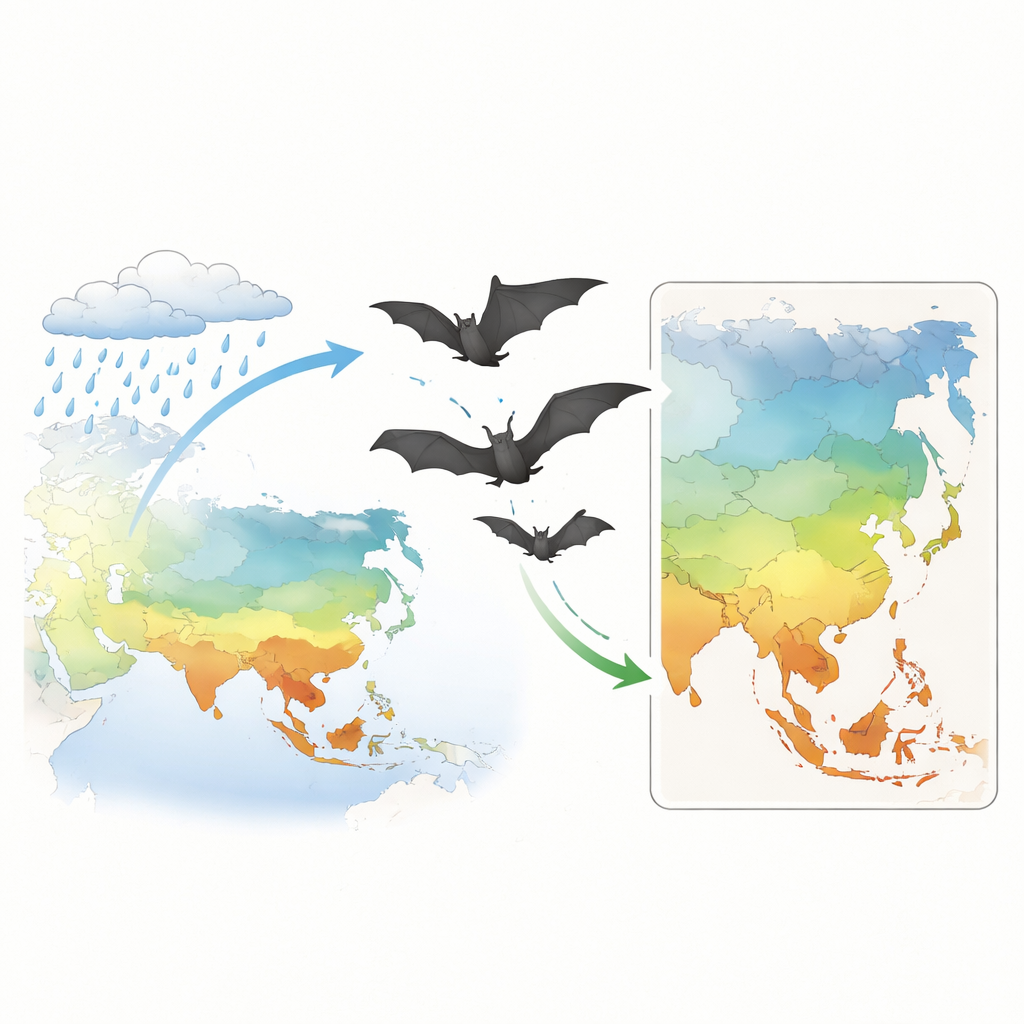
Rainwater is not all the same. As clouds move over mountains, across latitudes, and through different climates, the ratio of light and heavy forms of hydrogen in water changes in predictable ways. When animals drink that water or eat plants and insects that grew with it, a record of the local conditions is locked into slowly growing tissues such as hair, feathers, and claws. Once those tissues are formed, their chemical signature no longer changes, acting like a tiny passport stamp that reflects where the animal was living at the time.
Turning Raindrops into Maps
Scientists can turn these invisible chemical differences into “isoscapes”—maps showing how the heavy form of hydrogen varies across large areas. Until now, such maps have been detailed for North America and Europe but were patchy or very coarse for Asia, especially in the tropics. In this study, the authors combined long-term international monitoring data on rainwater with many smaller local studies to construct three higher-resolution maps: one for the whole of Eurasia, one for Asia, and one focused on Southeast Asia and southern China. Using specialized statistical tools, they linked the hydrogen fingerprint in rain to simple landscape features like elevation and latitude, filling in the gaps between weather stations.
Following the Trail of Bat Hair
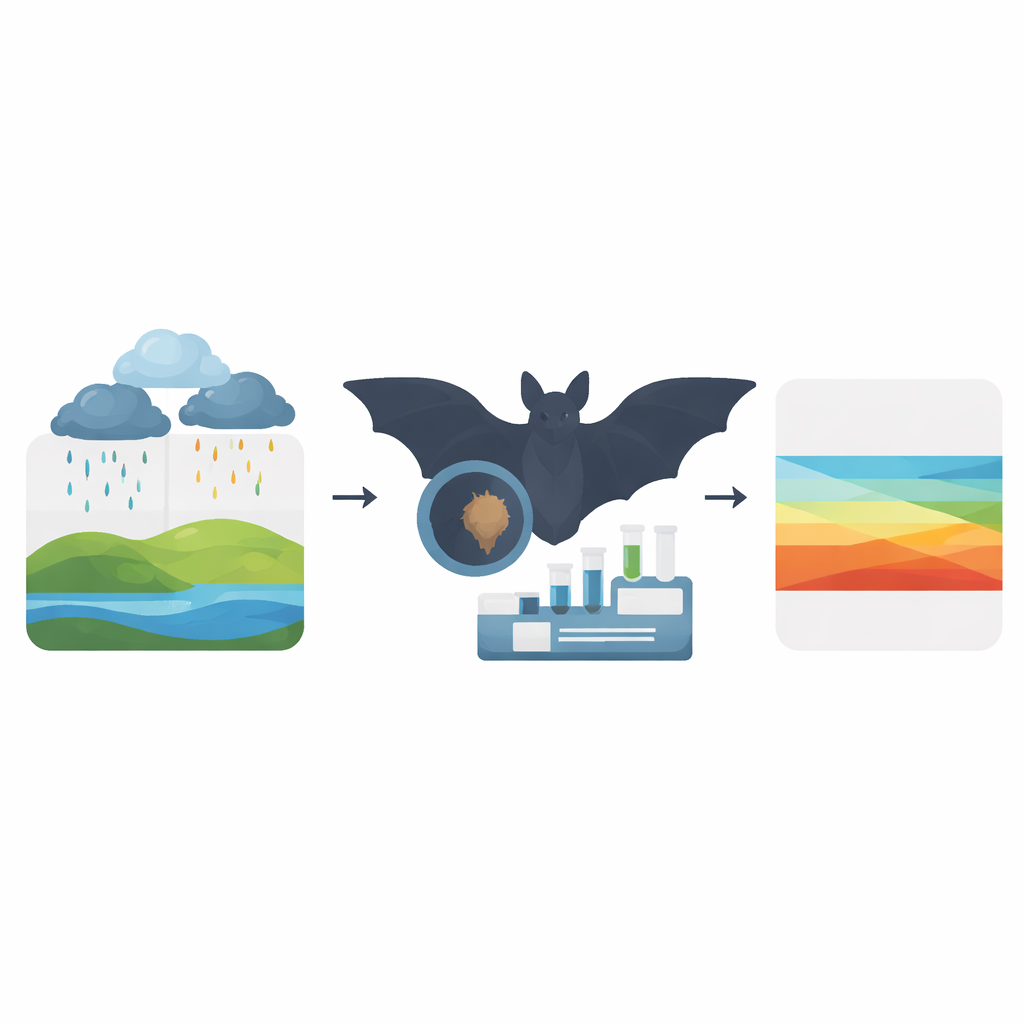
To connect these new maps to real animals, the team analyzed hair from 739 individual bats, spanning 25 species in tropical Asia. Bats were humanely captured in mist nets and harp traps at 19 sites in southern China and northern Vietnam, then released after a small sample of hair was taken. In the laboratory, the hair was carefully cleaned and heated so that its hydrogen could be measured with high-precision instruments. Because adult bat hair reflects the conditions where it grew, comparing these measurements to the isoscapes allows scientists to relate each bat’s “hydrogen address” to its likely place of origin.
Building Tools for Migration and Crime Fighting
The authors are not just presenting a collection of numbers; they provide ready-to-use digital layers, code, and clear instructions so that other researchers can recreate or adapt the maps. The datasets include elevation grids, model files, and finished isoscape layers for Eurasia, Asia, and Southeast Asia, plus species-by-species bat hair values. Tests of the models show that the maps capture broad patterns: heavier hydrogen near coasts and lowlands, and lighter hydrogen at higher latitudes and elevations. The study also highlights where uncertainty is greatest—usually far from monitoring stations—guiding future efforts to collect more data. These resources can help track long-distance movements of bats and other animals and can be used in wildlife forensics to estimate where confiscated animals or animal products originally came from.
What This Means for Bats and Beyond
Put simply, this work turns Asian rainfall into a continent-wide backdrop for tracing animal movements. By matching the chemical clues in bat hair to detailed maps of hydrogen in rain, scientists can start to infer where bats grew their fur, even if the animals were only caught once. That ability opens doors for understanding migration routes, identifying key stopover or breeding areas, and pinpointing the origins of animals seized from illegal trade. While the maps are not perfect and more data—especially from remote regions—will improve them, they provide a crucial foundation for following the hidden flights of bats and for using natural chemical fingerprints to protect wildlife across Asia.
Citation: Chornelia, A., Hughes, A.C. Stable hydrogen isotope in tropical bat hair and the Asian isoscape: A dataset to advance migration research. Sci Data 13, 642 (2026). https://doi.org/10.1038/s41597-026-06912-1
Keywords: bat migration, stable isotopes, isoscapes, wildlife forensics, Asian biodiversity