Clear Sky Science · en
The chromosomal-level genome assembly and annotation of Phyllospadix iwatensis (Surfgrass)
Grass of the Waves
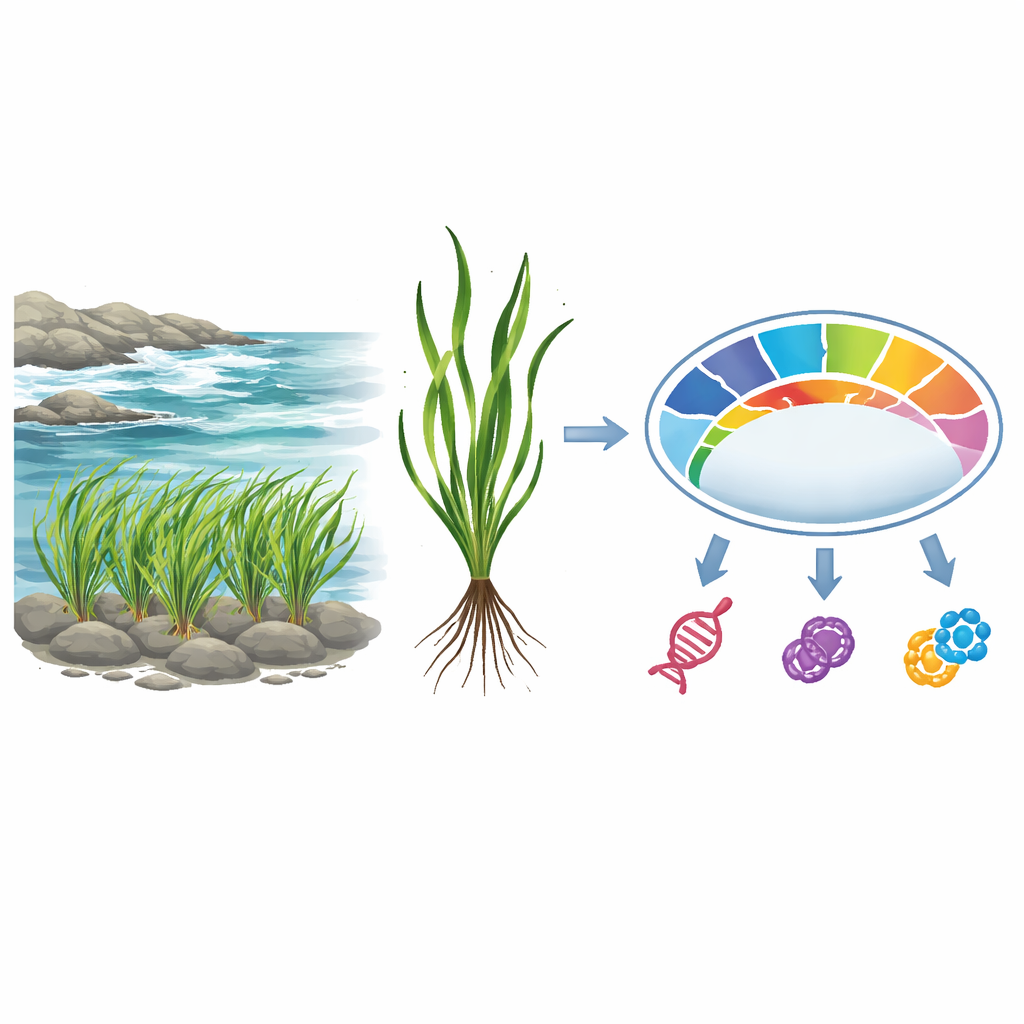
Along stormy rocky shores in East Asia grows an underwater "meadow" called surfgrass, or Phyllospadix iwatensis. Unlike typical seagrass that roots in sand or mud, this plant clings to bare rock and endures crashing surf. Understanding how it manages this lifestyle matters not only for marine ecology and conservation, but also for grasping how land plants repeatedly reinvented themselves to live back in the sea. This study delivers a detailed genetic blueprint of surfgrass, opening the door for future work on how it anchors, reproduces, and survives in harsh coastal waters.
A Tough Plant in a Rough Home
Seagrasses are flowering plants that long ago returned from land to the ocean. Today they form vast underwater pastures that stabilize coasts, store carbon, and shelter marine life. Most species live in soft sediments, but Phyllospadix iwatensis is different. It grows on wave-battered rocky shores and has separate male and female plants. Its body is adapted to this restless habitat: short creeping stems, masses of fibrous roots and tiny root hairs that grip rock, and seeds with thick coats and special hooks that help them hold on. These unusual features made surfgrass an ideal candidate for a deeper genetic look.
Why Its Genome Matters
In the last decade, scientists have assembled genomes for several seagrass species from around the world. Those datasets revealed dramatic changes that helped plants make the jump from land to salty, submerged life: entire genome duplications, bursts of mobile DNA, and the loss of genes no longer needed for dry air, such as those for leaf pores or scent production. At the same time, genes for salt balance, underwater light harvesting, and carbon use often expanded. But surfgrass had been missing from this picture, even though it is the only member of its family specialized for rocky coasts and one of the few to have male and female individuals. A high-quality genome for Phyllospadix iwatensis fills this gap and lets scientists compare how different seagrass lineages solved similar problems in distinct habitats.
Building a Chromosome Map
To decode surfgrass, the team collected plants from the Yellow and Bohai Seas in northern China and carefully cleaned them to avoid contamination. They extracted DNA and RNA and used a combination of cutting-edge sequencing methods. Short, highly accurate DNA reads helped estimate overall genome size and quality. Very long reads captured big stretches of DNA in single pieces, while a method called Hi-C recorded which parts of the DNA molecule sit close together inside the cell nucleus. Together, these data allowed the researchers to assemble the genome into long continuous segments and then organize them into ten chromosome-like units, covering more than 96% of the total DNA.

What the Genome Reveals
The finished surfgrass genome is compact, about one-tenth the size of the human genome, yet more than half of it consists of repeated sequences, many belonging to mobile DNA elements that can copy and move around. The researchers identified over 23,000 genes and were able to assign likely functions to nearly 95% of them by comparing them with large international databases. They also cataloged hundreds of thousands of repeats and different types of simple sequence patterns. Quality checks using standard benchmarking tools showed that the assembly and gene set are highly complete, meaning very few expected core genes are missing. All of the raw data and the assembled genome are now publicly available so other scientists can explore questions ranging from evolution to conservation genetics.
A Foundation for Future Discoveries
For non-specialists, the take-home message is that we now have a reliable, chromosome-level "parts list" for a plant that thrives where waves hit hardest. This genome will let researchers trace how surfgrass and its relatives repeatedly rewired their DNA to tolerate salt, low light, and physical stress, and how its unusual traits, such as rock anchoring and separate sexes, are encoded. In turn, this knowledge can inform efforts to protect and restore seagrass habitats that are vital for fisheries, shoreline protection, and climate regulation. The study does not answer every question about how surfgrass works, but it provides the essential genetic map that future work will build upon.
Citation: Wang, J., Wang, D., Zhao, K. et al. The chromosomal-level genome assembly and annotation of Phyllospadix iwatensis (Surfgrass). Sci Data 13, 663 (2026). https://doi.org/10.1038/s41597-026-06911-2
Keywords: seagrass genomics, surfgrass, marine plant adaptation, chromosome-level assembly, coastal ecosystems