Clear Sky Science · en
Direct numerical simulation of three-dimensional Kolmogorov flow for turbulence model development
Why Stirring Fluids Still Matters
From predicting the path of a hurricane to improving the fuel efficiency of airplanes, our ability to forecast how fluids move is still surprisingly limited. This is largely because turbulence—the chaotic, swirling state of motion that appears when flows get fast and complex—is notoriously hard to model. The article describes a new, openly available collection of high-precision computer simulations of a simple but powerful test flow known as Kolmogorov flow. By making this resource easy to use, the authors aim to accelerate the development of better turbulence models, including those powered by machine learning, which could ultimately sharpen weather forecasts, climate projections, and engineering design tools.

A Simple Flow with Big Lessons
Kolmogorov flow is a deliberately stripped-down way to study turbulence. Instead of simulating an entire aircraft wing or a storm system, researchers consider a box of fluid that is endlessly repeated in every direction, like tiles on a floor. Inside this box, the fluid is pushed back and forth by a smoothly varying force, producing waves and, at higher speeds, fully turbulent motion. Although this setup is far removed from real-world scenery, it reproduces many of the essential traits of turbulent flows, such as uneven energy distribution, bursts of intense motion, and complex patterns that change over time. Precisely because it is controlled and repeatable, Kolmogorov flow has become a favorite test case for theories and computer models of turbulence.
Building a High-Quality Turbulence Library
To turn this idealized flow into a practical tool, the authors performed detailed numerical experiments known as direct numerical simulations. These simulations solve the fundamental equations of fluid motion without relying on the shortcuts that everyday engineering models must use. The team simulated three-dimensional Kolmogorov flow over a wide range of conditions, varying both the strength of the forcing and the characteristic speed of the flow. They considered cases where the forcing is kept on and the turbulence settles into a quasi-steady state, as well as cases where the forcing is turned off and the turbulence gradually dies out. For each case, they stored full three-dimensional snapshots of the fluid velocity at many points in time, capturing the intricate structure of the turbulence in space and time.
From Raw Simulations to Ready-to-Use Data
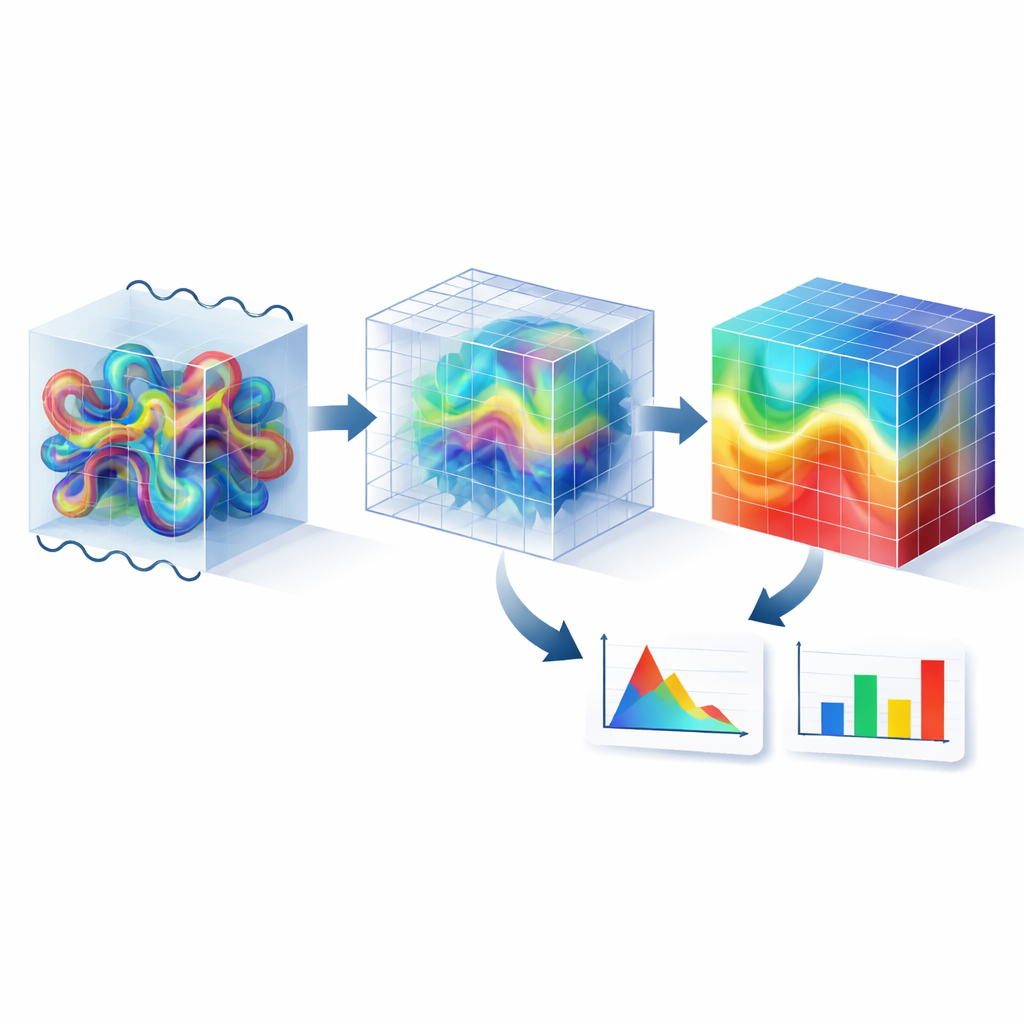
Raw outputs from high-end simulations are not easy to handle. They often live on irregular computational grids and in specialized file formats that require expert software and substantial computing power. To lower this barrier, the authors provide a Python-based interpolation tool that converts the original simulation data onto uniform, evenly spaced grids—formats that are compatible with common visualization software and modern machine learning libraries. In practical terms, this means that a researcher can download the dataset, run the supplied script, and immediately work with neatly structured three-dimensional fields, rather than wrestling with numerical details. The dataset also includes carefully documented metadata so that users can precisely reproduce how each case was set up.
Checking the Physics Behind the Numbers
High-resolution data are only useful if they faithfully represent the underlying physics. The authors therefore carried out a series of checks to validate their simulations. They compared average flow profiles and the distribution of turbulent energy across different length scales against well-established reference results from earlier studies. They also examined the energy budget of the flow, checking whether the simulated energy input, transfer, and loss balanced in the way theory predicts. In a few of the most demanding cases, the smallest turbulent motions were not fully resolved, leading to a slight underestimate of how quickly energy is dissipated. The team quantified this shortfall and introduced a simple correction factor so that users can account for it when using the data to calibrate models.
Why This Dataset Matters for the Future
Modern turbulence models, including those used in industry and weather prediction, still struggle to describe flows like Kolmogorov flow, where the overall size of the domain strongly constrains the turbulent structures that can form. By covering a wide spread of flow conditions in a carefully curated and openly shared database, this work offers a demanding testbed for improving those models. The same data have already helped inspire a new, geometry-aware turbulence model that better respects how the size of the system limits turbulence. For non-specialists, the key message is that this dataset is a building block: it gives researchers a clean, well-understood playground in which to train and test new ideas, potentially leading to more reliable simulations of everything from wind farms to jet engines.
Citation: Andrea Kovács, K., Balogh, M. & Kristóf, G. Direct numerical simulation of three-dimensional Kolmogorov flow for turbulence model development. Sci Data 13, 533 (2026). https://doi.org/10.1038/s41597-026-06899-9
Keywords: turbulence, Kolmogorov flow, direct numerical simulation, computational fluid dynamics, machine learning models