Clear Sky Science · en
Exploring curiosity, interest, and surprise: normative ratings of a magic trick video dataset in Italy
Why Magic Tricks Matter for the Mind
Most people enjoy the feeling of being baffled by a good magic trick. That brief moment of “How did they do that?” is more than just fun—it reveals how our minds handle gaps in what we know. This study uses magic tricks to explore three closely related feelings that shape how we learn: curiosity, interest, and surprise. By carefully measuring how hundreds of Italian adults react to short magic videos, the researchers created a rich public dataset that can help scientists, teachers, and clinicians better understand how these emotions support memory, attention, and lifelong learning.
The Feelings Behind Wanting to Know More
Curiosity, interest, and surprise are called “epistemic emotions” because they are tied to knowledge and understanding. Curiosity pushes us to close an “information gap” when we sense we are missing an important piece of the puzzle. Interest keeps our attention on something meaningful over time, turning brief engagement into deeper, long-lasting involvement. Surprise appears when reality does not match what we expected, forcing us to rethink what we thought we knew. Together, these emotions sharpen our focus, encourage us to explore, and help stamp new experiences into memory. Brain research shows that they trigger reward and memory systems, linking the pleasure of discovery with better learning.
Why Magic Is a Powerful Tool
Studying these emotions in the lab is tricky: researchers need stimuli that are controlled and repeatable, yet still feel natural and engaging. Earlier approaches relied on puzzles, ambiguous images, and trivia questions to spark curiosity or surprise. While useful, these methods often targeted just one emotion at a time and did not fully capture the rich mix of feelings we experience in real life. Magic tricks are different. They create a sharp clash between what we expect and what we see, prompting viewers to search for hidden causes. The Magic Curiosity Arousing Tricks (MagicCATs) collection harnesses this power in 166 carefully filmed video clips, all standardized in length, style, and framing but varied in materials and techniques. This makes them ideal for repeatedly studying how curiosity, interest, and surprise unfold together.

Building an Italian Benchmark
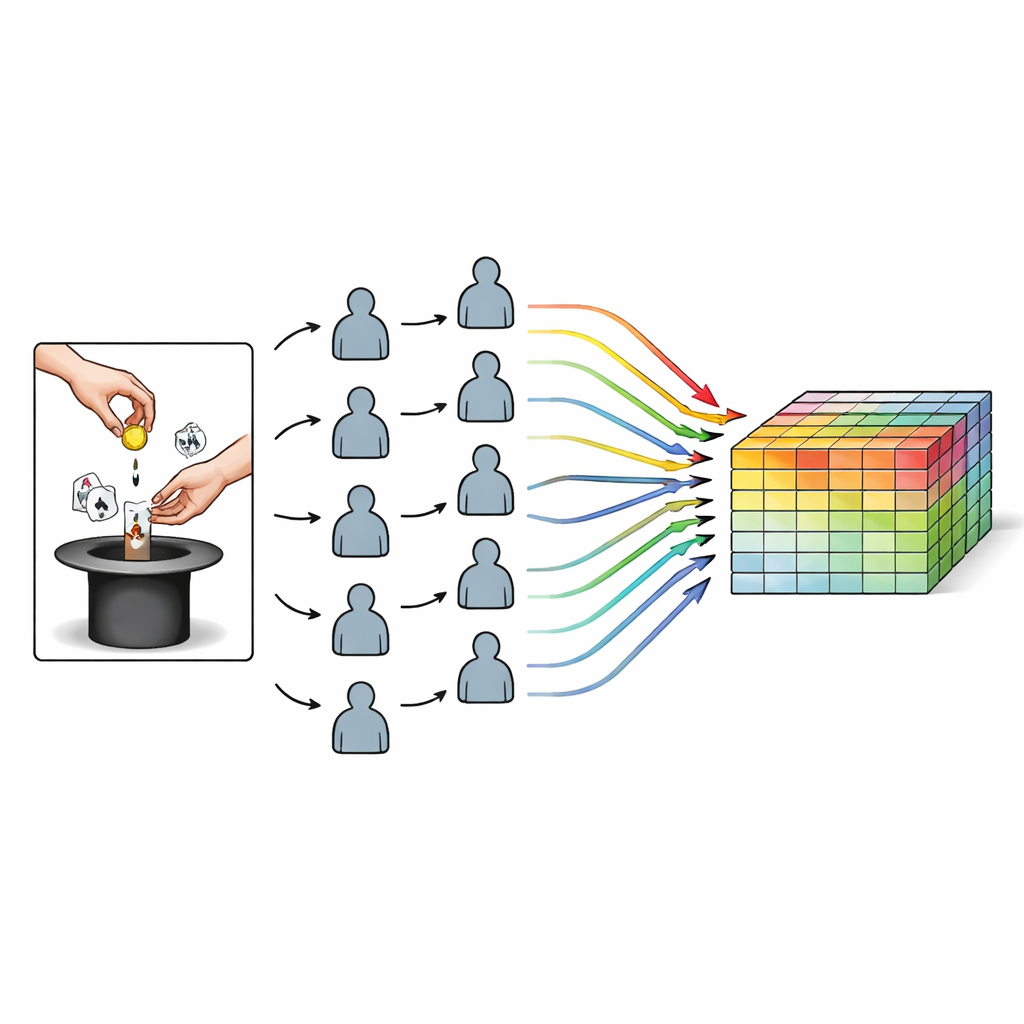
To make MagicCATs more widely useful, the authors gathered detailed ratings from 654 adults in Italy, aged 18 to 86. Participants watched subsets of the magic videos and rated each one on how clear the trick seemed, how surprising and interesting it was, how confident they felt about guessing the method, and how curious they were about the solution. Clarity was noted with a simple yes/no response, while the other feelings were scored on a 10-point scale. The researchers carefully screened out incomplete, inconsistent, or suspicious response patterns to ensure that the remaining data were reliable. English subtitles in the original videos were translated into Italian, but the visual content and editing were otherwise preserved, allowing future studies to compare responses across cultures.
From Individual Reactions to a Shared Resource
The final dataset, shared openly on an online repository, includes several linked files: demographics for each participant, detailed information about every magic trick, how clips were grouped into viewing lists, and the average ratings and variability for all five dimensions. Each video thus comes with a kind of “emotional profile” in the Italian context—researchers can quickly select tricks that are, for example, highly surprising but only moderately clear, or that reliably spark strong curiosity. The standardized design and careful documentation make it easy to replicate experiments or design new ones that combine magic videos with brain imaging, eye tracking, or educational tasks.
New Paths for Learning, Aging, and Well-Being
By anchoring MagicCATs in a well-described Italian sample, this work turns a clever idea—using magic tricks to study the mind—into a robust tool for many fields. Scientists can now explore how these emotions interact during learning, how they change with age, and how they might support mental health and resilience. Educators can draw on the findings to design lessons that harness curiosity and surprise to deepen understanding. In simple terms, this article shows that our love of being amazed is not just entertainment: when measured carefully, it becomes a window into how feeling intrigued, engaged, and astonished helps the brain learn and adapt throughout life.
Citation: Marascia, E., Di Crosta, A., La Malva, P. et al. Exploring curiosity, interest, and surprise: normative ratings of a magic trick video dataset in Italy. Sci Data 13, 578 (2026). https://doi.org/10.1038/s41597-026-06897-x
Keywords: curiosity, magic tricks, learning and memory, epistemic emotions, experimental psychology