Clear Sky Science · en
A dayside aurora dataset from the Global-scale Observations of the Limb and Disk mission
Lights in the Daytime Sky
Most people picture the northern lights as shimmering curtains across a dark, polar night. But auroras never actually turn off—they also glow on the sunlit side of Earth, hidden behind the glare of daytime. This study introduces a new, publicly available dataset that finally brings those elusive daytime auroras into focus, using a weather‑satellite‑like view of Earth and modern image‑processing techniques borrowed from computer vision and deep learning.
Watching Earth from a Fixed Window in Space
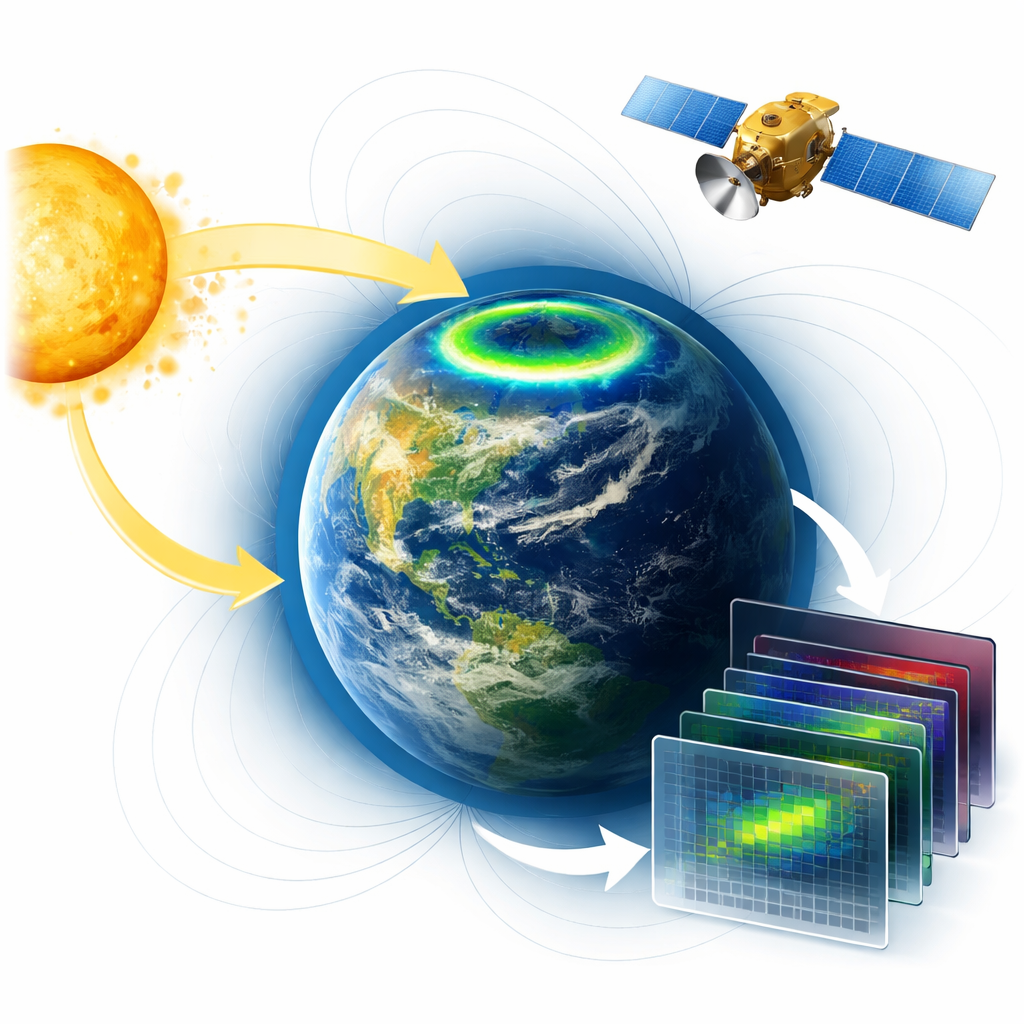
The data come from NASA’s GOLD mission, an instrument that has been circling Earth in geostationary orbit since 2018. From its fixed perch over the Americas and the Atlantic, GOLD stares continuously at the same half of the planet in far‑ultraviolet light, a band of wavelengths invisible to our eyes but ideal for tracking the energetic particles that create auroras. Whenever electrons from near‑Earth space crash into atoms and molecules high above the poles, they give off distinct ultraviolet colors. GOLD records these emissions in three such bands, providing repeated snapshots of the northern auroral region throughout the day over more than six and a half years.
Separating Faint Auroras from the Bright Day Sky
Seeing daytime auroras from space is hard because the upper atmosphere also glows under sunlight, producing a bright background known as dayglow. That glow can easily drown out the finer auroral patterns scientists care about. The authors turn this apparent obstacle into an advantage by using GOLD’s view of the Southern Hemisphere. For much of the mission, the far south within GOLD’s field of view is nearly free of auroras and is dominated by dayglow alone. By pairing southern images with northern ones taken under similar seasonal and lighting conditions, the team trains a neural‑network model to predict what the dayglow should look like, pixel by pixel, for any given observing geometry and level of geomagnetic activity.
From Raw Images to Clean Auroral Maps
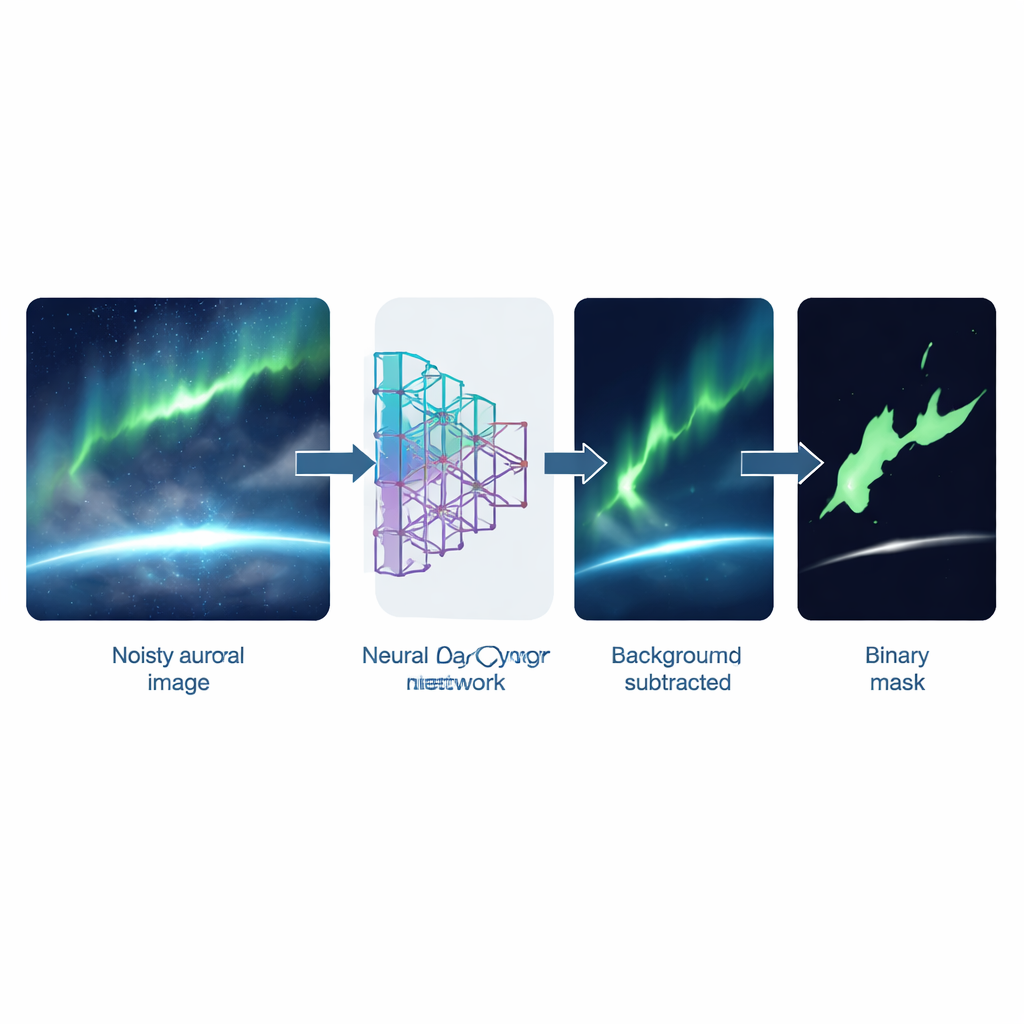
Armed with this trained model, the researchers estimate and subtract the dayglow from each northern scan, leaving behind only the extra light due to auroras. Even then, traces of non‑auroral signal remain, especially near the limb—the apparent edge—of the Earth’s disk. To refine the result, the team builds a multi‑step, classical image‑processing pipeline. They sharpen and filter the images to emphasize curved, ring‑like structures, cluster bright pixels into coherent patches at high latitudes and carefully distinguish true auroral arcs from look‑alike glows on the limb. This produces an initial set of binary “masks” that mark which pixels contain aurora and which do not for each spectral band.
Teaching a Neural Network to Spot Auroras
While this rule‑based method works well when GOLD scans Earth frequently, its assumptions begin to fail after the mission’s cadence slows in 2022. To ensure consistency across all years, the authors treat their classical masks from a high‑quality year as teaching material for a second neural network. This model learns to turn raw northern scans directly into auroral masks, without needing the intermediate boundary‑smoothing tricks. Tested against an independent, well‑established model of the global auroral oval, the deep‑learning approach slightly outperforms the classical method and behaves reliably across a wide range of space‑weather conditions.
A New Resource for Space‑Weather Watchers
The end result is a curated collection of more than 47,000 dayside aurora observations from 2018 to mid‑2025, all packaged in a format ready for scientific use. For each snapshot, users receive the raw ultraviolet images in three key colors, best estimates of the dayglow background and a clean map of where auroras are present, along with detailed timing and position information. By removing a major processing hurdle, this dataset opens the door for studies of how the daytime auroral zone shifts with the solar wind, for testing models that couple Earth’s magnetic environment to its upper atmosphere and for training future machine‑learning systems to forecast space‑weather impacts that can affect power grids, radio links and satellites.
Citation: Holmes, J., England, S.L. A dayside aurora dataset from the Global-scale Observations of the Limb and Disk mission. Sci Data 13, 481 (2026). https://doi.org/10.1038/s41597-026-06884-2
Keywords: aurora, space weather, GOLD mission, satellite imaging, deep learning