Clear Sky Science · en
Database for Prevalence and Determinants of Frailty in the Elderly with Quantifying Functional Mobility
Why walking speed matters as we age
Many people think of aging in terms of wrinkles or gray hair, but one of the most important changes happens in how we move. A growing body of research shows that subtle changes in the way older adults walk can signal a vulnerable state called frailty, which raises the risk of falls, hospital stays, and loss of independence. This article presents FRAILPOL, a large open database from Poland that links how older people move during a simple chair‑stand‑and‑walk test to their overall health, creating a resource that could power early warning tools built into everyday devices like watches and phones.
A simple test with a big message
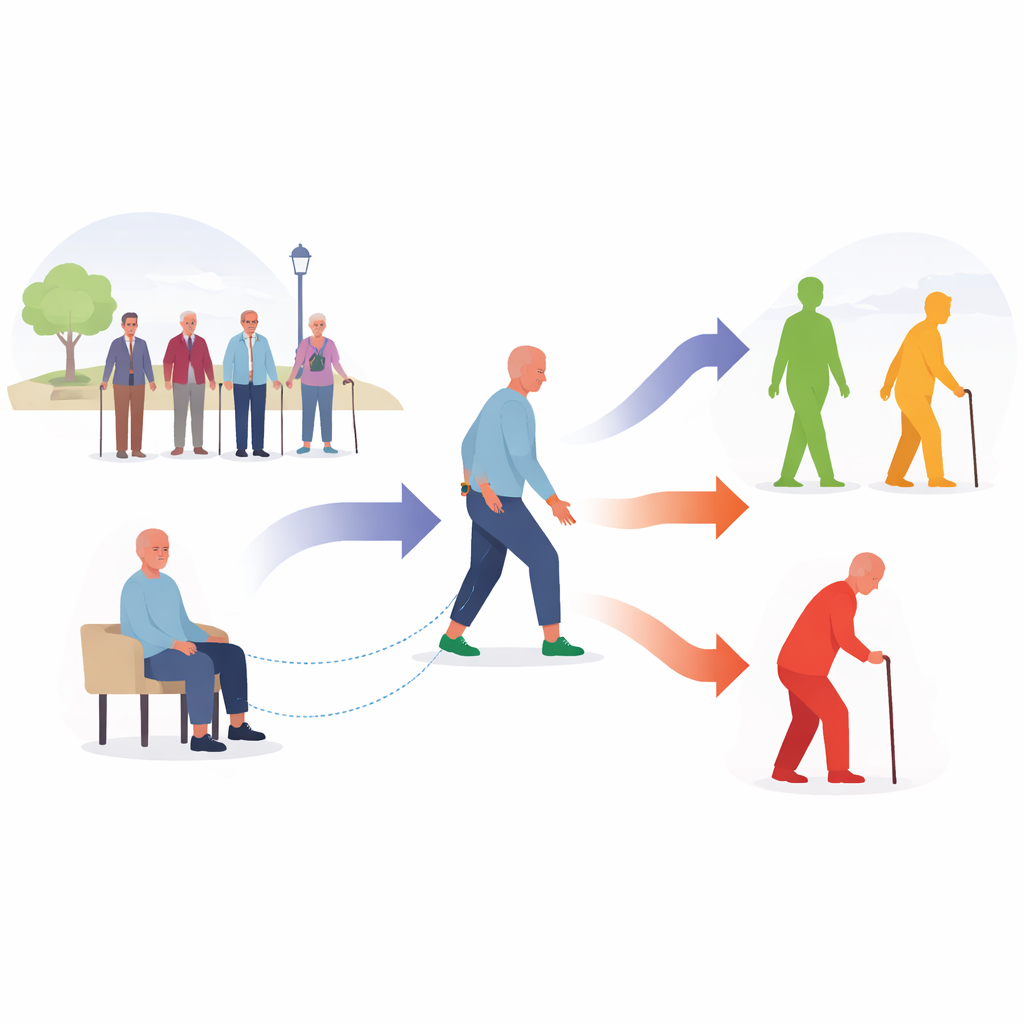
The heart of the study is a common check called the Timed Up and Go (TUG) test. In it, a person stands up from a chair, walks three meters, turns around a marker, and sits down again. For 668 community‑dwelling older adults, mostly in their early seventies but ranging from 61 to 99, the researchers did much more than time the test with a stopwatch. Each participant wore five small motion sensors—on both wrists, both ankles, and the lower back—while also answering questions about weight loss, tiredness, physical activity, and grip strength. Combined with a brief memory and thinking check, these data allowed the team to sort people into three groups: robust, pre‑frail, and frail.
From raw motion to meaningful patterns
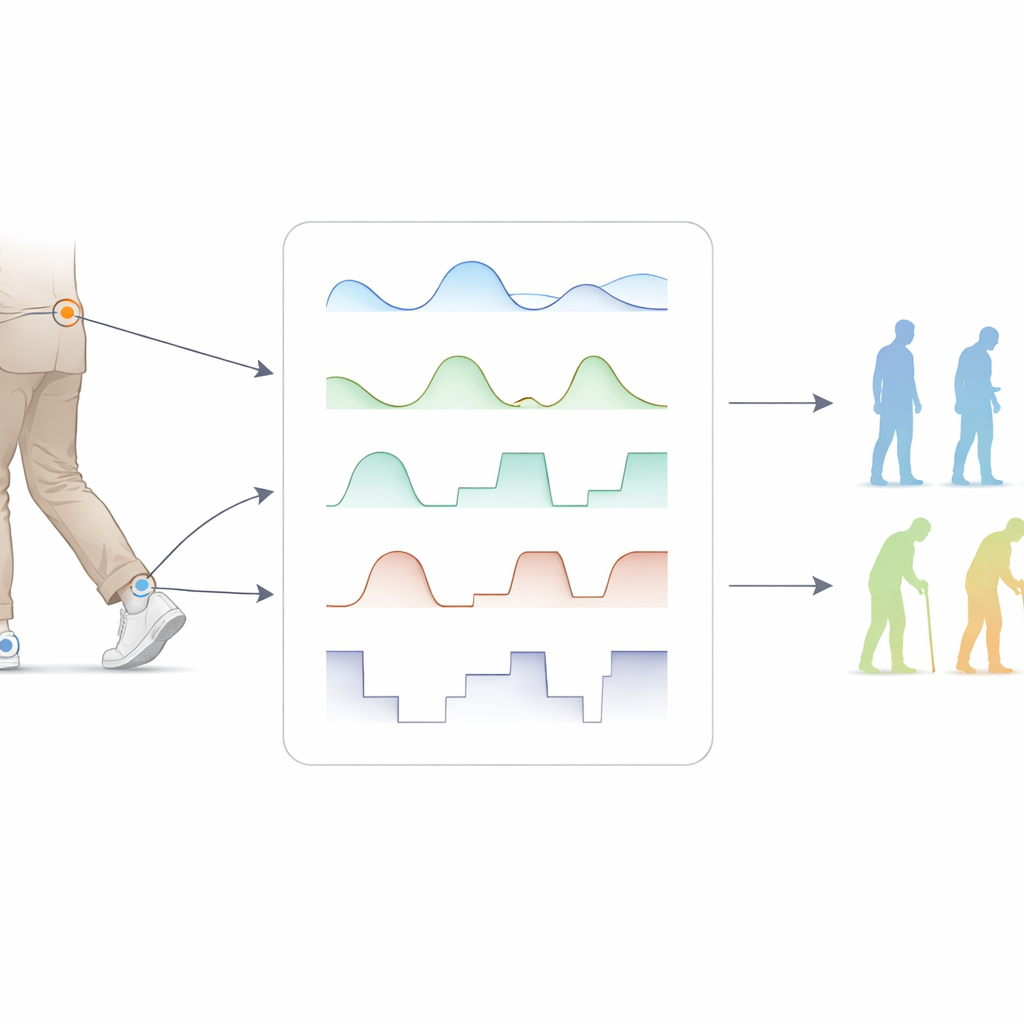
Motion sensors record tiny jolts and rotations dozens of times per second, far too detailed for a clinician to inspect by eye. The FRAILPOL team built a processing pipeline that focuses on the feet, where walking patterns show up most clearly. They converted the ankle sensor readings into a standard frame aligned with the foot, then used a pattern‑matching method to slice the continuous signal into individual strides—heel‑strike to heel‑strike. For each person, they calculated how many strides were taken, how long each stride lasted, how much time the foot spent in the air or on the ground, how far it traveled, how high it lifted, and how fast the person effectively moved forward.
What walking reveals about vulnerability
When these stride‑by‑stride measures were compared across health groups, a clear picture emerged. Robust older adults tended to take more steps with shorter stride times, reflecting quicker, more confident walking. Frail individuals showed the opposite pattern: fewer, slower strides, shorter step lengths, and lower overall walking speed, consistent with reduced mobility and greater fall risk. Those in the pre‑frail group fell in between, suggesting a transitional stage where the body is still compensating, but reserves are slipping. Overall TUG times in the study—around 8 seconds for robust people and over 15 seconds for frail ones—lined up well with cutoffs used worldwide to flag high fall risk, reinforcing that the sensor‑based measures are capturing real functional change.
Teaching machines to spot early warning signs
To show how the database could support automated screening, the authors trained several standard machine‑learning models on the gait features to predict who was robust, pre‑frail, or frail. Using only ankle‑based measures, the best models correctly separated robust from frail participants in about seven out of ten cases, and did reasonably well at distinguishing the three health stages, despite having far fewer examples of the frail group. These results are not yet accurate enough for clinical decisions on their own, but they provide a solid benchmark and highlight key challenges, such as dealing with imbalanced data and the difficulty of catching the earliest, most subtle signs of decline.
What this means for everyday life
For non‑specialists, the take‑home message is that how an older person walks over just a few meters can reveal a great deal about their overall resilience. FRAILPOL turns this insight into a public resource: a carefully curated, openly shared collection of sensor data, health measures, and frailty labels. By making it available to researchers worldwide, the project lays the groundwork for future tools that could quietly monitor gait through wearables, flag emerging problems while people still feel well, and guide exercises or other steps to keep them independent longer.
Citation: Szczȩsna, A., Amjad, A., Błaszczyszyn, M. et al. Database for Prevalence and Determinants of Frailty in the Elderly with Quantifying Functional Mobility. Sci Data 13, 478 (2026). https://doi.org/10.1038/s41597-026-06854-8
Keywords: frailty, gait, wearable sensors, older adults, machine learning