Clear Sky Science · en
CzechLynx: A Dataset for Individual Identification and Pose Estimation of the Eurasian Lynx
Why this matters for wildlife and technology
The Eurasian lynx is one of Europe’s most secretive big cats, roaming vast forest landscapes at very low densities. Tracking how many lynx there are, where they move, and how their populations change over time is crucial for conservation—but sorting through hundreds of thousands of camera‑trap photos by hand is slow and error‑prone. This paper introduces CzechLynx, a large, openly available collection of lynx images designed not just for biologists, but also for computer scientists who build image‑analysis tools. By linking wildlife monitoring to modern artificial intelligence, the dataset aims to make it far easier to protect these elusive predators.
A long look at shy cats in wild forests
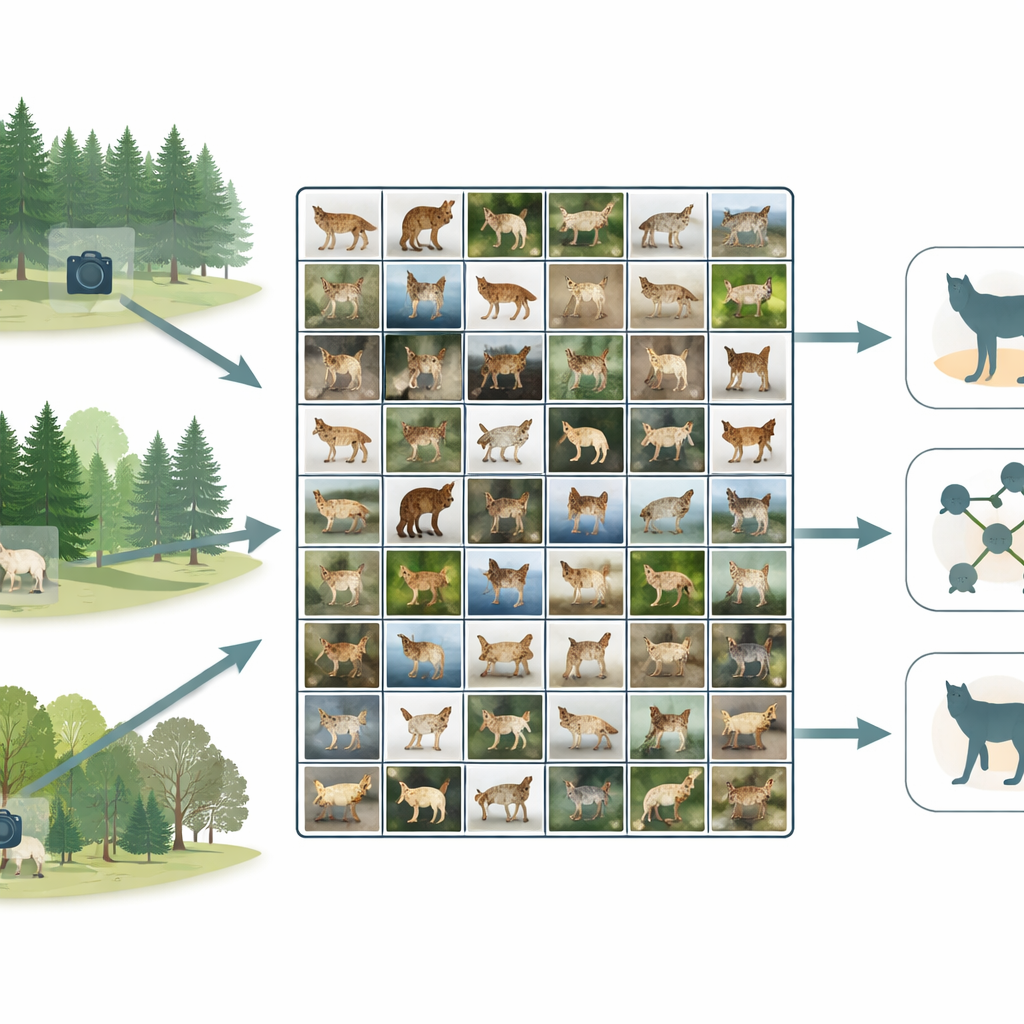
CzechLynx brings together 39,760 photographs of Eurasian lynx collected over more than 15 years from camera traps in two Central European regions: southwest Bohemia and the Western Carpathians. These are rugged, mostly forested areas where lynx live at very low densities and can travel across many hundreds of square kilometers. Conservation groups and park authorities placed cameras along forest roads, game trails, and scent‑marking sites, often using systematic grids to ensure broad coverage. Every image in the dataset went through careful screening: empty frames and pictures with people or vehicles were removed, then teams of experts used the lynx’s unique coat patterns to confirm which individual animal appeared in each photo.
Cleaning, choosing, and labeling the images
Many cameras recorded short video clips rather than single photos, which could have produced huge numbers of nearly identical frames. To keep the dataset manageable and informative, the authors used an automated detector to find the frames where an animal appeared clearly, then selected only up to three representative images from each encounter. These chosen shots favor full‑body, side‑on views where the spot patterns are visible and the animal is close enough for fine details. Human annotators then added several layers of information: precise outlines of each lynx’s body, a set of up to 20 keypoints marking joints and facial landmarks, and descriptive tags such as which side of the animal is visible. Semi‑automatic tools—modern segmentation and pose‑estimation models—were used to draft these labels, which were then checked and refined by people.
Building a digital twin of the lynx
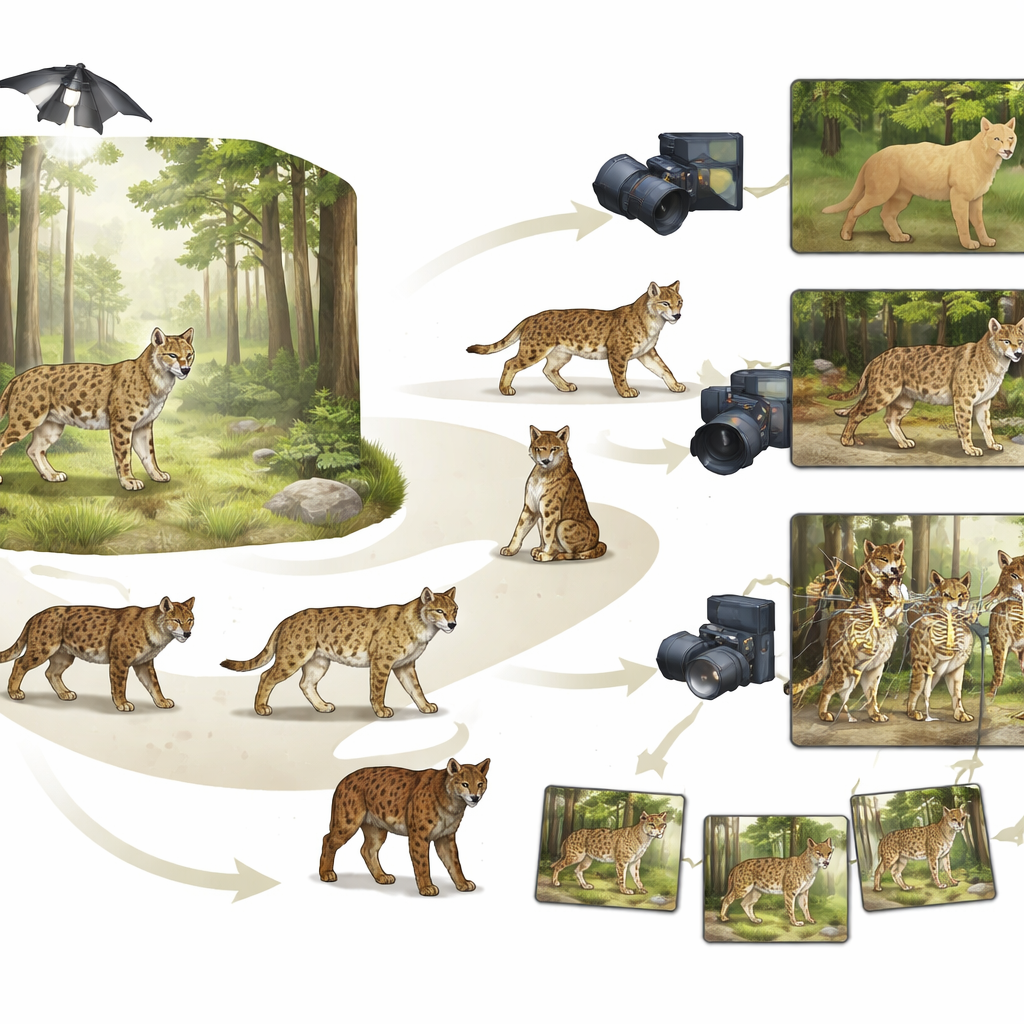
Real camera‑trap data, though rich, has limits: rare poses, unusual lighting, and some coat patterns simply do not appear often enough to fully train and test advanced algorithms. To fill these gaps, the team created a synthetic counterpart to the real images. Using the Unity game engine, they placed a detailed 3D lynx model into photorealistic virtual forest scenes inspired by actual camera‑trap locations. The virtual animal follows paths through these scenes, pauses at random points, and is viewed from different camera angles under varying light and weather. To simulate many distinct individuals, the researchers generated hundreds of different fur textures using a text‑driven image‑synthesis method, producing a wide range of natural‑looking spot and stripe patterns. Each rendered frame automatically comes with perfect knowledge of the lynx’s outline, skeleton, and identity.
Testing computer vision under real‑world conditions
The dataset is organized around three key tasks: telling individual lynx apart, estimating their body pose, and separating them from the background. A single, consistent table of metadata links each image to its identity, time and place, viewpoint, and task‑specific splits. To mimic realistic conservation challenges, the authors define several evaluation schemes. In a “geo‑aware” setting, models are trained on one region and tested on another, probing how well they transfer to new landscapes. In “time‑aware” settings, training and test images are separated by seasons and years, so that algorithms must cope with animals aging, changing appearance, or being joined by new individuals. These carefully designed splits help avoid subtle data leakage and offer a tough, realistic benchmark for future methods.
What this means for saving lynx
At its core, CzechLynx turns years of painstaking fieldwork into a shared resource for the broader research community. By pairing expertly verified real photos with lifelike synthetic images and detailed annotations, the dataset gives computer‑vision systems everything they need to learn how to detect, track, and recognize individual lynx over long times and across distant regions. For conservationists, more reliable automated tools could mean faster updates on population size, survival, and movement—all vital for spotting trouble early, targeting protections, and supporting the long‑term recovery of one of Europe’s iconic wild cats.
Citation: Picek, L., Straka, J., Jirik, M. et al. CzechLynx: A Dataset for Individual Identification and Pose Estimation of the Eurasian Lynx. Sci Data 13, 511 (2026). https://doi.org/10.1038/s41597-026-06853-9
Keywords: Eurasian lynx, camera traps, wildlife monitoring, computer vision, synthetic data