Clear Sky Science · en
One-Legged Stand Test: Synchronized Motion Capture, Force Plate, and Radar Dataset for Fall-Risk
Why Standing on One Leg Matters
For many older adults, a simple misstep can lead to a serious fall, with consequences ranging from broken bones to loss of independence. Doctors often use a quick test—standing on one leg—to gauge balance and fall risk. This article describes a rich new database built around that familiar test, combining precise measurements of body motion, pressure under the feet, and radar signals. The goal is to give scientists and engineers the raw material they need to design better tools to spot balance problems early, ideally long before a dangerous fall occurs.
A Simple Test with Hidden Depth
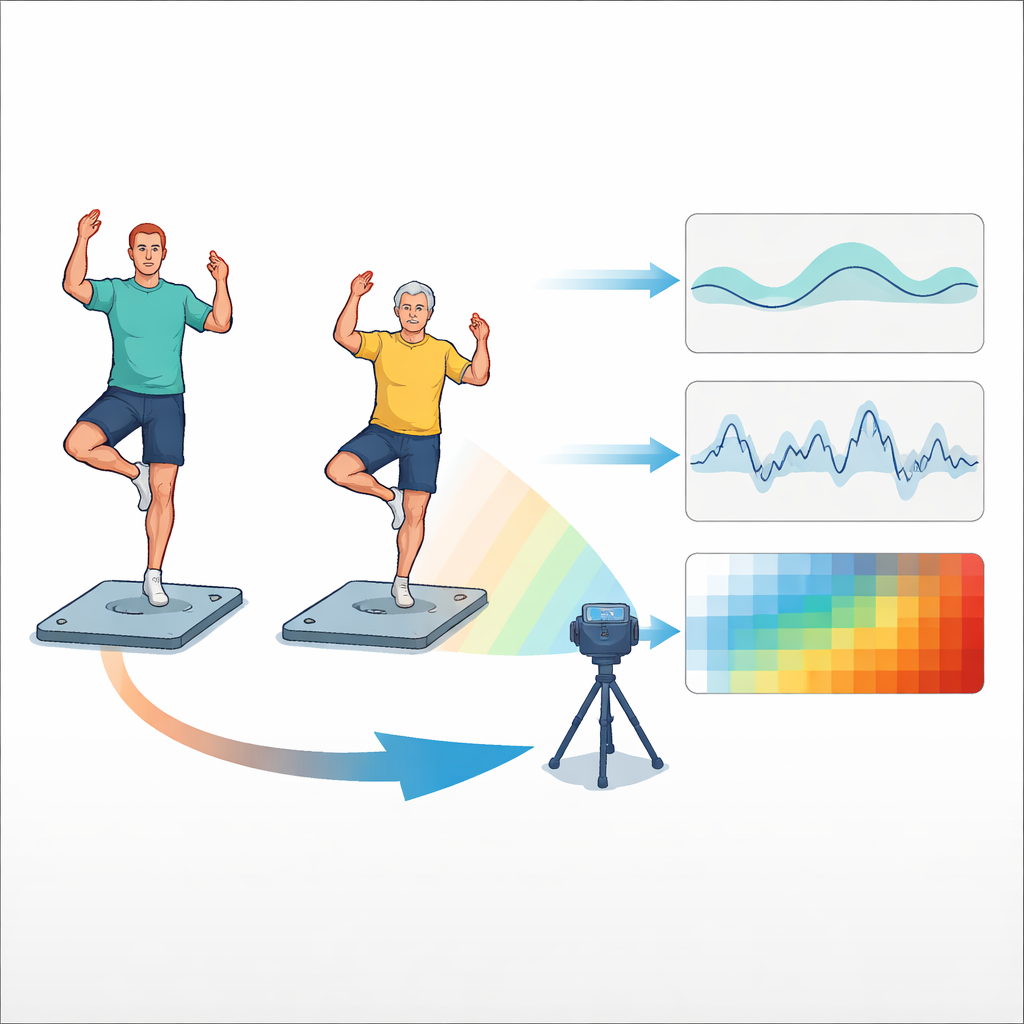
The one-legged stand test asks a person to lift one foot and hold a steady pose on the other. Shorter hold times have been linked to higher chances of falling and even higher mortality. Yet, time alone does not explain how someone maintains balance or begins to lose it. The researchers behind this work focused on uncovering those hidden details. They recorded 32 healthy volunteers, split into a younger group (18–32 years) and an older group (64 years and up), as they repeatedly performed a tree-pose style one-legged stance. By looking not just at how long each person could stand, but also at every tiny sway and adjustment, the dataset opens the door to a much deeper understanding of balance.
Three Ways of Watching the Same Move
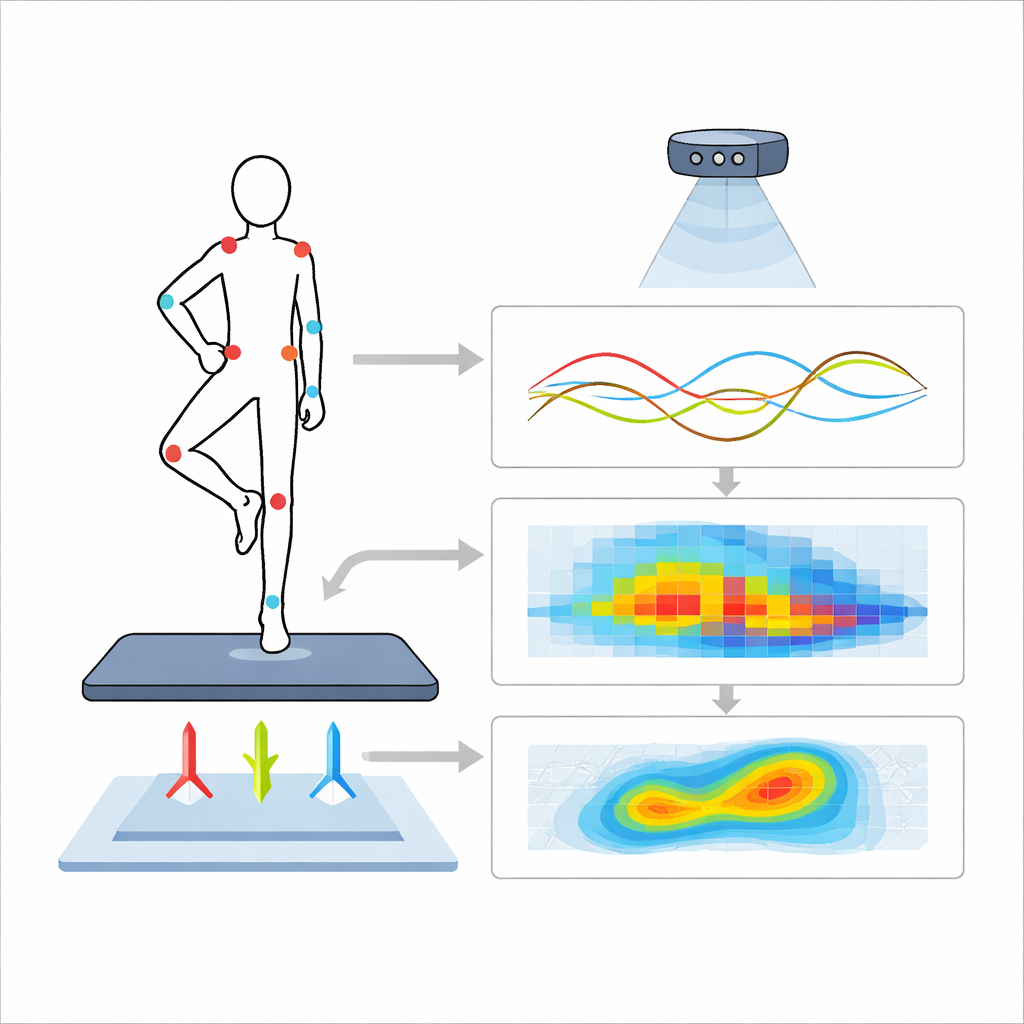
The team used three different instruments at the same time. First, a motion capture system, similar to those used in movie studios, tracked 18 reflective markers on major joints such as ankles, knees, hips, shoulders, and wrists. This created a three-dimensional record of how each part of the body moved during the test. Second, two force plates—one under each foot—measured how hard and where the feet pressed into the ground, capturing subtle shifts in weight and stance. Third, a small radar unit placed several meters away sent out radio waves and measured the reflected signals as the person swayed and moved. Radar can do this without cameras or body-worn devices, making it attractive for private, at-home monitoring.
Turning Raw Motion into Meaningful Events
To make the data useful, the researchers broke each attempt into key moments: standing on two legs, lifting the test foot, reaching a stable one-legged stance, beginning to lose that stability, and finally placing the foot back down. Force plate data revealed when the lifted foot left or touched the ground. Motion capture data, especially the angle of the lifted knee, showed when a person had truly settled into a steady pose and when that steadiness began to break down. Every detected event was checked by hand against video to ensure accuracy. The radar signals were then processed into “range–Doppler maps,” which show where the person is and how fast different parts of the body are moving, frame by frame. All three data streams were time-aligned using a moving reflective target, so that a given instant in one sensor matches that same instant in all others.
A Public Resource for Future Fall-Prevention Tools
The finished dataset, now freely available on a public research platform, is carefully organized by participant and trial. It includes raw and processed files, a table listing every one-legged stand attempt and its key moments, and example computer code to help new users get started. While there are some limitations—such as missing trials for one participant and long-duration tests only in the older group—the collection still offers a rare, detailed view of how people of different ages manage to balance on one leg.
From Lab Measurements to Everyday Safety
At its heart, this work is about turning a basic clinic test into a launchpad for smarter fall-prevention technologies. By pairing gold-standard lab tools with privacy-friendly radar, the dataset lets researchers compare established and emerging methods side by side. In plain terms, it helps connect what happens inside a biomechanics lab with what might one day happen in a living room or senior housing unit. If scientists can learn to read early warning signs of instability in these rich signals, future systems could quietly watch over older adults, flagging rising fall risk before a dangerous tumble ever occurs.
Citation: Copeland, D., Zhang, X., Linton, E. et al. One-Legged Stand Test: Synchronized Motion Capture, Force Plate, and Radar Dataset for Fall-Risk. Sci Data 13, 518 (2026). https://doi.org/10.1038/s41597-026-06831-1
Keywords: fall risk, balance testing, one-legged stand, radar sensing, motion capture