Clear Sky Science · en
Muscle Proteomic Dataset of A Threatened Indian walking catfish, Clarias magur (Hamilton 1822) Exposed to Thermal Stress
Why warming waters matter for farmed fish
As climate change pushes water temperatures higher and makes heat waves more common, farmed fish are on the front lines. Warm‑water species like the Indian walking catfish help feed millions of people in South Asia, yet we still know little about how their bodies cope with long stretches of heat. This article does not present a single striking experiment or cure; instead, it delivers something just as valuable for future discoveries: a carefully built, openly shared map of the proteins in catfish muscle under normal and long‑term warm conditions.
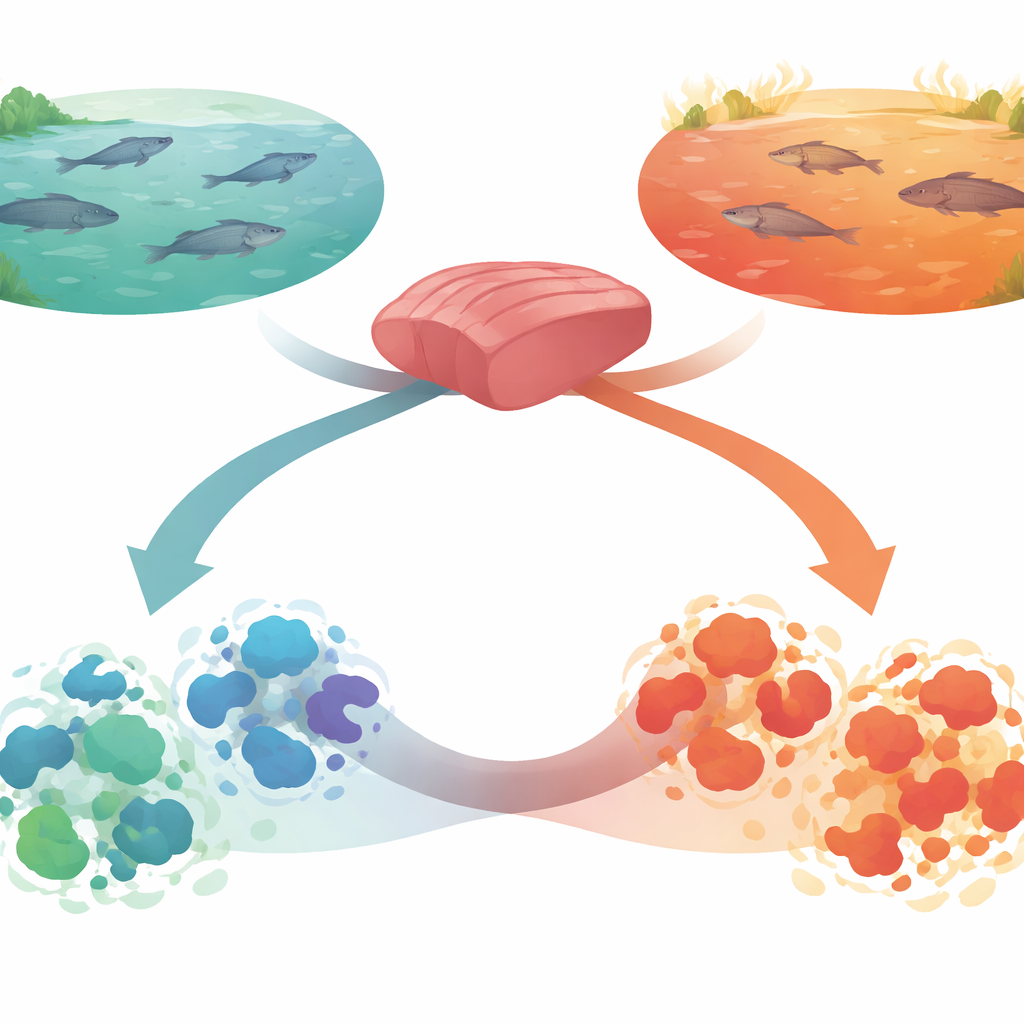
Taking a closer look inside catfish muscle
The researchers focused on Clarias magur, a hardy catfish prized in aquaculture for its ability to survive low‑oxygen and crowded ponds. They wanted to document, in detail, which muscle proteins are present when fish live at their usual temperature and how that protein pattern shifts when the animals endure sustained warmth that is stressful but not immediately lethal. Muscle is central to growth, swimming, and meat quality, so understanding its molecular makeup can eventually help breeders and farmers select fish that grow well and stay healthy as waters warm.
How the fish were raised and tested
Juvenile catfish were first acclimated in tanks at a comfortable 26 °C. One group remained at this temperature as a control, while another group was warmed gradually, one degree per day, up to 37 °C, then kept at this higher temperature for two full months. Throughout the trial, the team closely tracked feeding, body weight, behavior, and water quality, including oxygen, ammonia, and pH. This slow, controlled heating is similar to what fish may experience during prolonged hot spells in nature and farms. After the exposure period, the fish were humanely euthanized and muscle samples were frozen for later analysis.
Turning tissue into a protein catalogue
To see which proteins were present, the scientists used modern mass spectrometry, a technique that breaks proteins into fragments and measures their masses with high precision. They extracted proteins from muscle, chemically prepared them, and digested them into smaller pieces, which were then separated on a special column and examined in a high‑resolution instrument. Because a complete reference protein list for this catfish does not yet exist, the team matched their measurements against a well‑curated database from zebrafish, a closely related species, while applying strict statistical checks to keep false hits very low. They also repeated the measurements in multiple biological samples and monitored instrument performance to ensure reliable results.

What the protein patterns reveal
The final dataset is large and nuanced. In total, 2,159 distinct proteins were detected in control fish and 1,880 in heat‑stressed fish, with 1,570 proteins shared between both groups. Some proteins appeared only in warmed fish, while others were found only in controls, hinting at molecular shifts that help catfish either cope with or succumb to long‑term warmth. Rather than drawing firm biological conclusions, the authors emphasize that this is a reference resource: it includes raw data files, processed protein lists, experimental details, and water‑quality logs, all deposited in a public repository where other scientists can reanalyze or reinterpret them.
Building a foundation for climate‑ready aquaculture
For non‑specialists, the key takeaway is that the study provides an open, reusable map of how a major farmed fish’s muscle proteins look under normal and prolonged warm conditions. This resource can be mined to hunt for biomarkers of heat tolerance, to compare with other fish species, or to support breeding programs aiming for strains that stay robust in hotter ponds. In a world where aquaculture must adapt quickly to climate change, such shared datasets give researchers a head start on understanding, and ultimately improving, the resilience and welfare of the fish that help feed us.
Citation: Singh, P.J., Batta, A. & Srivastava, S.K. Muscle Proteomic Dataset of A Threatened Indian walking catfish, Clarias magur (Hamilton 1822) Exposed to Thermal Stress. Sci Data 13, 461 (2026). https://doi.org/10.1038/s41597-026-06826-y
Keywords: aquaculture, heat stress, fish proteomics, climate change, Indian walking catfish