Clear Sky Science · en
MEETI: A Multimodal ECG Dataset from MIMIC-IV-ECG with Signals, Images, Features and Interpretations
Why this matters for heart health and everyday care
Every year, millions of people have their heart’s electrical activity recorded as squiggly lines called electrocardiograms, or ECGs. These tests help doctors spot dangerous rhythm problems and other heart conditions, but reading them is time‑consuming and requires years of training. At the same time, artificial intelligence has grown remarkably good at tasks like reading X‑rays and summarizing medical notes, yet similar progress for ECGs has been slower. This paper introduces MEETI, a new kind of ECG dataset that brings together several views of the same heart test—signals, images, numbers, and explanations—so computers can learn to “understand” ECGs in ways that make sense to both doctors and patients.
A new all‑in‑one view of the heartbeat
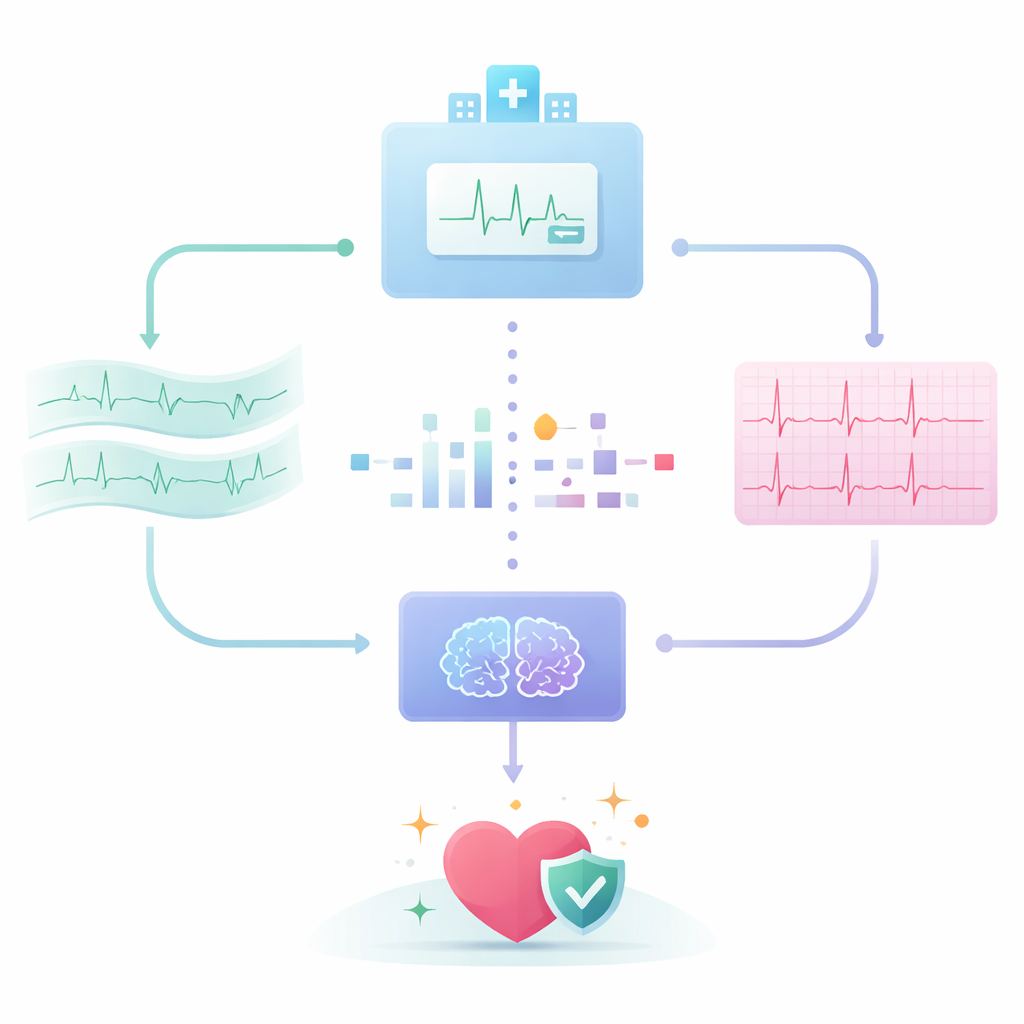
Traditional ECG databases usually offer just one type of information: either the raw electrical signal, an ECG image that looks like graph paper, or a short written report. MEETI (short for MIMIC‑IV‑Ext ECG‑Text‑Image) is the first large public resource to carefully line up four ingredients for each ECG: the original 10‑second signal from 12 leads, a high‑resolution image that mimics the printout in a hospital, a set of precise beat‑by‑beat measurements, and a detailed written interpretation generated by a modern language model. All of this is built on top of the large MIMIC‑IV‑ECG collection from a major US medical center, covering more than three‑quarters of a million ECG recordings from over 160,000 patients. By linking these pieces through shared identifiers, MEETI turns each ECG into a rich, multi‑layered portrait of heart activity.
How the team turned signals into rich data
To construct MEETI, the authors first downloaded and checked roughly 800,000 ECG records, ensuring that each one was properly anonymized and technically sound. Using open‑source tools, they rendered every 12‑lead signal into a standard clinical layout at high resolution, preserving the fine details that cardiologists rely on. Next, they ran each ECG through FeatureDB, a toolkit that automatically detects the familiar P, QRS, and T portions of every heartbeat. From this, the system calculates key measurements such as heart rate, the time between beats, how long different parts of the heartbeat last, and how tall or short specific waves are. These numbers are stored for every beat in every lead, giving an unusually detailed view of how a person’s heartbeat behaves over those 10 seconds.
Teaching language models to talk about heart rhythms
Short human‑written ECG reports are often vague and miss opportunities to spell out how a diagnosis relates to measurable features in the tracing. To fill this gap, the team designed careful prompts for a state‑of‑the‑art language model so it could generate long‑form, clinically grounded interpretations. For each ECG, the model receives both the original clinician report and the extracted parameters—such as sequences of QRS durations across multiple beats—and is instructed to stay faithful to the expert’s conclusions while using the measurements as evidence. Cardiologists helped design and review this process, confirming on sample cases that the resulting explanations capture the same findings as the original reports while weaving in concrete numbers. The result is a text description that connects what the eye sees on the graph to objective, reproducible measurements.
What is inside the resource and how it can be used
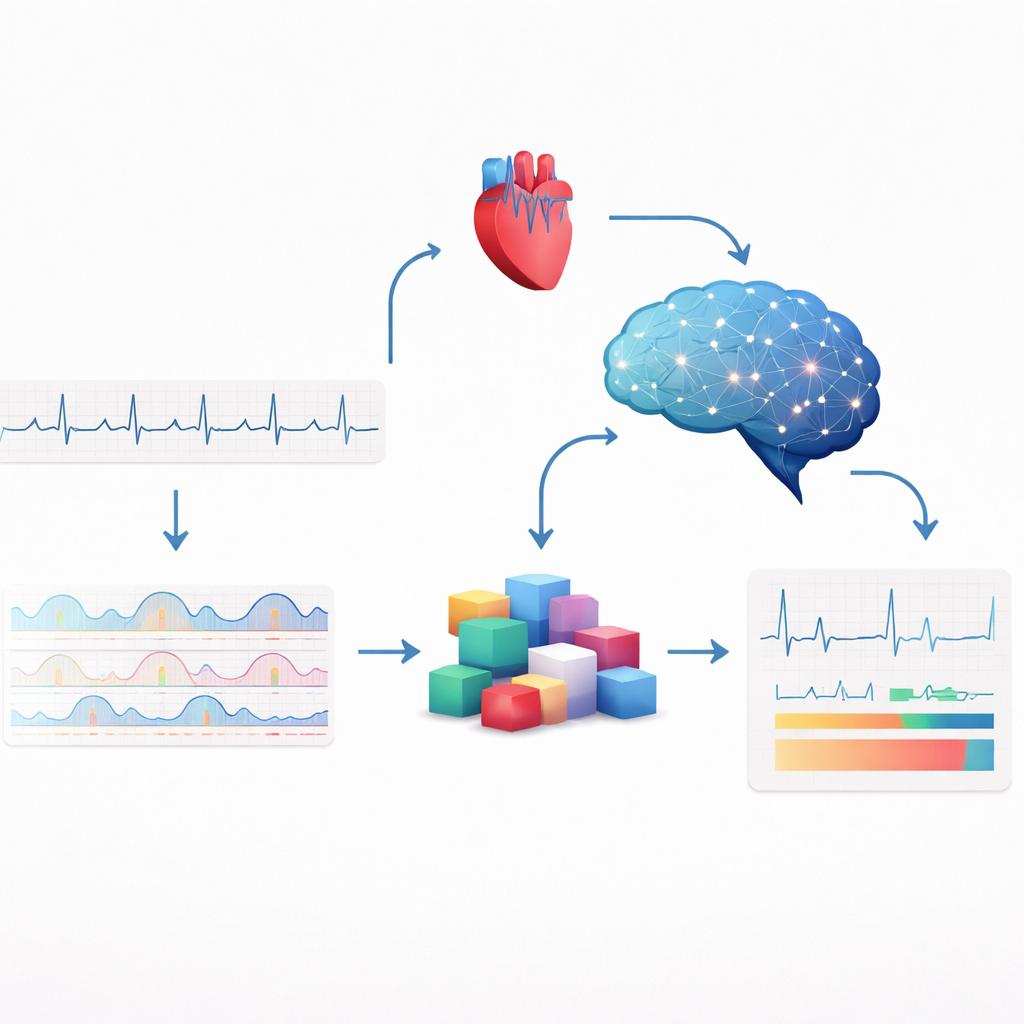
MEETI is organized so that researchers can easily navigate from a patient’s folder to all of their studies, and from each study to its matching image, signals, beat‑level parameters, and language‑model explanation. Summary statistics across the entire dataset show that key measurements, like the average time between beats or the length of the QRS complex, fall within expected clinical ranges and have almost no missing values, underscoring the dataset’s quality and completeness. The authors provide example code for loading the data and reading the images and text, and they release all scripts used for parameter extraction and image creation as open‑source tools. This structure allows scientists to train models that jointly analyze waveforms, images, and language, and to explore questions ranging from automatic rhythm classification to generating understandable reports for trainees and patients.
What this means for future heart‑smart AI
The authors conclude that MEETI removes a key bottleneck in building helpful, trustworthy AI for ECGs. By combining raw signals, clinical‑style images, fine‑grained measurements, and rich explanations in a single, public resource, the dataset makes it possible to train systems that do more than simply label a tracing as “normal” or “abnormal.” Instead, future models can be asked to reason about how specific changes in the waveform support a diagnosis, or to show which beats and leads drove their conclusions. For patients, this could eventually mean clearer reports and earlier detection of subtle problems; for clinicians, it offers tools that not only match expert performance but can also explain themselves. In short, MEETI lays the groundwork for the next generation of heart‑focused AI that sees, measures, and explains the heartbeat all at once.
Citation: Zhang, D., Lan, X., Geng, S. et al. MEETI: A Multimodal ECG Dataset from MIMIC-IV-ECG with Signals, Images, Features and Interpretations. Sci Data 13, 527 (2026). https://doi.org/10.1038/s41597-026-06796-1
Keywords: electrocardiogram dataset, multimodal medical AI, cardiovascular diagnostics, ECG interpretation, medical machine learning