Clear Sky Science · en
BODIES: BOdy shape parameter and 3D meshes of Individuals basEd on SUPR
Why digital body doubles matter
From trying on clothes online to training surgeons in virtual reality, many technologies now rely on realistic digital versions of our bodies. Yet building such detailed 3D avatars is still slow and tricky, especially when exact body shape and measurements really matter. This study introduces a large new dataset designed to make it easier for computers to reconstruct accurate human bodies from simple images, potentially improving everything from virtual fitting rooms to medical simulators. 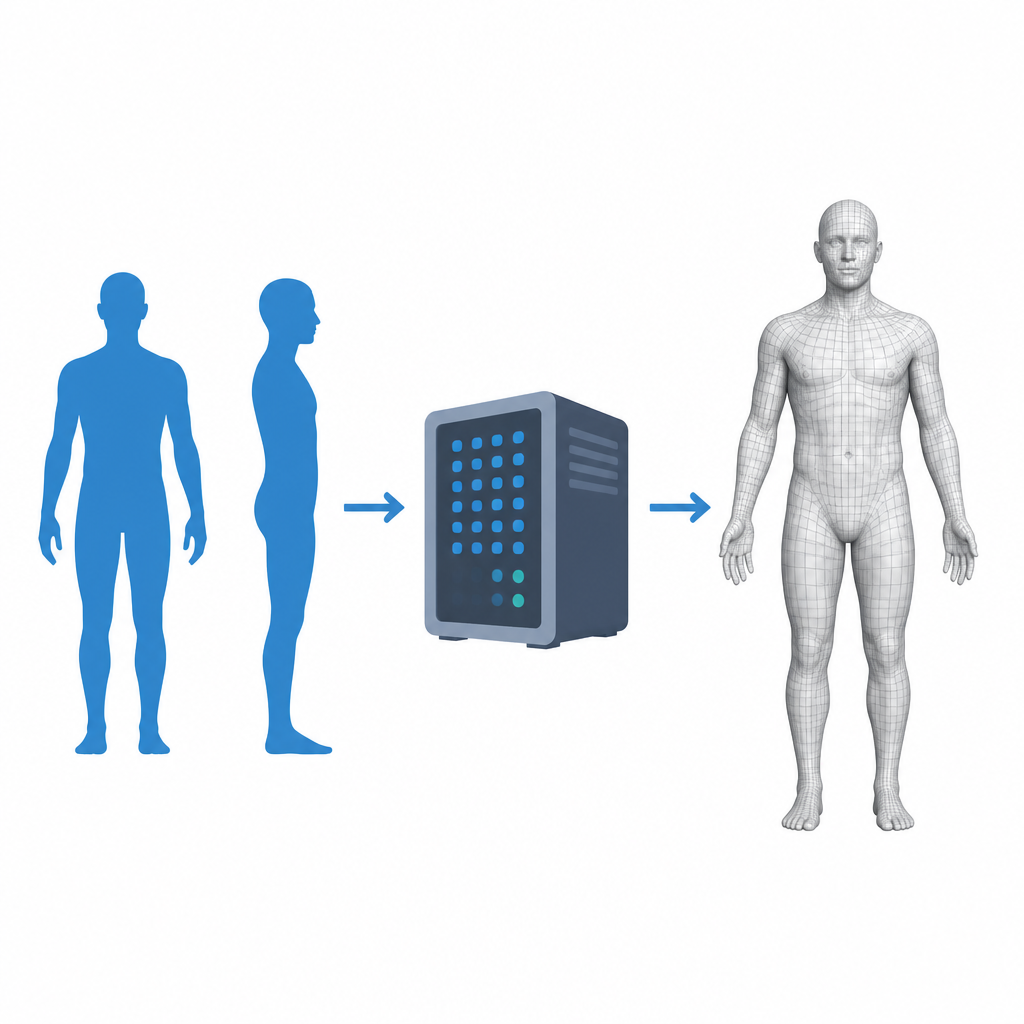
A new way to describe the human body
Most current systems for modeling people in 3D are built around a popular standard called SMPL, which treats the human body as a single deformable surface controlled by a limited set of numbers. While useful, SMPL struggles with fine details such as faces, hands, and feet, and it was trained on data that do not fully cover the huge variety of real human shapes. A newer model, called SUPR, represents the body in parts and was trained on over a million scans, including extreme body types and detailed records of head, hands, and feet. In principle, SUPR should capture human shape and motion more faithfully, but it has seen little use because there were no large, ready-to-use datasets built on it.
Building the BODIES dataset
To close this gap, the authors created BODIES, a synthetic collection of 84,000 digital subjects defined using the SUPR model. Each subject is described in a simple, neutral standing pose by a set of numerical values that control body shape, plus a 3D surface mesh and two images showing front and side views. The researchers generated separate male and female populations, gradually increasing how many shape values were used, from a compact description with 10 numbers up to a detailed one with 300. They drew these values from a bell-shaped statistical distribution similar to how height and weight are spread in real populations, then trimmed extremes to avoid impossible bodies. For every subject they stored the mesh, the shape values, computed height and weight, and standardized images, and they organized everything so other teams can plug the data directly into their own machine learning pipelines. 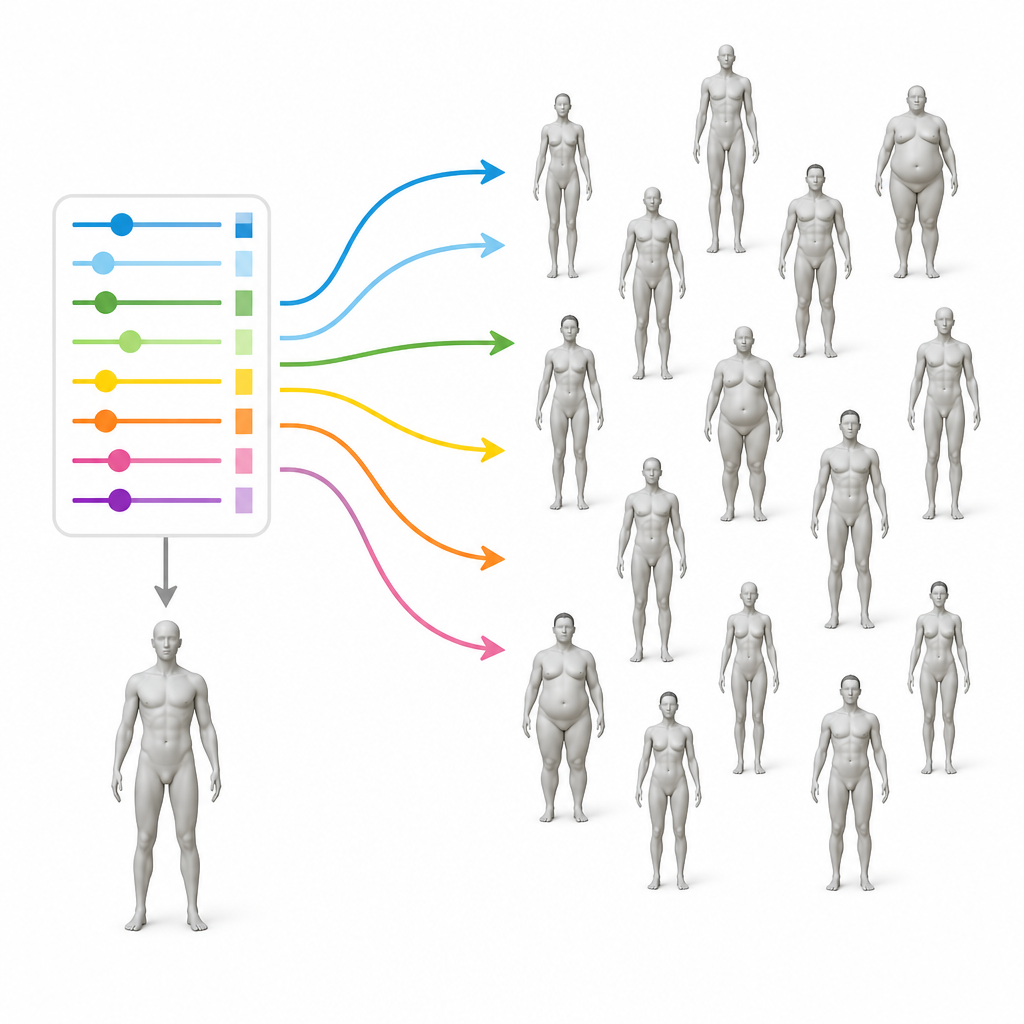
Testing how well the bodies are rebuilt
The team then asked whether using SUPR and the BODIES dataset actually improves the reconstruction of 3D bodies from images. They started from an existing three-part system: a module that cuts a person’s outline from front and side images, a module that compresses these outlines into compact visual features, and a final module that turns those features, plus height and weight, into body-shape numbers and a 3D mesh. The authors upgraded the image processing steps and adapted the system to work with SUPR instead of SMPL. In their first set of tests, they compared training this system on an older SMPL-based dataset versus on BODIES, then measured how far the reconstructed meshes were from the originals. Using BODIES and SUPR generally reduced errors, especially for female bodies, suggesting that the richer model and broader shape coverage help the system learn more accurate shapes.
How many shape details are helpful
Next the authors explored how the number of shape values affects performance. Intuitively, more numbers should let the system capture finer details, but they also make the prediction problem harder. By training and testing across versions of BODIES that used 10 up to 300 shape values, the researchers found that reconstruction errors tend to rise as the target description becomes more detailed. With only two silhouettes and a few measurements to rely on, the system struggles to pin down the many tiny adjustments allowed by hundreds of shape settings. However, when they looked at how well models trained with different levels of detail generalized across all versions of the dataset, those trained with an intermediate or higher number of shape values often struck a better balance, learning to represent subtle body features without overfitting too strongly to one narrow case.
From virtual people to real scans
Finally, the team tested how training on synthetic data carries over to real humans. They used carefully cleaned 3D scans of 34 people, generated front and side images, and asked models trained on either the older SMPL dataset or on BODIES to reconstruct these bodies. They evaluated accuracy by comparing heights, weights, and key circumferences, and also by asking volunteers to rate visual similarity. Overall, errors were larger than in purely synthetic tests, reflecting the jump from computer-generated shapes to messy reality. Still, models trained on BODIES often matched or outperformed the SMPL-trained ones, particularly for women, confirming that the SUPR-based dataset can better handle complex body forms even under real-world conditions.
What this means for future avatars
To a non-specialist, the main message is that this work supplies both a new rich library of digital bodies and evidence that a more detailed body model can improve how accurately machines reconstruct human shape. BODIES offers tens of thousands of standardized examples that developers can use to train systems behind virtual fitting rooms, realistic game and film characters, and patient-specific medical tools. While the study also shows the limits of inferring intricate body details from just two views, it points toward more faithful digital stand-ins that better match the size and proportions of real people.
Citation: Cannavò, A., Manigrasso, F., Moro, F. et al. BODIES: BOdy shape parameter and 3D meshes of Individuals basEd on SUPR. Sci Data 13, 736 (2026). https://doi.org/10.1038/s41597-026-06777-4
Keywords: 3D human body reconstruction, digital avatars, synthetic body dataset, virtual try on, body shape modeling