Clear Sky Science · en
An ambient acoustic ice-fracturing dataset taken in shallow freshwater
Listening to Cracks in Winter Ice
When a frozen lake groans, pops, or booms in winter, it is not just a curious sound for skaters and ice fishers—it is a window into how ice responds to weather and climate. This article presents a carefully collected week-long record of those sounds from a shallow freshwater lake in Michigan, turning everyday ice noises into a public scientific resource that can help researchers study changing winters, lake safety, and the physics of ice itself.
Why Cracking Ice Matters
Ice sheets on lakes and seas are more than seasonal scenery: they are vital for northern travel, fishing, and global shipping routes, and they are sensitive indicators of a warming climate. As temperatures and winds shift, the floating ice sheet flexes and breaks, releasing bursts of sound into the air, ice, and water. By "listening" to these fracture sounds, scientists can track how and when ice breaks up, infer how thick and strong it is, and understand the hidden ways that sound travels in cold, shallow waters. Until now, however, most detailed acoustic records have come from remote, expensive ocean expeditions; high-quality data from simpler, inland lakes have been rare.
A Week of Listening on a Frozen Lake
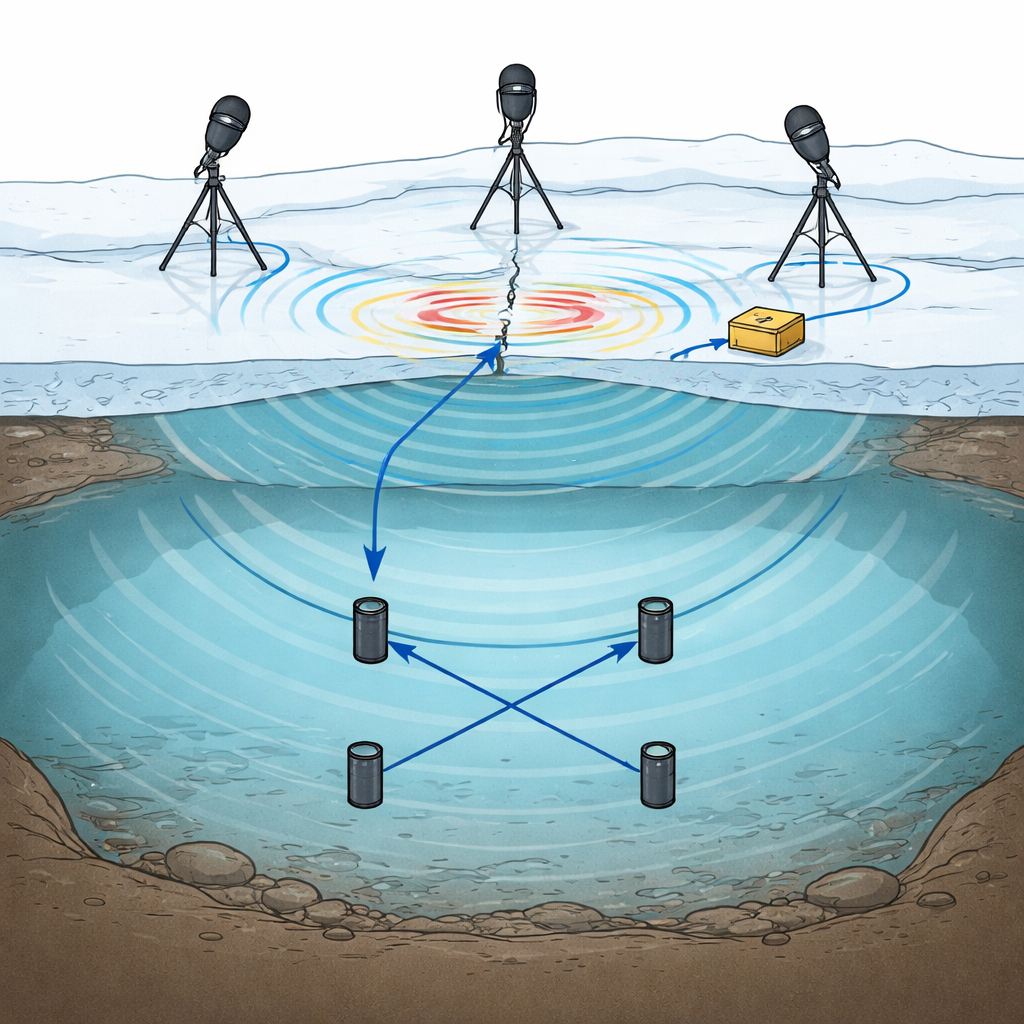
The authors set up their experiment on Portage Lake in Michigan’s Upper Peninsula during late February and early March of 2024, when the lake was covered by a stable sheet of ice near the shore. They deployed three kinds of sensors: microphones in the air above the ice, geophones resting on the ice surface, and hydrophones suspended below the ice in the water. Together, these devices captured how each crack’s energy spread through air, solid ice, and water. All instruments recorded at a high sampling rate, allowing the team to capture both low rumbles and sharp, high‑pitched snaps across a wide range of weather conditions, while nearby weather-station data tracked temperature, wind, and other environmental changes.
Making Controlled Ice "Knocks"
To make sense of the chaotic, naturally occurring cracks, the team added a second sub-dataset of controlled tests. Using an instrumented hammer, they struck the ice at many precisely measured locations arranged around the sensor arrays, from just a few meters away to hundreds of meters into the lake. Each hammer blow produced a known, repeatable impact, like knocking on a wall to see how sound travels through it. By comparing the hammer’s measured force to the signals received by each microphone, geophone, and hydrophone, the researchers could check timing, signal strength, and direction of arrival, and verify that their instruments and analysis methods behaved as expected.
From Raw Pops to Meaningful Patterns
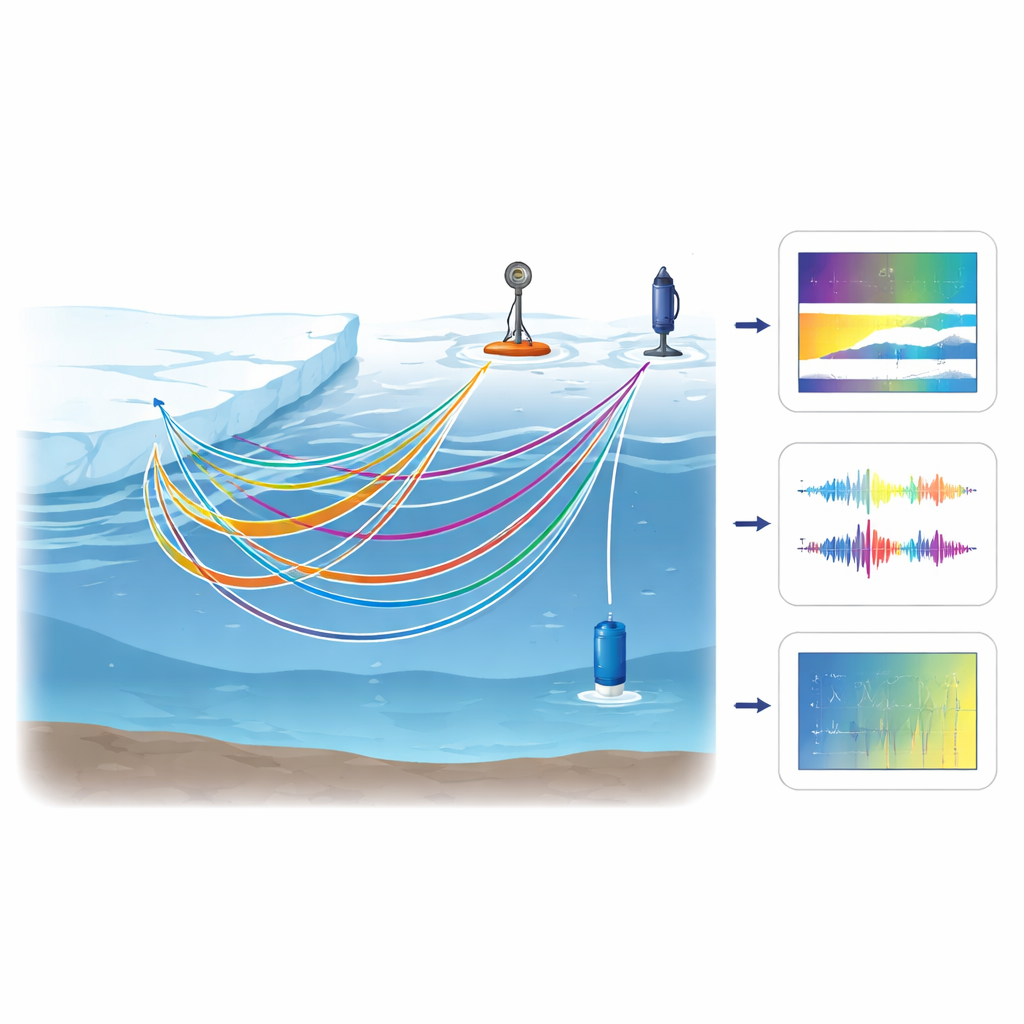
Once the recordings were collected, the authors used standard signal-processing tools to confirm that the data reflect real physical behavior in the ice and water, not just random noise. They computed spectrograms to see how energy changed with time and frequency, and examined how closely different sensors agreed with each other. For example, they showed that impulsive cracking events appear at the same time in different hydrophones with high coherence, and that some signals first appear in the ice (seen by the geophones) and then in the water (seen by the hydrophones), as expected for waves traveling through a floating ice sheet. In the hammer tests, they cross‑correlated the hammer force with each sensor’s response to measure how long it took sound to arrive, and then used timing differences between hydrophones to estimate the direction from which the waves came—finding angles that closely matched the known hammer locations.
An Open Resource for Winter Science
All of the recordings—ambient ice cracks, hammer impacts, and matching weather data—have been released in a standardized, well-documented format that other researchers can easily use. The dataset spans microphones, geophones, and hydrophones, includes both quiet and energetic cracking periods, and covers frequencies from slow flexing of the ice to rapid, high‑pitched events. For a general reader, the bottom line is that the authors have turned the eerie soundtrack of a frozen lake into a shareable scientific library. This resource can help improve methods for gauging ice thickness and safety, refine models of sound in shallow, ice‑covered waters, and ultimately deepen our understanding of how winter lakes are changing in a warming world.
Citation: Case, J., Barnard, A. & Brown, D. An ambient acoustic ice-fracturing dataset taken in shallow freshwater. Sci Data 13, 648 (2026). https://doi.org/10.1038/s41597-026-06712-7
Keywords: ice fracturing, acoustic monitoring, frozen lakes, climate impacts, winter safety