Clear Sky Science · en
A multimodal dataset of harmful simulated behaviours in high-risk clinical settings using radar
Why watching without touching matters
In busy hospital wards that care for people in severe mental distress, nurses must constantly balance safety, privacy, and dignity. Staff need to notice early signs of self-harm or dangerous agitation, but constant in-person watching can feel intrusive and is hard to maintain around the clock. This paper introduces a rich new collection of data that could help computers quietly monitor rooms using radar and body signals, spotting risky behavior early without cameras or wearables that patients might refuse.
A new window into a hospital room
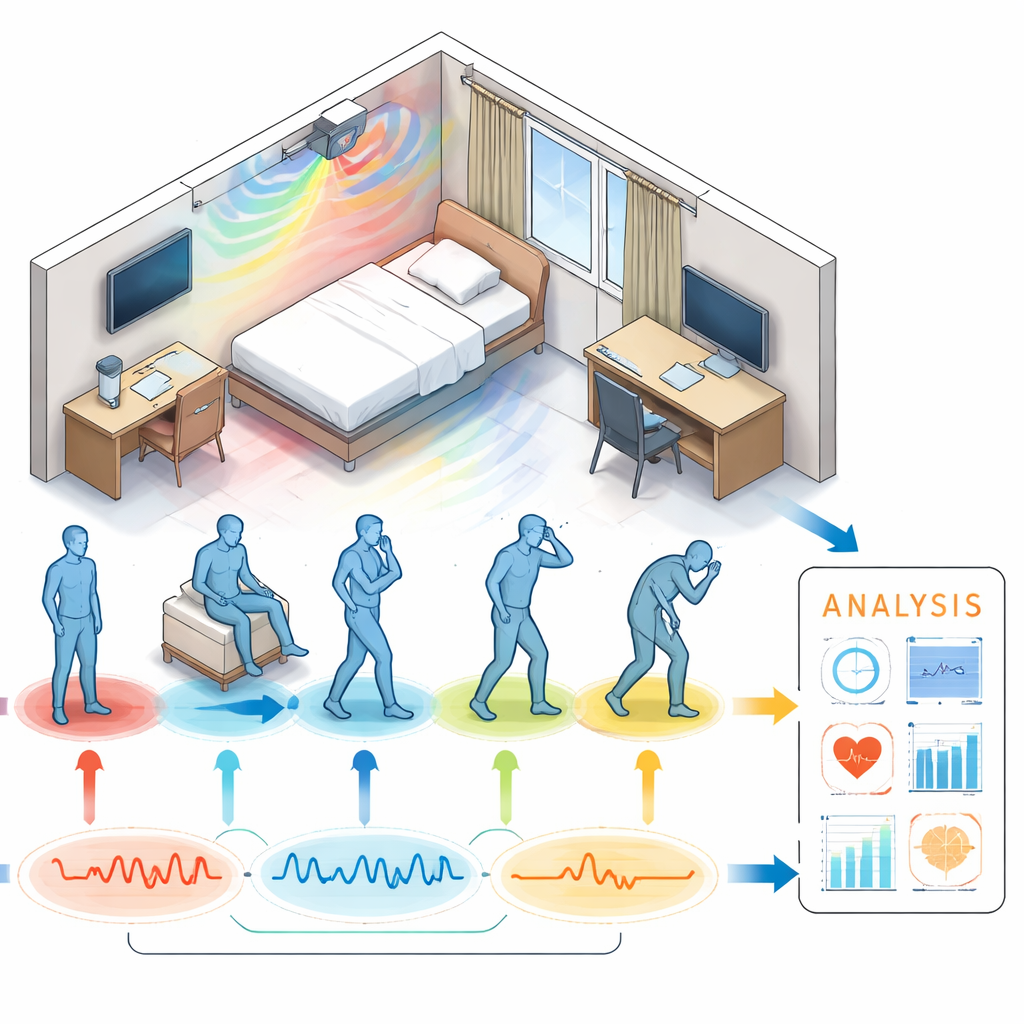
The researchers created a detailed test space that mimics a simple bedroom in a secure psychiatric unit, complete with bed, desk, chair, and television. A small radar device on the wall sends out radio waves that bounce off anything that moves in the room, even through light obstacles like curtains. At the same time, volunteers wore a small medical recorder that tracked heart activity, breathing, and body movements, plus a finger oximeter to measure blood oxygen. All of these streams were recorded together, giving a second‑by‑second picture of what a person was doing and how their body was responding.
Everyday actions and moments of danger
To reflect real life as closely as possible, the team did not limit themselves to neat, repetitive motions. Twenty‑three volunteers performed twelve different activities in the room. Some were ordinary: sitting at the desk, lying on the bed, watching television, pacing, or having a short visit from a caregiver. Others were designed to imitate high‑risk situations seen in secure units, such as sitting or pacing in an agitated way, guarding the neck as if using a ligature, or rhythmically banging the head against a padded panel. Staff from a secure care facility helped choose these behaviors based on how often they occur, how dangerous they can be, and what could be safely simulated in the lab.
Capturing the body’s hidden signals
Each experiment session contained two ten‑minute sequences. In one, the volunteer began at rest; in the other, they first exercised on a bike to raise heart and breathing rates, adding realistic variety to the body signals. The order and exact length of activities were randomized to avoid predictable patterns. Throughout, the radar sampled motion from different distances hundreds of times per second, while the body sensor logged heartbeats, chest movement from breathing, and motion and rotation from tiny accelerometers and gyroscopes. Carefully synchronized clocks and detailed time stamps tie everything together so that each radar echo and heartbeat can be matched to the correct activity and moment in time.
Checking that patterns truly reflect behavior
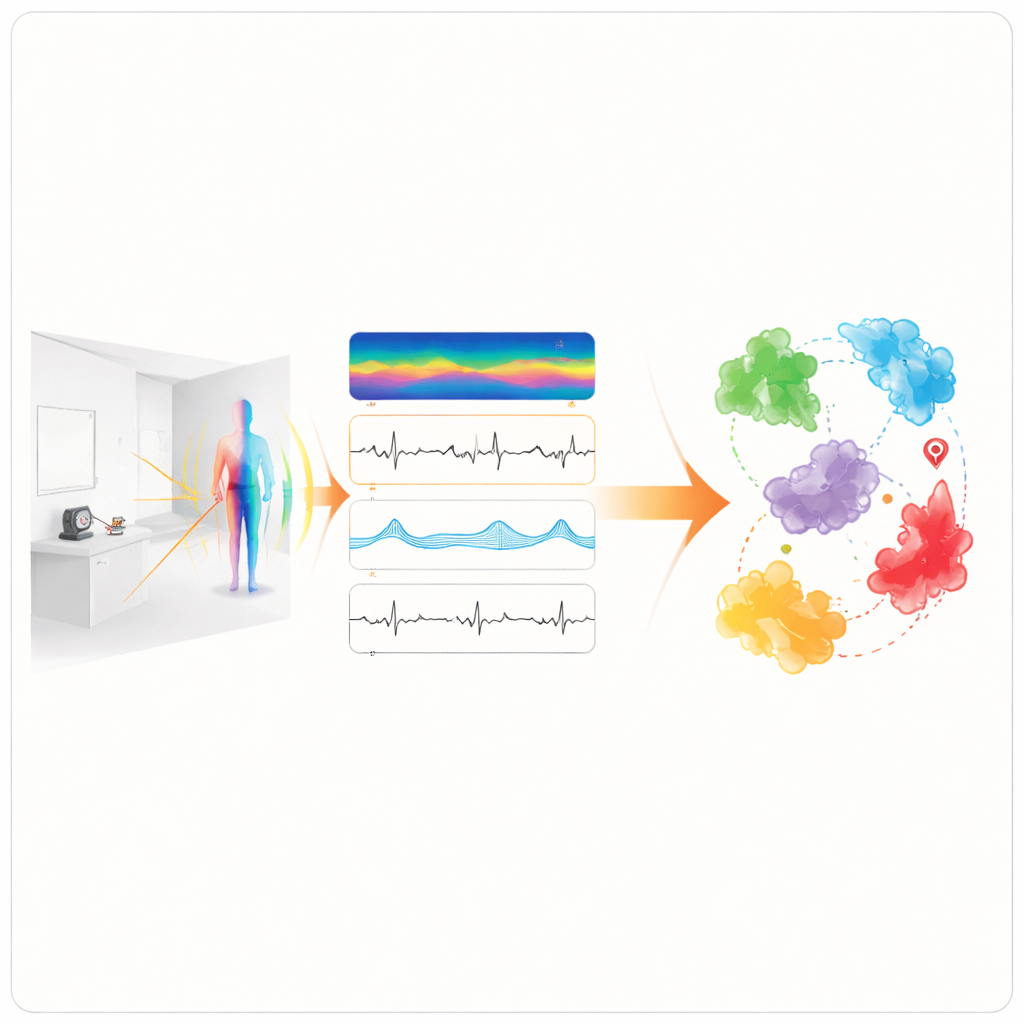
To make sure the recordings were reliable, the authors transformed the raw radar echoes into images where colors represent how strong the reflections were over time and distance. When they looked at these images for different people doing the same activity, they found consistent patterns: headbanging produced a very different radar “texture” from calm sitting, and agitated pacing did not resemble lying on the bed. This consistency suggests that computer programs could learn to tell activities apart from radar alone, or combine radar with heart and breathing signals for even more accurate detection. The team also offers guidance on how to use the dataset, such as trimming the first and last few seconds of each activity to avoid brief disturbances when people change position.
What this means for safer care
In simple terms, this work does not yet deliver an automatic warning system; instead, it provides the raw material others need to build and test one. By openly sharing a large, carefully labeled set of radar and body‑signal recordings that include both everyday and simulated harmful behaviors, the authors give researchers a realistic proving ground. Future systems trained on this dataset could quietly scan a room, recognize worrying movements or rising agitation without filming faces or requiring patients to wear gadgets, and alert staff in time to step in. If developed responsibly, such technology could strengthen safety in high‑risk clinical settings while still respecting the privacy and comfort of the people who live and recover there.
Citation: Tilbury, B., Arevalillo-Herráez, M. & Ramzan, N. A multimodal dataset of harmful simulated behaviours in high-risk clinical settings using radar. Sci Data 13, 669 (2026). https://doi.org/10.1038/s41597-026-06703-8
Keywords: radar-based patient monitoring, harmful behaviour detection, psychiatric inpatient safety, multimodal clinical dataset, non-contact vital signs