Clear Sky Science · en
A bacteria community sequencing data set from pothos (Epipremnum aureum)
Why the Hidden Life of a Houseplant Matters
Pothos, the easygoing trailing plant that thrives on windowsills and office shelves, turns out to host a bustling community of bacteria that quietly help it cope with low nutrients and changing environments. As more people and growers turn to water-based (hydroponic) setups instead of soil, understanding this invisible world becomes important for keeping plants healthy, supporting indoor greening, and even improving sustainable farming. This study tracks how the bacterial partners of pothos change when the plant moves from soil to water, offering a detailed map of its microbiome that other researchers can now explore.
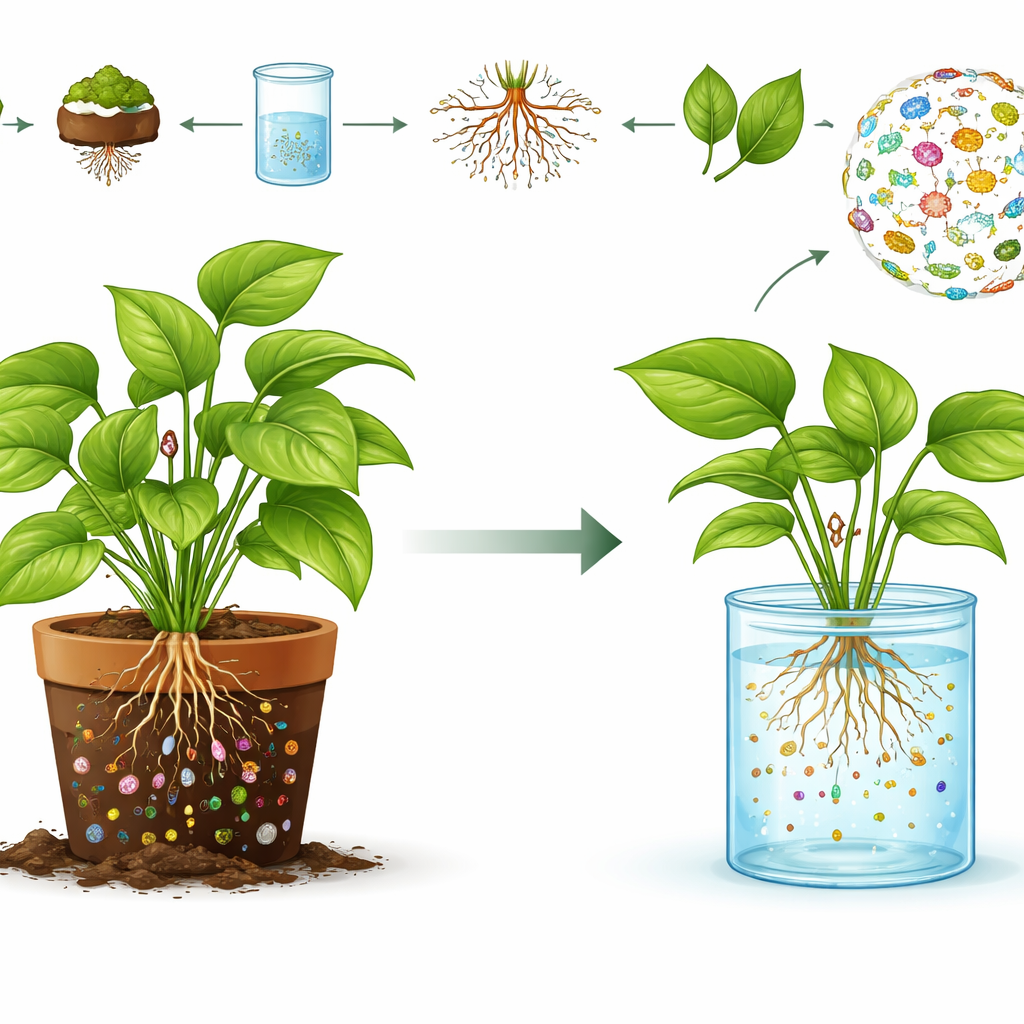
From Potting Mix to Glass of Water
The researchers began with common pothos plants bought from a flower market, originally grown in a mixture of soil, coconut coir, and humus. Some plants stayed in this soil, while others had their roots rinsed and were moved into simple hydroponic setups: tap water, pure distilled water, or distilled water with small amounts of common mineral salts. Over an 86-day period, the team repeatedly sampled four key “neighborhoods” where microbes live: the surrounding soil, the hydroponic water, the roots, and the leaves. Each sample was collected under strictly clean conditions, quickly frozen, and then used to extract DNA, ensuring that the recorded communities truly reflected the living microbiome.
Reading the Bacterial Barcodes
To identify who was living where, the scientists used a standard genetic survey technique that reads a specific part of bacterial DNA (the 16S rRNA gene) as a kind of barcode. Millions of DNA fragments from all samples were sequenced on a high-throughput machine and then cleaned, merged, and sorted using established software pipelines. Closely related DNA sequences were grouped into high-resolution units called amplicon sequence variants, or ASVs, which serve as stand-ins for individual bacterial types. The team then compared how many types were present, how evenly they were distributed, and how community composition differed between roots, leaves, soil, and water.
Shared Microbial Neighbors, Different Neighborhood Rules
The pothos microbiome turned out to be both rich and strongly shaped by habitat. Across 98 samples, the team detected 3,696 distinct bacterial types spanning 24 major groups. A surprisingly large “core community” of 1,711 types was found in all four environments—water, roots, leaves, and soil—hinting at a shared pool of microbes that can move between plant tissues and their surroundings. Yet each compartment imposed its own rules. Soil hosted the most diverse and balanced set of bacteria, while hydroponic water contained a stripped-down community, likely constrained by limited nutrients and physical conditions. Root and leaf samples fell in between, with leaves showing a special enrichment of one major group, suggesting that different plant parts selectively favor particular microbial residents.
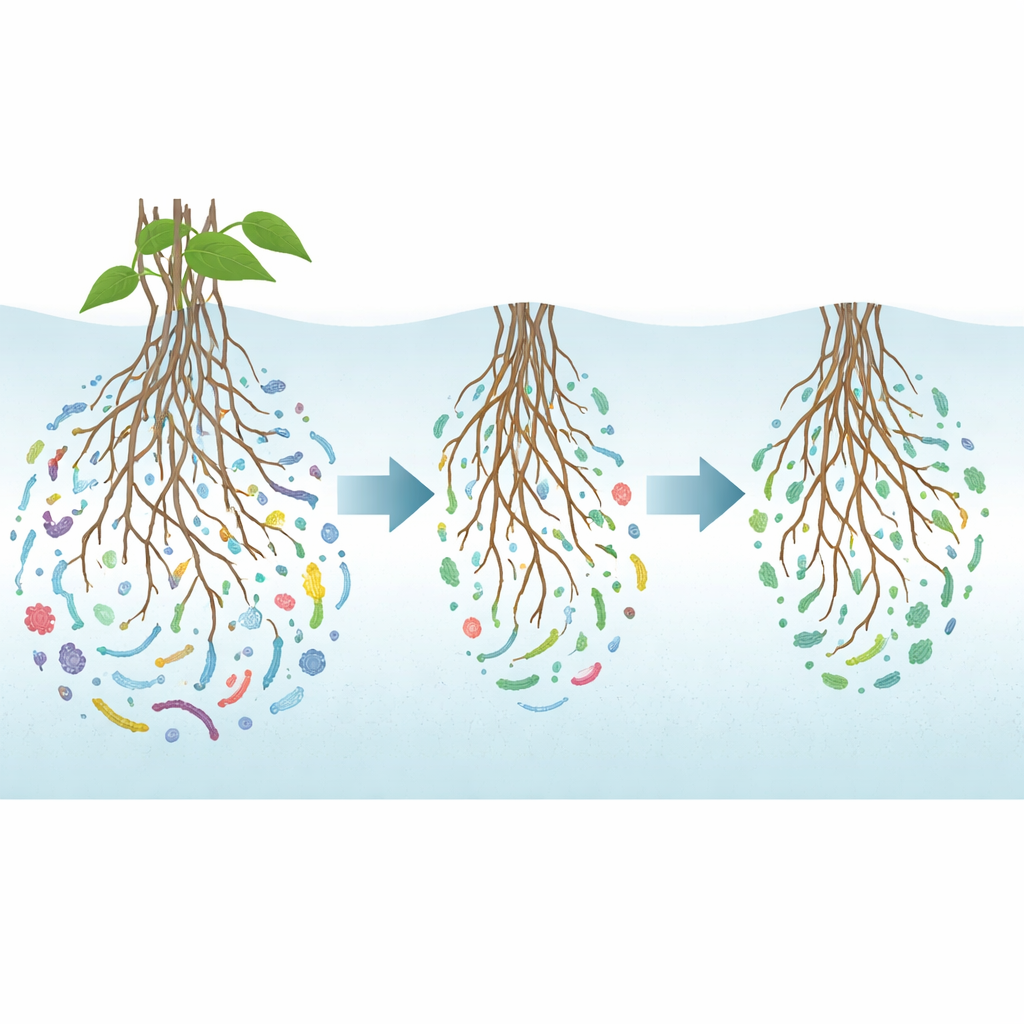
How Water Selects Its Specialists
Following the hydroponic water communities through time revealed a story of ecological sorting. At first, the water contained a broad mix of bacteria with diversity similar to that on roots, probably introduced when the plants were first transferred from soil. Within a week, however, many of the rarer types disappeared, and overall diversity dropped and then stabilized. This pattern points to an initial colonization phase, when many microbes can enter, followed by a selection phase, during which only those well suited to the low-nutrient, oxygenated, and plant-influenced water conditions persist. In all sample types, one broad bacterial group dominated, with a second group particularly common on leaves and a handful of others present at lower levels, outlining a consistent but compartment-specific structure.
A Reusable Map of an Invisible Garden
To make the dataset useful far beyond this single experiment, the authors applied strict quality checks, showed that sequencing depth was sufficient to capture most of the diversity, and made both the raw data and analysis code publicly available. For non-specialists, the main takeaway is that even a familiar desk plant like pothos depends on complex, shifting microbial partners—especially when moved from soil to water. This work provides a detailed reference for those invisible communities, laying groundwork for future efforts to fine-tune hydroponic systems, support healthier indoor plants, and better harness plant–microbe partnerships in sustainable agriculture.
Citation: Zhu, B., Wang, J., Zhang, X. et al. A bacteria community sequencing data set from pothos (Epipremnum aureum). Sci Data 13, 584 (2026). https://doi.org/10.1038/s41597-026-06677-7
Keywords: pothos microbiome, hydroponic plants, plant–microbe interactions, bacterial communities, indoor greening