Clear Sky Science · en
Chromosome-level genome assembly of the longfin barb (Acrossocheilus longipinnis)
A Hidden River Resident in Trouble
In the fast-growing cities and dammed rivers of southern China, a small striped fish called the longfin barb is quietly slipping toward rarity. This freshwater species, prized for its striking appearance in home aquariums, is found naturally only in the Pearl River basin. As dams, sand mining, pollution, and invasive species reshape its habitat, scientists are racing to understand the fish’s biology well enough to help protect and responsibly breed it. This study delivers a key missing piece: a complete, high‑quality map of the longfin barb’s DNA, assembled down to the level of individual chromosomes.
Why This River Fish Matters
The longfin barb is part of a diverse group of Asian freshwater fishes that play important roles in local ecosystems and in regional fisheries and aquaculture. Males are especially eye‑catching, with elongated fin rays and bold pale bars along a silver‑gray body, which has made the species popular in the ornamental fish trade. At the same time, surveys show that wild populations have declined sharply. Without detailed genetic information, it is difficult to track remaining diversity in the wild, design effective breeding programs, or predict how the species might respond to changing rivers. Until now, researchers only had access to its small mitochondrial genome, a tiny fraction of the full genetic blueprint.
Building a Complete DNA Blueprint
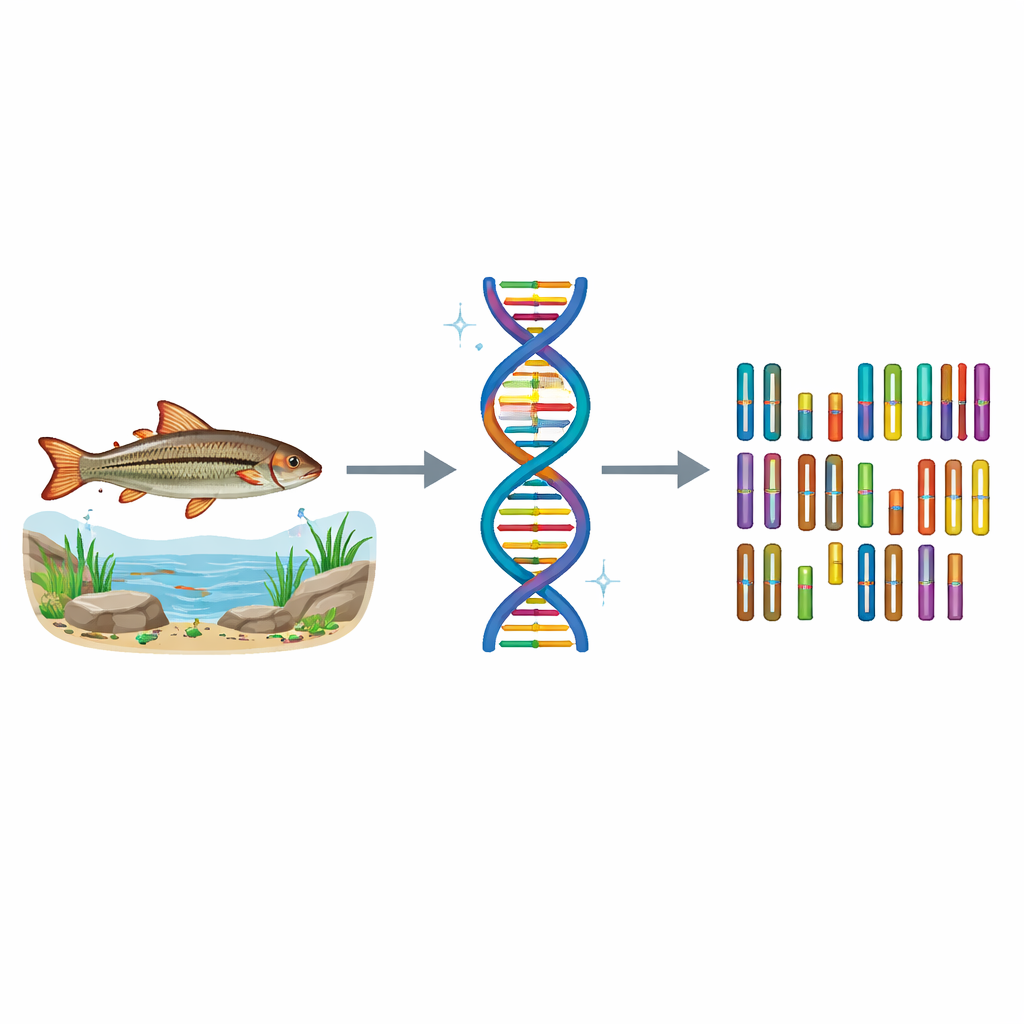
To fill this gap, the team collected tissue from longfin barb individuals raised under controlled conditions and extracted both DNA and RNA. They combined several cutting‑edge sequencing approaches: very long, highly accurate DNA reads, more numerous short reads, and a special method that captures how distant parts of the DNA strand fold and touch inside the cell nucleus. By weaving these streams of data together with specialized software, they assembled a genome of about 936 million DNA letters and organized more than 99% of it into 25 chromosome‑length pieces, closely matching the fish’s actual chromosomes.
Peering Inside the Genome’s Structure
Beyond simply lining up the DNA sequence, the researchers examined what it contains and how it is arranged. They found that nearly 60% of the longfin barb genome is made of repeat segments—stretches of DNA that occur over and over. One common type, called long terminal repeats, alone accounts for about one‑third of the entire genome. Using combinations of computer predictions, comparisons to other fish species, and evidence from the fish’s own RNA, the team identified 24,718 genes that code for proteins. They then linked almost all of these genes to known functions by matching them against large international databases, creating a rich catalog of the fish’s biological toolkit.

Checking Accuracy and Reliability
Because future studies will depend heavily on this genome, the authors devoted considerable effort to testing its quality. Independent checks showed that almost all of the basic, widely shared fish genes expected to be present are indeed found as complete copies. Nearly all of the original DNA reads, both long and short, could be accurately mapped back onto the assembled genome, indicating few missing or misplaced sections. The team also pinpointed special chromosomal regions called centromeres—zones rich in repeats and poor in genes where chromosomes are pulled apart during cell division—and confirmed that the few remaining tiny gaps in the sequence lie within especially repetitive stretches.
A New Genetic Foundation for Protection and Use
For non‑specialists, the bottom line is that scientists now have a detailed, reliable reference map of the longfin barb’s entire genetic code. This resource will make it far easier to study how the species evolved, how its populations are structured across the Pearl River basin, and which genes underlie desirable traits such as growth, coloration, or disease resistance. In turn, that knowledge can guide conservation breeding programs, help maintain genetic diversity in captivity, and support more sustainable use of this vulnerable ornamental fish. The genome does not save the longfin barb by itself, but it provides a powerful foundation for the biological detective work and practical management that effective protection requires.
Citation: E, Z., Xiong, F., Zhu, Y. et al. Chromosome-level genome assembly of the longfin barb (Acrossocheilus longipinnis). Sci Data 13, 600 (2026). https://doi.org/10.1038/s41597-026-06656-y
Keywords: fish genome, conservation genetics, chromosome assembly, freshwater biodiversity, ornamental fish