Clear Sky Science · en
Structural mechanism for noncanonical GPCR signaling in the Hedgehog pathway
How cells use a quiet switch to control growth
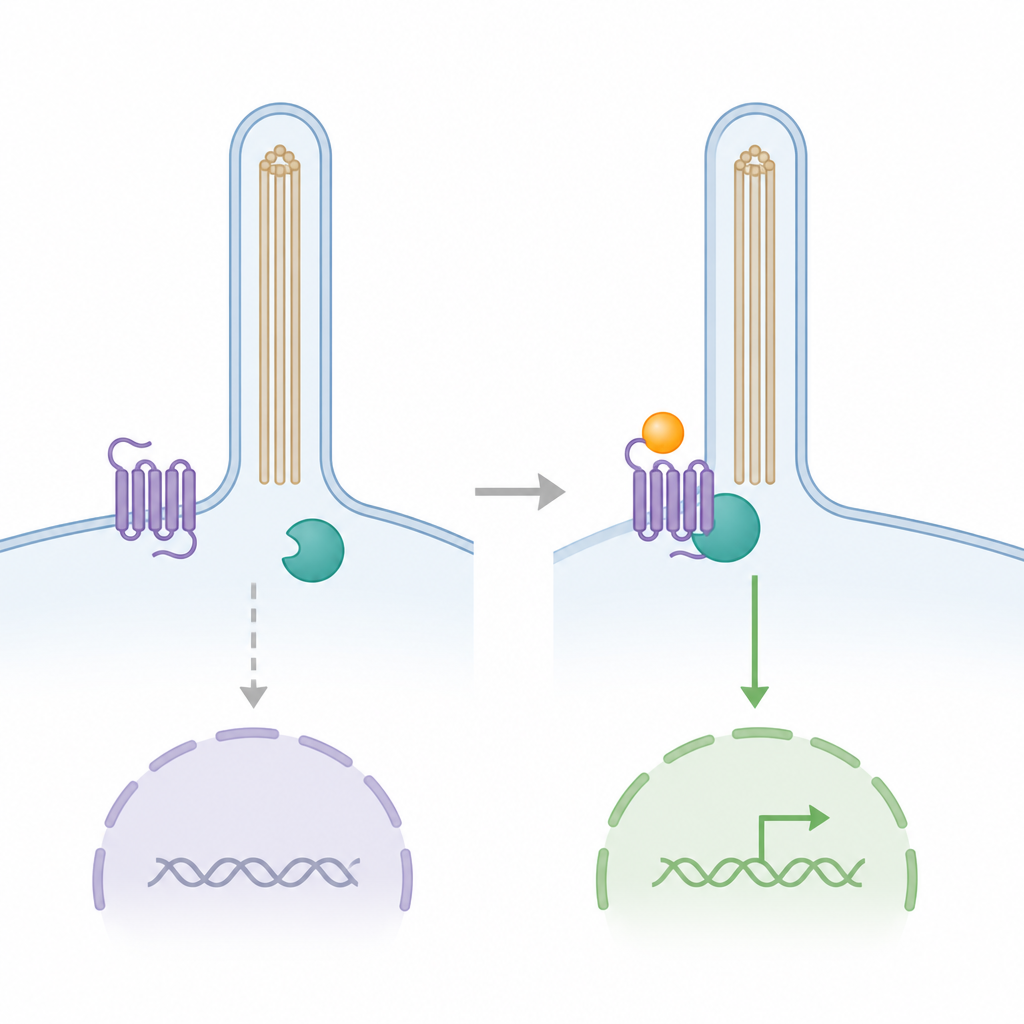
The Hedgehog pathway helps embryos form properly and keeps many tissues healthy throughout life. When this system misfires, it can fuel cancers and birth defects. This study uncovers, at atomic detail, how a key cell-surface protein called Smoothened shuts down an enzyme switch inside tiny cellular antennae called primary cilia, providing a fresh view of how signals travel from outside the cell to the DNA inside.
A different kind of cell antenna signal
Most cell-surface receptors in our bodies talk to enzymes through a well-known relay. They activate helper proteins, which change levels of a messenger molecule, which in turn flips enzymes on or off. Smoothened breaks these rules. It is a member of the large GPCR receptor family, but in the Hedgehog pathway it turns off the enzyme protein kinase A (PKA) directly, without using the usual messengers. When Hedgehog signals are absent, PKA keeps gene regulators called GLI in check. When Hedgehog signals appear, Smoothened must somehow grab PKA and stop it, lifting the brake on GLI and allowing growth-related genes to turn on inside the nucleus.
Seeing an invisible handshake
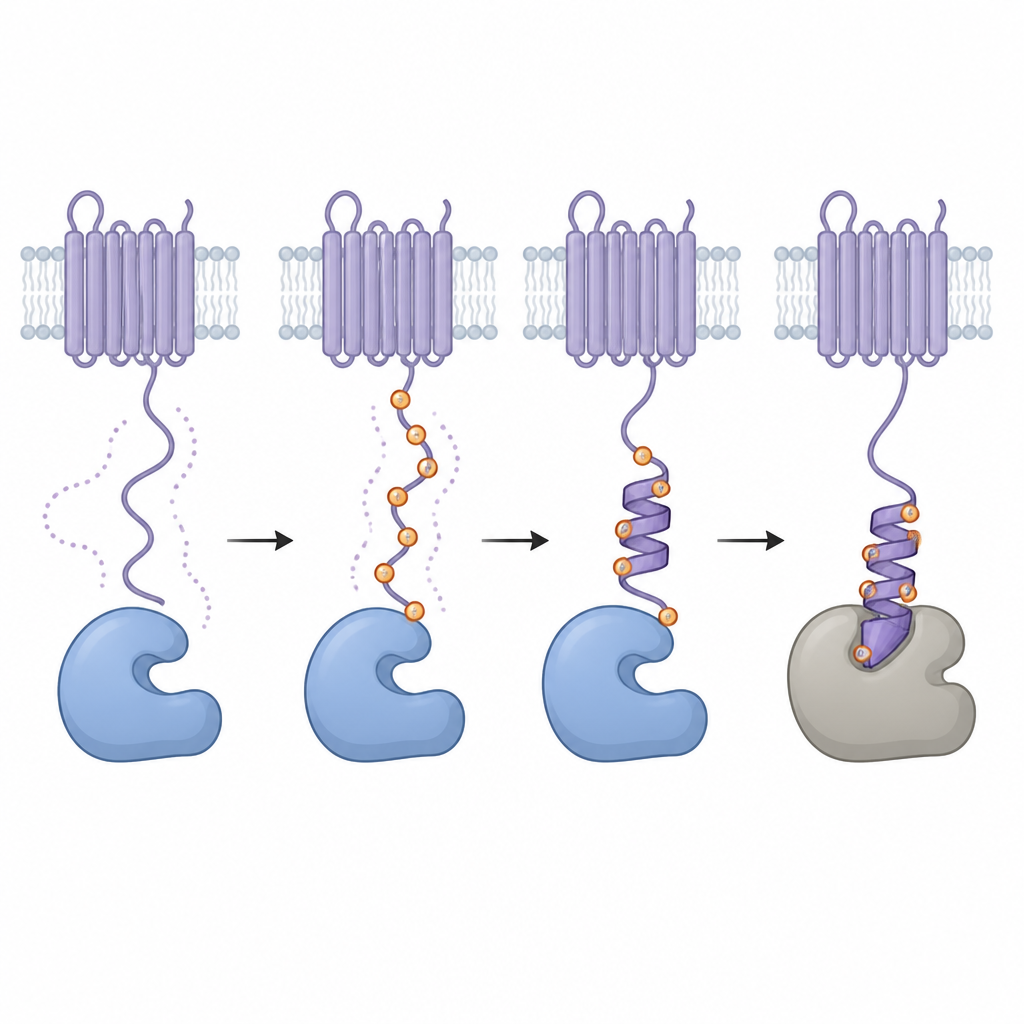
The portion of Smoothened that contacts PKA is floppy and disordered under most conditions, which makes it very hard to capture with traditional structural biology methods. The authors combined cutting-edge structure prediction (AlphaFold3), molecular simulations, mass spectrometry that tracks how protein backbones flex in solution, and targeted mutations to build and test a 3D model of the Smoothened–PKA pair. Their work shows that when Smoothened is in its active form, a stretch of its inner tail threads into PKA’s active groove like a fake substrate, while other parts of Smoothened wrap around the enzyme’s surface. Together, these contacts hold PKA in a shut conformation so it can no longer tag GLI with phosphate groups.
Copying strategies from classic enzyme partners
An unexpected discovery is how closely Smoothened mimics PKA’s natural regulators, even though its amino-acid sequence looks very different. PKA is normally controlled by partner proteins that block its active groove and also press against side regions of the enzyme to clamp it shut. The authors found that a short helical segment in Smoothened’s tail occupies the same pocket and makes the same types of hydrophobic and charge-based contacts as these classic partners. Computer simulations and chemical crosslinking experiments confirmed that this helical “handle,” together with the groove-blocking segment, forms a stable, high-affinity grip on PKA. If key residues in this region are mutated, Smoothened still reaches the cilium and gets activated at the membrane, but it can no longer silence PKA or turn on Hedgehog target genes.
Phosphate marks sculpt a working clamp
Another puzzle was why Smoothened must be heavily phosphorylated by GRK2/3 kinases before it can bind PKA. The team showed that a cluster of phosphate marks on Smoothened’s inner tail nestles against a row of positively charged residues on the same tail and near the membrane. This internal tug of war helps the once-floppy tail fold into ordered helices positioned just right to grip PKA. Additional phosphate sites beyond the blocking segment appear to help the tail wrap more fully around PKA’s front lobe, further stabilizing the complex. Experiments that weakened these charge-based attractions or disturbed the newly formed helices sharply reduced PKA binding and Hedgehog pathway activity, even though Smoothened still responded to its normal lipid activators.
Borrowing a familiar frame for an unusual connection
When the researchers compared their model to known structures of more conventional GPCR complexes, they found striking resemblances. In classic systems, a receptor’s inner loops and tail, together with surrounding lipids, provide multiple docking surfaces for effectors such as G proteins or arrestins. Smoothened uses the same overall layout: a short loop from its tail plugs an internal cavity between its seven membrane-spanning helices, its inner loops contact broad patches on PKA, and the surrounding membrane helps orient PKA via a fatty anchor. Binding PKA, in turn, subtly reshapes parts of Smoothened far from the contact site, echoing the long-range allosteric effects seen in other receptors.
What this means for health and disease
In everyday language, this work shows how Smoothened converts an outside Hedgehog cue into a tightly targeted block on PKA inside the cilium, freeing GLI proteins to switch on specific genes. By revealing the detailed geometry and chemistry of this unusual receptor–enzyme embrace, the study points to new ways to interfere with aberrant Hedgehog signaling in cancers, especially when tumors evolve resistance to drugs that hit Smoothened’s main binding pocket. More broadly, it suggests that many receptors may use similar folding tricks in their floppy tails to form precise, switch-like contacts with enzymes deep inside the cell.
Citation: Steiner, W.P., Iverson, N., Liu, G. et al. Structural mechanism for noncanonical GPCR signaling in the Hedgehog pathway. Nat Struct Mol Biol 33, 795–809 (2026). https://doi.org/10.1038/s41594-026-01800-z
Keywords: Hedgehog signaling, Smoothened, protein kinase A, primary cilium, GPCR structure