Clear Sky Science · en
Structural basis for recognition of diverse localizing mRNAs by Egl–BicD
How cells deliver messages to the right place
Every cell is full of messages written in the language of RNA. Many of these messages need to arrive at very specific spots so that proteins are made only where they are needed. This targeted delivery helps shape embryos, wire neurons and organize tissues. The study described here uncovers how a transport protein in fruit flies can recognize a wide variety of RNA messages and carry them to precise locations inside cells.
A transport adapter with many jobs
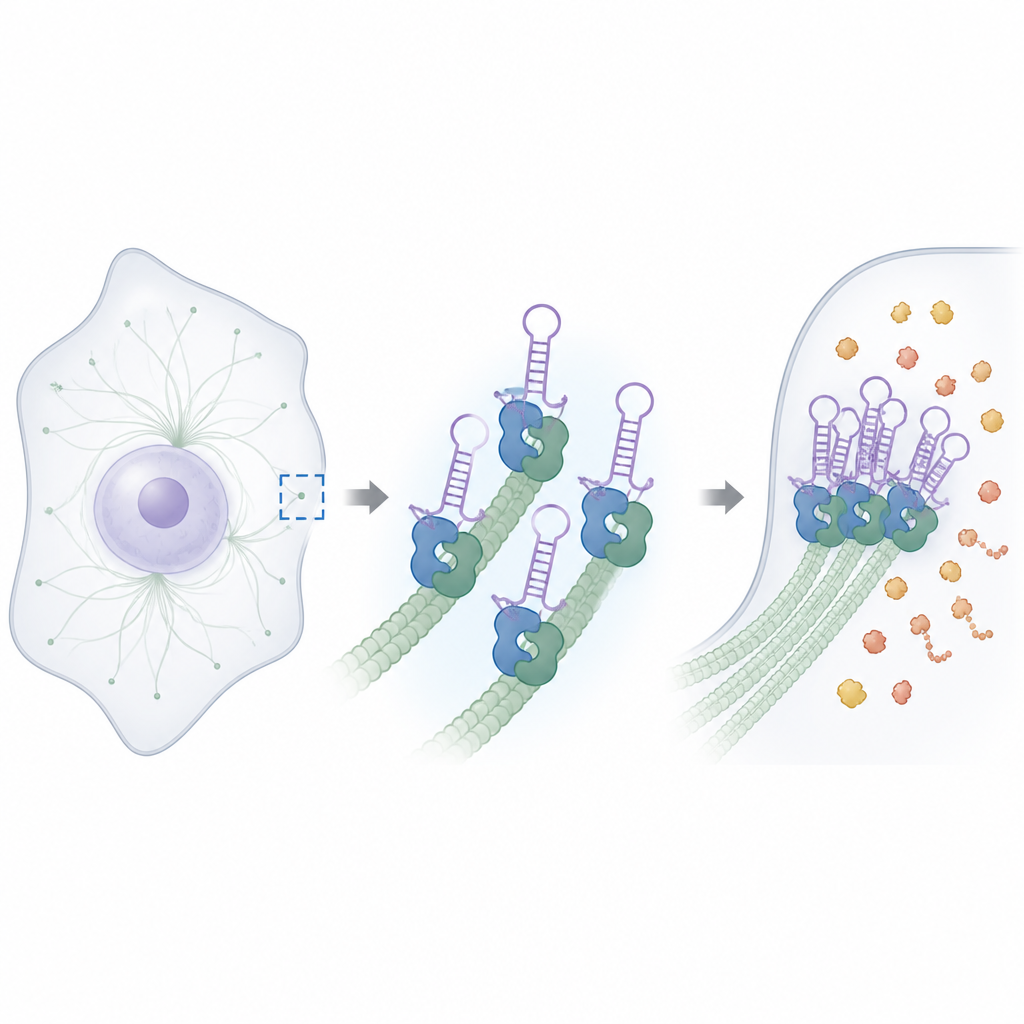
The work focuses on an RNA-binding protein called Egalitarian, or Egl, which teams up with another protein, Bicaudal D (BicD). Together they act as an adapter that links certain messenger RNAs to a motor called dynein, which walks along internal tracks in the cell. In fruit flies, this system helps position key developmental messages that control the body plan of the embryo and the growth of nerve cells. The puzzle has been that the RNA segments recognized by Egl look very different from one another in their sequence, even though they all depend on the same transport machinery.
Seeing the adapter grasp many different messages
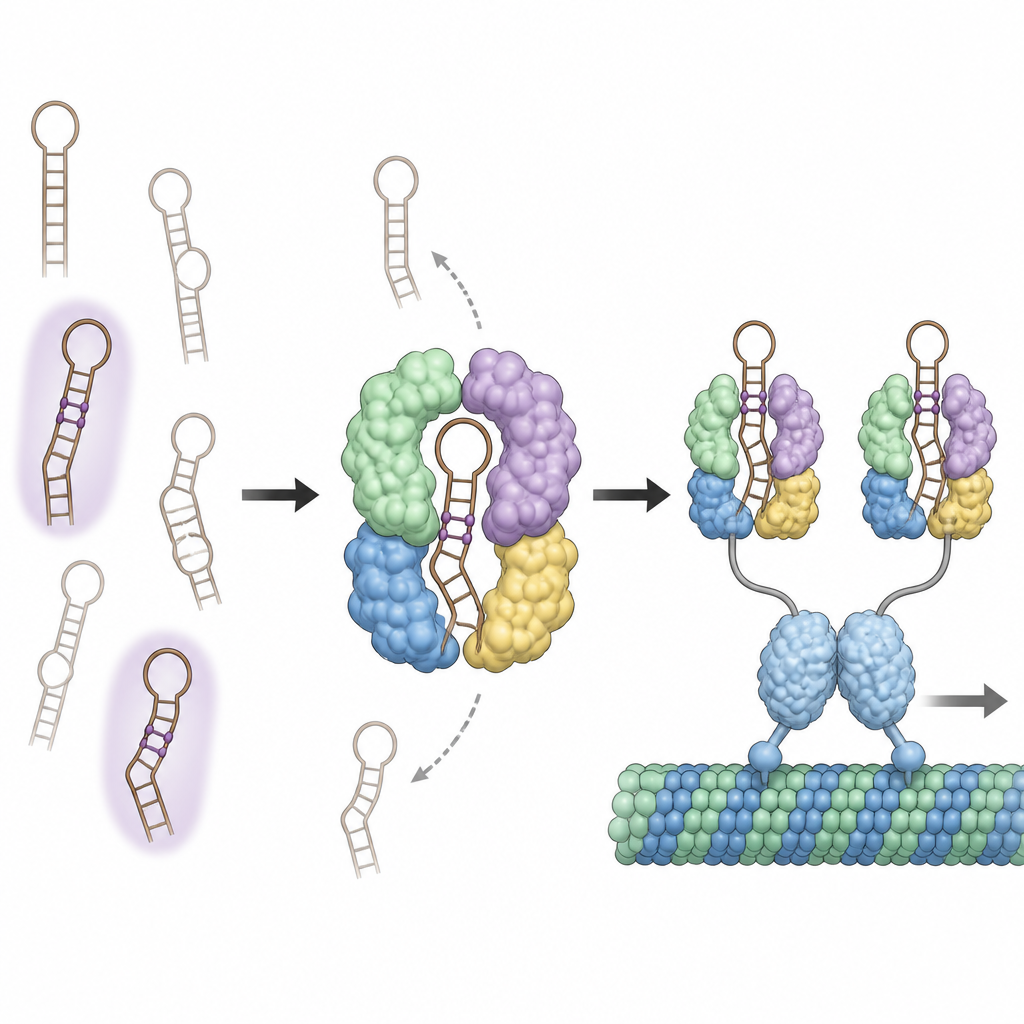
To understand how this adapter works, the researchers used cryo-electron microscopy to visualize Egl and BicD bound to several natural RNA segments that are known to direct transport. Each of these RNA pieces folds into a short double-stranded stem topped by a loop. The images reveal that Egl does not use a single standard gripping surface. Instead, each Egl protein contributes several distinct regions that come together only when RNA is present, forming a snug pocket around the stem-loop. Two copies of Egl attach to opposite sides of a BicD coiled-coil, and parts of both proteins cooperate to embrace a single RNA stem-loop in a highly coordinated way.
A shared shape and two key rungs on the ladder
Although the RNAs vary in length and exact sequence, the structures show that they share hidden similarities. All of them form a bent stem-loop, with a kink introduced by small bulges on one strand of the double helix. This bend positions two specific rungs on the RNA ladder at just the right spacing for Egl to sense them. At these spots, Egl reaches into the narrow groove of the RNA and makes contacts that favor a particular type of base pair. When the scientists altered these base pairs or removed the bulges that create the bend, the RNA bound much more weakly to Egl and failed to reach its normal destination when injected into fly embryos. This indicates that Egl reads both the overall shape of the RNA and the identity of these key base pairs.
Two handles on one message to start the engine
The study also finds that a single stem-loop is usually not enough to fully activate transport. In their structural images, Egl–BicD always holds two RNA stem-loops at once. Using fluorescently labeled RNAs and purified motor components, the team showed that dynein-driven movement most often occurs when two RNA elements are present. In natural messages such as the K10 and hairy transcripts, one stem-loop acts as the primary signal, while an additional, lower-affinity stem-loop in the same RNA serves as a support element. Together they allow two Egl dimers to bind the same RNA molecule, which in turn promotes a strong interaction with BicD and efficient recruitment of dynein.
Why this layered code matters
By combining recognition of RNA shape, a few strategically placed base pairs and the presence of paired stem-loops within one transcript, Egl can selectively recognize many different messages without relying on a simple letter-by-letter code. This layered system ensures that only RNAs with the right structural features and number of elements trigger motor activation, helping cells deliver specific cargo to the right place at the right time. The principles uncovered here may apply to other RNA transport factors and could aid in predicting which RNAs in an organism are routed to particular cellular addresses.
Citation: Singh, K., Chilaeva, S., McClintock, M.A. et al. Structural basis for recognition of diverse localizing mRNAs by Egl–BicD. Nat Struct Mol Biol 33, 882–893 (2026). https://doi.org/10.1038/s41594-026-01794-8
Keywords: mRNA localization, RNA structure, dynein transport, RNA binding proteins, Drosophila development