Clear Sky Science · en
Comparative characterization of Cas12f orthologs reveals mechanistic features underlying enhanced genome editing efficiency
Smaller Tools for Fixing DNA
Gene editing is often compared to using molecular scissors to rewrite the code of life, but the best scissors we have are bulky and hard to deliver into human cells. This study explores a new set of naturally tiny gene-editing proteins that could fit more easily into common gene therapy carriers, potentially making future treatments safer, more precise and easier to administer.
Why Size Matters in Gene Editing
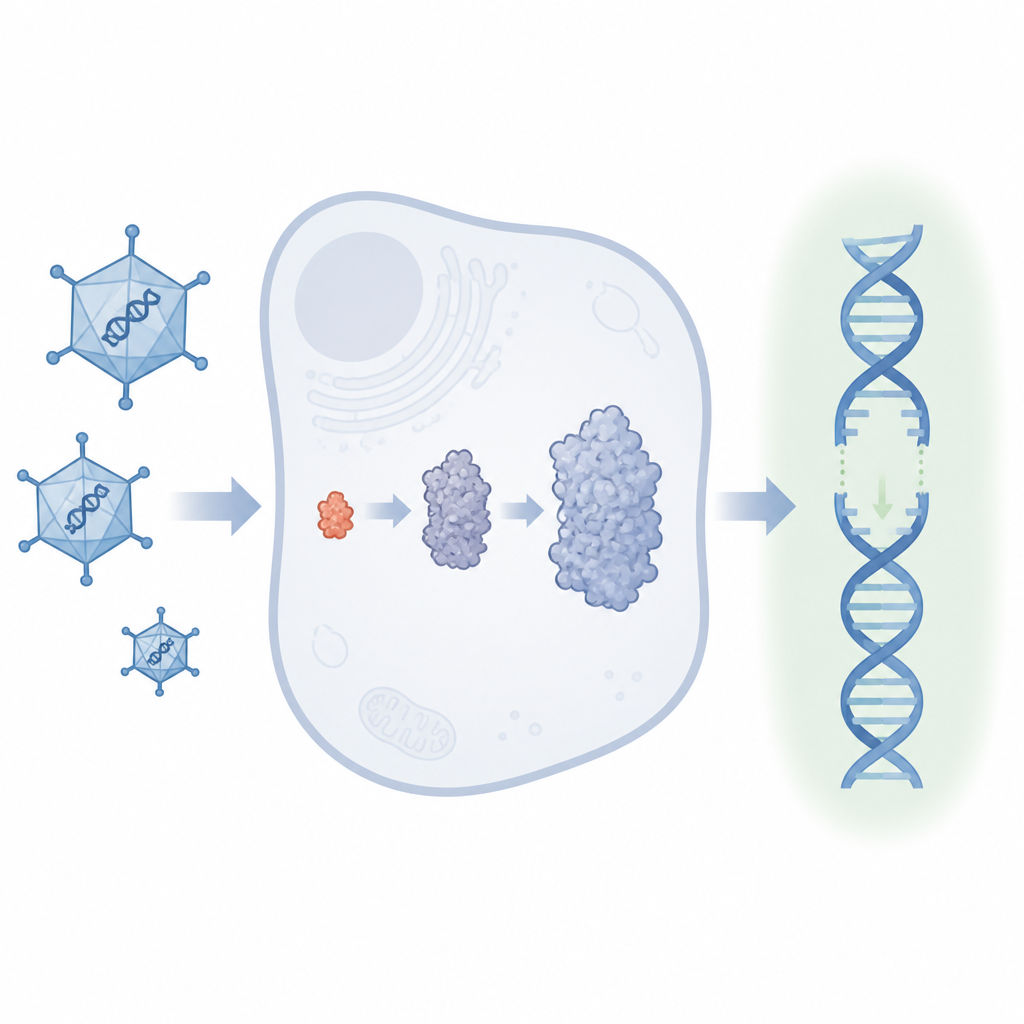
Most popular CRISPR tools, like Cas9, are large proteins that strain the carrying capacity of adeno-associated viruses, the workhorse delivery vehicles in many gene therapy trials. Squeezing these big editors and their guide molecules into such small viral packages can lower efficiency and complicate treatment design. By contrast, a family of much smaller CRISPR proteins called Cas12f offers an appealing alternative, but until now they have struggled to edit DNA in human cells as effectively as their larger cousins.
Finding a Stronger Mini Editor
To search for better small editors, the researchers combed through large metagenomic databases built from microbial DNA collected in the environment. Among thousands of candidate genes they uncovered a standout enzyme from a bacterium in the genus Alistipes, which they named Al3Cas12f. Despite being less than half the size of Cas9, this protein cut human DNA efficiently at many test sites, often outperforming other compact editors and even rivaling a commonly used, larger Cas12a enzyme at some locations.
How the Tiny Scissors Grip DNA
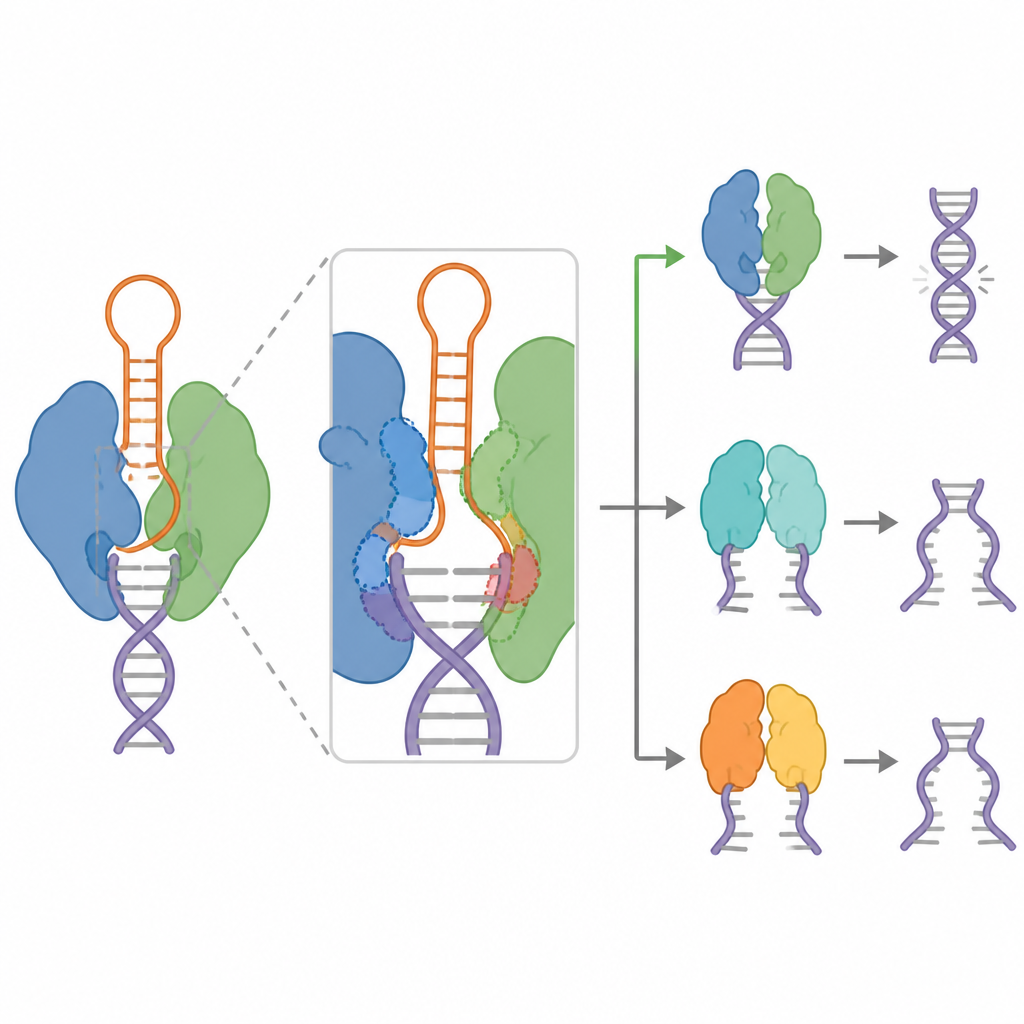
Using cryo-electron microscopy, the team visualized Al3Cas12f and two related Cas12f proteins while they were bound to guide RNA and target DNA. All three formed a paired structure in which two identical protein units work together, but Al3Cas12f stood out. Its two halves lock together through an unusually extensive set of contacts, like interlocking joints, and they cradle both the guide RNA and the DNA. This tight embrace helps form a complete DNA-RNA bubble, called an R-loop, which is a necessary step before cutting. In the other Cas12f proteins, key cutting regions must swing into place before the bubble can fully form, causing them to linger in less productive shapes and slowing editing.
Guides that Are Pre-Tuned for the Job
The small editors rely on a long guide RNA that folds into multiple stems and loops. By comparing the three systems, the scientists found that the guide attached to Al3Cas12f is already naturally streamlined. Extra segments that seem to dangle or create unhelpful interactions in the other enzymes are missing or bent into a snug position that strengthens contacts with the protein. Experiments that trimmed or reshaped these guide RNAs showed that removing certain stems in the less active enzymes improved their performance, supporting the idea that Al3Cas12f carries a pre-optimized guide scaffold that steers it quickly into an efficient cutting posture.
Engineering a More Even Performer
Although wild-type Al3Cas12f worked very well at some DNA sites, it still showed uneven results across the genome. Guided by their structural maps and sequence comparisons, the researchers introduced targeted amino acid changes near the regions that touch DNA and RNA. By stacking several of these substitutions, they created a triple mutant dubbed RKK that boosted editing at challenging sites from modest levels to well over 80 percent under lower dosing conditions. Across multiple test genes, this engineered version delivered stronger and more consistent edits than the original protein.
What This Means for Future Therapies
In plain terms, the study explains why one particular miniature CRISPR enzyme works better than its close relatives and shows how that knowledge can be used to tune it further. Al3Cas12f and its engineered RKK variant combine a very small footprint with strong and reliable DNA-cutting activity, making them attractive candidates for delivery in tight viral packages at lower doses. While much work remains before any clinical use, these insights offer a roadmap for designing compact gene editors that could broaden where and how gene therapy can be applied.
Citation: Guan, K., Ocampo, R.F., Matheus Carnevali, P.B. et al. Comparative characterization of Cas12f orthologs reveals mechanistic features underlying enhanced genome editing efficiency. Nat Struct Mol Biol 33, 756–767 (2026). https://doi.org/10.1038/s41594-026-01788-6
Keywords: CRISPR, Cas12f, genome editing, gene therapy, structural biology