Clear Sky Science · en
The dentate gyrus efficiently converges LEC and MEC inputs into multimodal, highly specific and reliable environmental representations
How the brain turns moments into memories
Remembering where you parked the car or how a room smelled during a special event depends on the brain’s ability to tie together sights, places and smells into a single memory. This study looks inside a tiny gateway of the brain’s memory system to ask how different kinds of sensory information are combined and stored over time, revealing how our experiences are turned into precise, long-lasting mental maps.
A gateway at the entrance to memory
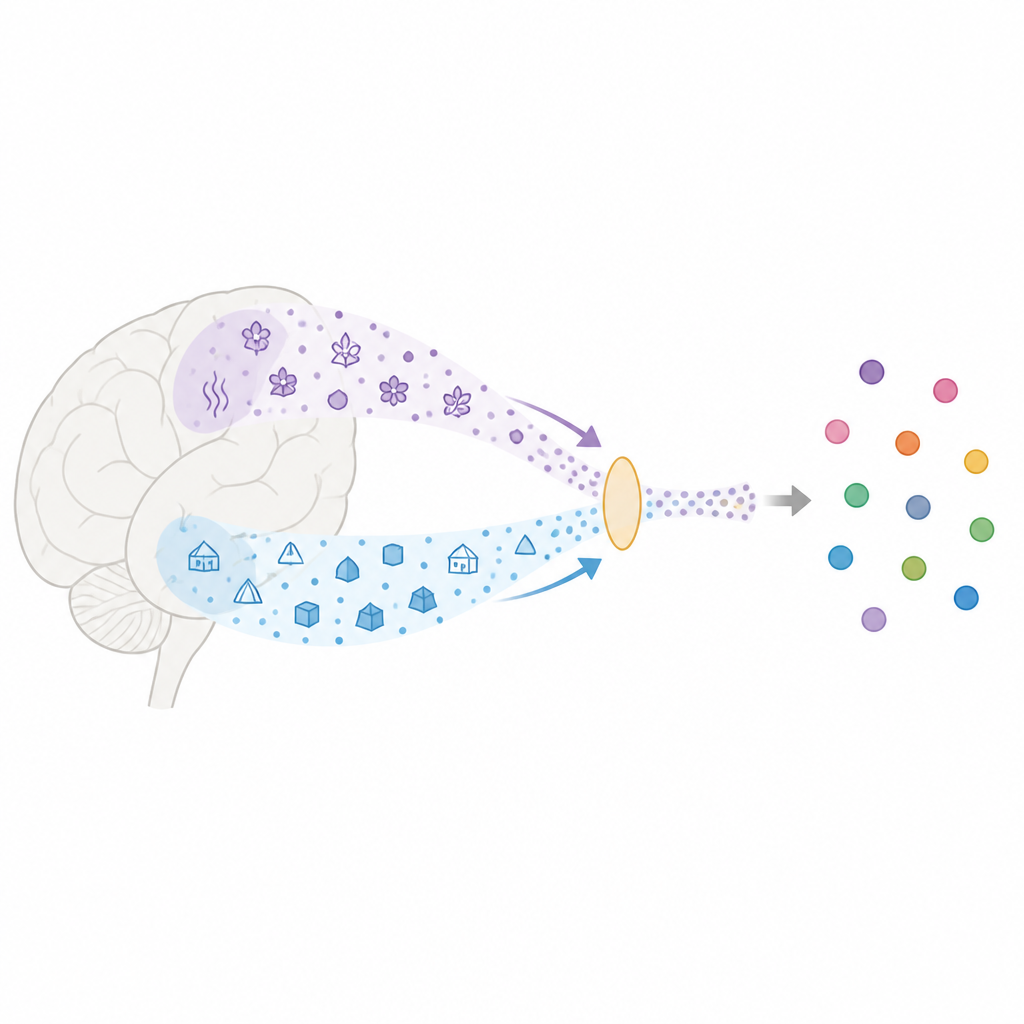
Deep inside the brain, a structure called the hippocampus supports episodic memory, the rich recollection of events in their spatial and temporal context. At its front door sits the dentate gyrus, a narrow strip of tissue that receives incoming signals from two neighboring regions: the lateral entorhinal cortex, which carries information about smells and local cues, and the medial entorhinal cortex, which carries information about location, movement and larger-scale surroundings. The authors set out to determine how these two input streams are represented in the dentate gyrus and how they change as an animal becomes familiar with new environments.
Watching memory circuits in virtual worlds
The researchers used two-photon calcium imaging to record activity from nerve cell projections and local cells in mice running through virtual reality tracks. In these computer-generated corridors and box-like paths, the animals encountered walls and floors with different patterns, objects of various shapes, rewards, sounds and a distinct odor. Over five days, the same sets of input fibers from the lateral and medial entorhinal cortex, as well as granule cells in the dentate gyrus, were tracked while the mice alternated between a familiar and a novel virtual environment. This allowed the team to follow how spatial and sensory representations appeared, stabilized and interacted across many days of experience.
Smell and space travel along different routes
The recordings showed that the two sources of input carry clearly different kinds of information. Fibers from the lateral entorhinal cortex were most strongly driven by the odor cue and transmitted relatively little detail about spatial position. In contrast, medial entorhinal inputs were rich in spatial structure: many of these fibers behaved like grid or place signals, were modulated by running speed and often fired near objects and rewards. Together, these inputs quickly formed robust patterns when the mice entered a new environment and remained stable over time, even when the same objects and cues were rearranged along a track. In other words, the sensory and spatial ingredients for a contextual map were present at the very entrance to the dentate gyrus from day one.
Slow, selective refinement inside the dentate gyrus
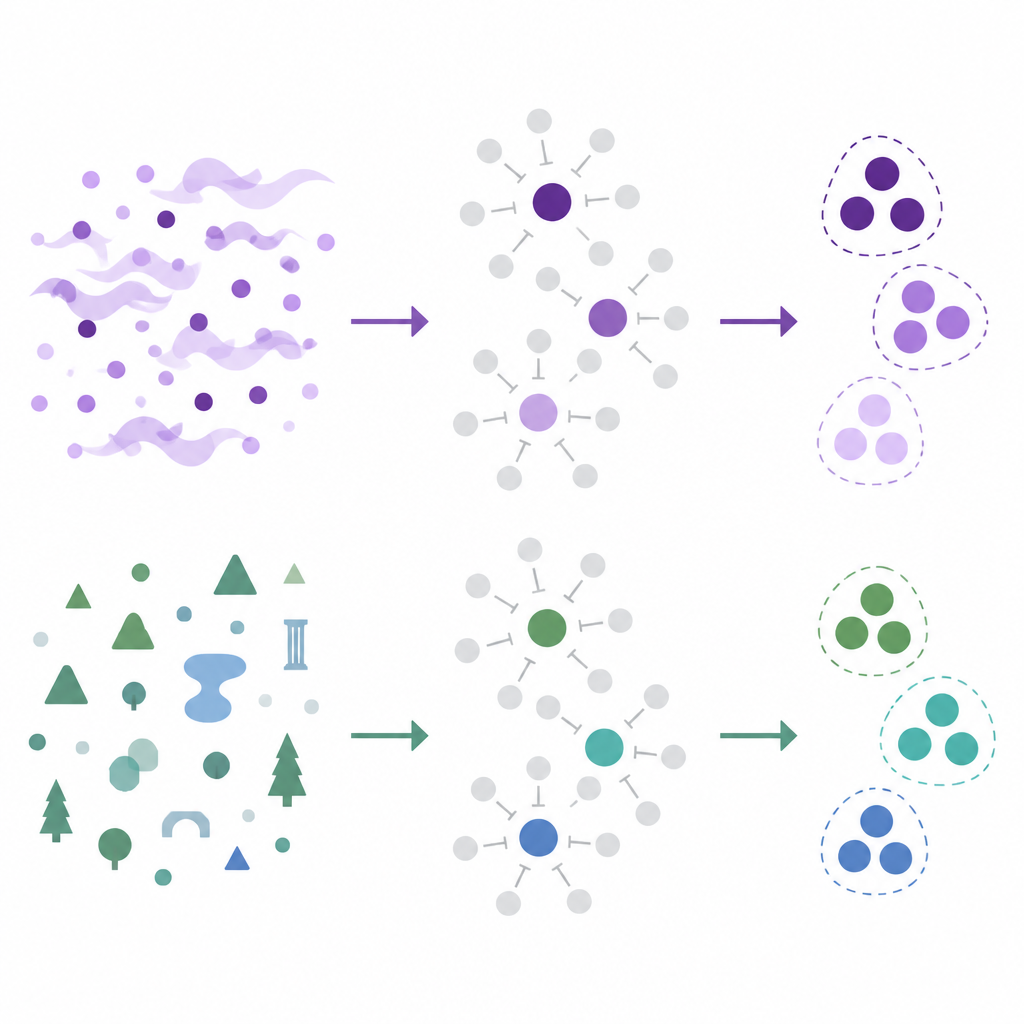
Granule cells in the dentate gyrus responded very differently. Their overall activity was sparse, with far fewer cells active at any moment compared to their entorhinal inputs. Yet their spatial tuning, reliability from trial to trial and ability to distinguish between environments all improved gradually over several days. Some dentate granule cells responded consistently to single objects, others to the odor or to reward locations, and a subset generalized across contexts, but most developed highly specific place responses. Decoding analyses showed that location and context could be read out from entorhinal inputs quite rapidly, but only dentate granule cells became progressively more accurate and efficient, maintaining good performance even when many cells were removed from the analysis.
Making similar places feel different
To test how well the system separates similar experiences, the team compared two kinds of virtual worlds. In one case, familiar and novel environments looked very different overall. In the other, they shared the same box-like appearance and objects but in different orders, making them harder to tell apart. Medial entorhinal inputs discriminated clearly between the very different worlds but showed more overlap when the worlds were similar. Dentate granule cells, however, preserved stronger distinctions in both situations: their patterns shifted more completely between contexts, while a controlled fraction of cells generalized where that might be useful, such as at shared track boundaries. This behavior matches the long-standing idea that the dentate gyrus performs “pattern separation,” transforming overlapping input patterns into distinct output codes.
What this means for everyday memory
Overall, the study suggests that the brain first collects rich mixtures of smell, objects, movement and space in entorhinal cortex, then gradually compresses and refines them in the dentate gyrus into sparse, highly specific and energy-efficient representations of context. These refined codes seem especially good at telling similar situations apart while still linking shared elements. For everyday life, this mechanism may help us distinguish one café from another that looks almost the same or remember a particular evening in a familiar room without confusing it with other nights spent in the same place.
Citation: Cholvin, T., Bartos, M. The dentate gyrus efficiently converges LEC and MEC inputs into multimodal, highly specific and reliable environmental representations. Nat Neurosci 29, 1166–1180 (2026). https://doi.org/10.1038/s41593-026-02240-0
Keywords: dentate gyrus, entorhinal cortex, spatial memory, pattern separation, virtual reality navigation