Clear Sky Science · en
Organization of neuropeptide systems in the human brain
Signals that Shape How We Feel and Think
Our brains are awash in tiny chemical messengers that help tune everything from breathing and hunger to trust and decision making. Among these messengers, neuropeptides stand out for working slowly and broadly, influencing whole brain states rather than just single flashes of activity. This study offers the first whole-brain map of where many of these neuropeptide signals land in the human brain, and what that might mean for everyday experiences like sleep, stress, reward, and higher thought.
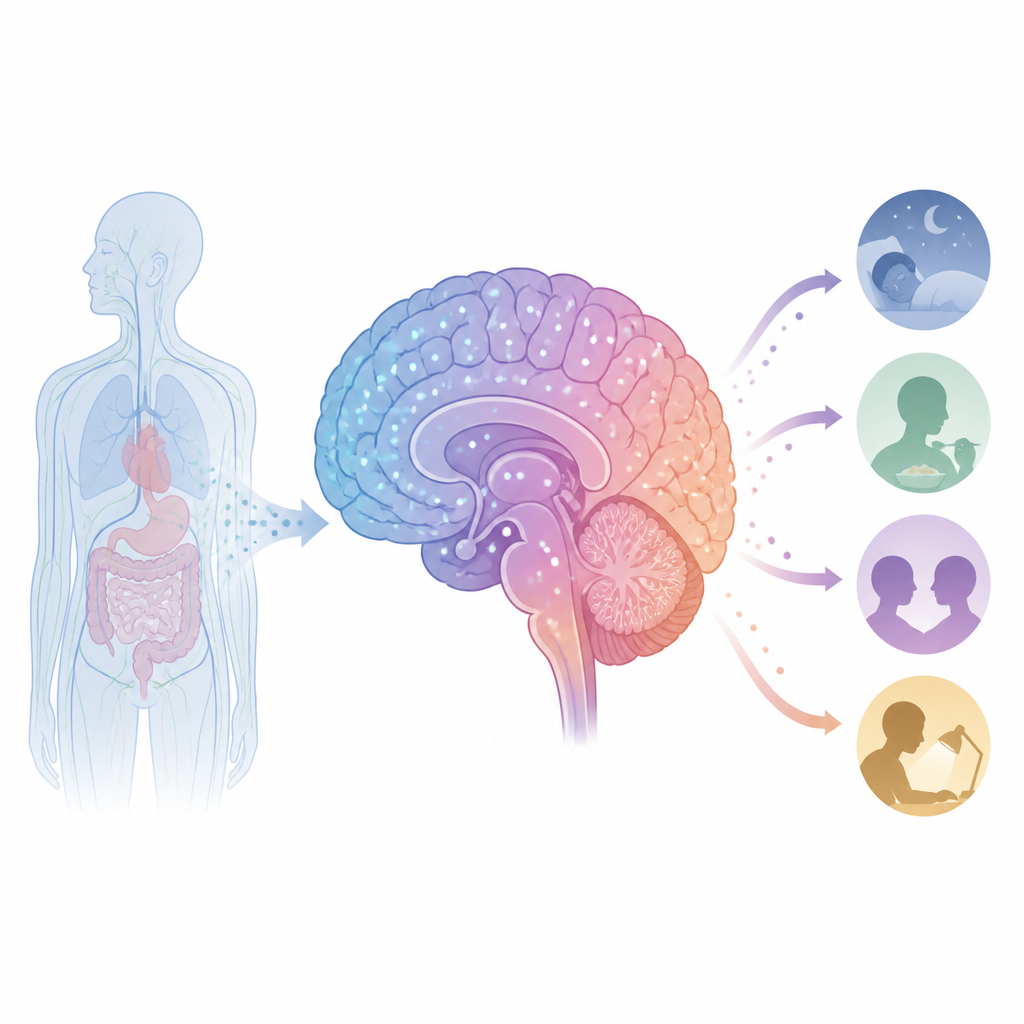
Slow Messages Across the Brain
Neuropeptides are short chains of amino acids released by neurons during sustained activity. Unlike the classic fast transmitters that jump across tight junctions between cells, neuropeptides spread more diffusely and linger longer. The researchers used gene expression data from donated human brains to estimate where 38 different neuropeptide receptors, grouped into 14 families, are expressed. By treating gene activity as a fingerprint for where each receptor is likely present, they built a topographic atlas covering both the wrinkled outer cortex and deeper subcortical structures. The resulting maps show that these receptors are not scattered randomly; instead, they follow clear spatial patterns that line up with known brain systems.
A Gradient from Body States to Thought
One of the strongest patterns is a gradient running between the cortex and the subcortex. Some receptors, such as those for somatostatin and melanin-concentrating hormone, are concentrated in the cortex and are especially common in regions that handle vision, movement, and attention. Others, including receptors for oxytocin, opioids, and natriuretic peptides, cluster in subcortical hubs like the hypothalamus, amygdala, and nucleus accumbens. Many of these deeper regions help regulate bodily needs, stress, and motivation. Within the hypothalamus itself, the team found that receptor expression varies along two axes that mirror well-known developmental and anatomical divisions, suggesting that neuropeptide systems are wired into the very blueprint by which this key control center forms.
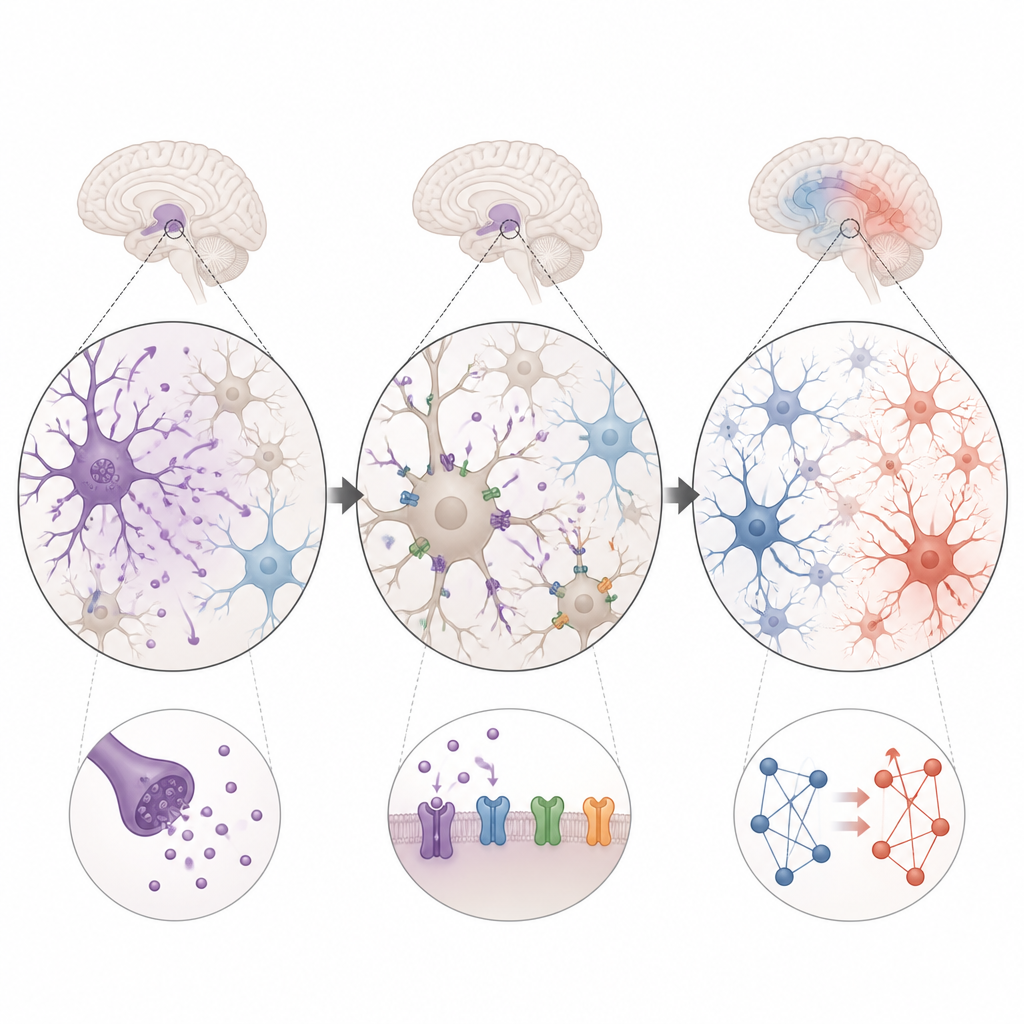
Sharing Space with Other Brain Chemicals
Because many neurons release neuropeptides alongside classic neurotransmitters, the authors asked how these systems overlap at the level of whole-brain maps. They compared the spatial patterns of neuropeptide receptors to those of 16 neurotransmitter receptors measured with positron emission tomography (PET). On average, about 60 percent of the variance in neuropeptide receptor distribution could be explained by these other receptor maps. The overlap was strongest with metabotropic receptors, which, like neuropeptide receptors, signal through slower, longer-lasting pathways inside cells. This suggests that brain regions rich in slow-acting molecular machinery serve as shared arenas where multiple chemical systems work together to tune circuits over longer timescales.
From Brain Chemistry to Behavior
To link these chemical patterns to behavior, the team tapped into a large database of brain imaging studies that associate particular regions with specific mental functions. A statistical approach identified a single dominant axis that paired neuropeptide maps with patterns of cognitive specialization. Cortically focused receptors were tied to terms related to sensory processing and higher cognition, such as visual attention, object recognition, and reading. In contrast, receptors enriched in subcortical regions aligned with terms linked to reward, anticipation, stress, sleep, anxiety, and eating. In other words, the same chemical gradient that separates cortex from subcortex also runs from bodily regulation and emotion to more abstract thought.
Tracing Neuropeptides Through Evolution
The study also probed how these signaling systems evolved by comparing neuropeptide receptor genes across 13 vertebrate species, from lamprey to chimpanzee. By examining patterns of genetic changes, the authors inferred when different receptor types experienced bursts of positive selection, a sign that they were being refined by evolutionary pressures. They found that genes for neuropeptide and other slow-acting receptors underwent extended periods of selection around the transition from early reptiles and birds to mammals, coinciding with the rise of the neocortex and more complex behavior. Receptors under earlier selection tend to be most active in subcortical regions today, while those refined later are more prominent in the cortex.
What This Means for Understanding Ourselves
Together, these findings show that neuropeptides provide a quiet but powerful layer of control that links bodily needs, emotional states, and higher mental functions. Their receptors are carefully arranged across the brain, intertwined with other slow-acting chemical systems, and shaped by deep evolutionary history. For a lay reader, the key message is that there is a chemical logic to how feelings in the gut, moods, and thoughts are coordinated. By charting where these slow messengers act, this work lays groundwork for future studies of how disruptions in neuropeptide signaling might contribute to disorders of mood, appetite, sleep, and cognition.
Citation: Ceballos, E.G., Farahani, A., Liu, ZQ. et al. Organization of neuropeptide systems in the human brain. Nat Neurosci 29, 1212–1224 (2026). https://doi.org/10.1038/s41593-026-02236-w
Keywords: neuropeptides, brain mapping, cognitive function, hypothalamus, neurotransmitters