Clear Sky Science · en
Persistent interferon signaling causes sensory neuron plasticity and pain before and during arthritis
Why joint pain can outlast joint swelling
Many people with rheumatoid arthritis find that even when their joints look less swollen, the pain stubbornly remains. This study asks a simple but important question: what if the real driver of arthritis pain lives not in the joints themselves, but in the nerves that sense them? By following pain pathways from the immune system to individual nerve cells, the researchers uncover a long‑lasting signal that keeps nerves on high alert before, during and after arthritis.
From harmless twinge to constant ache
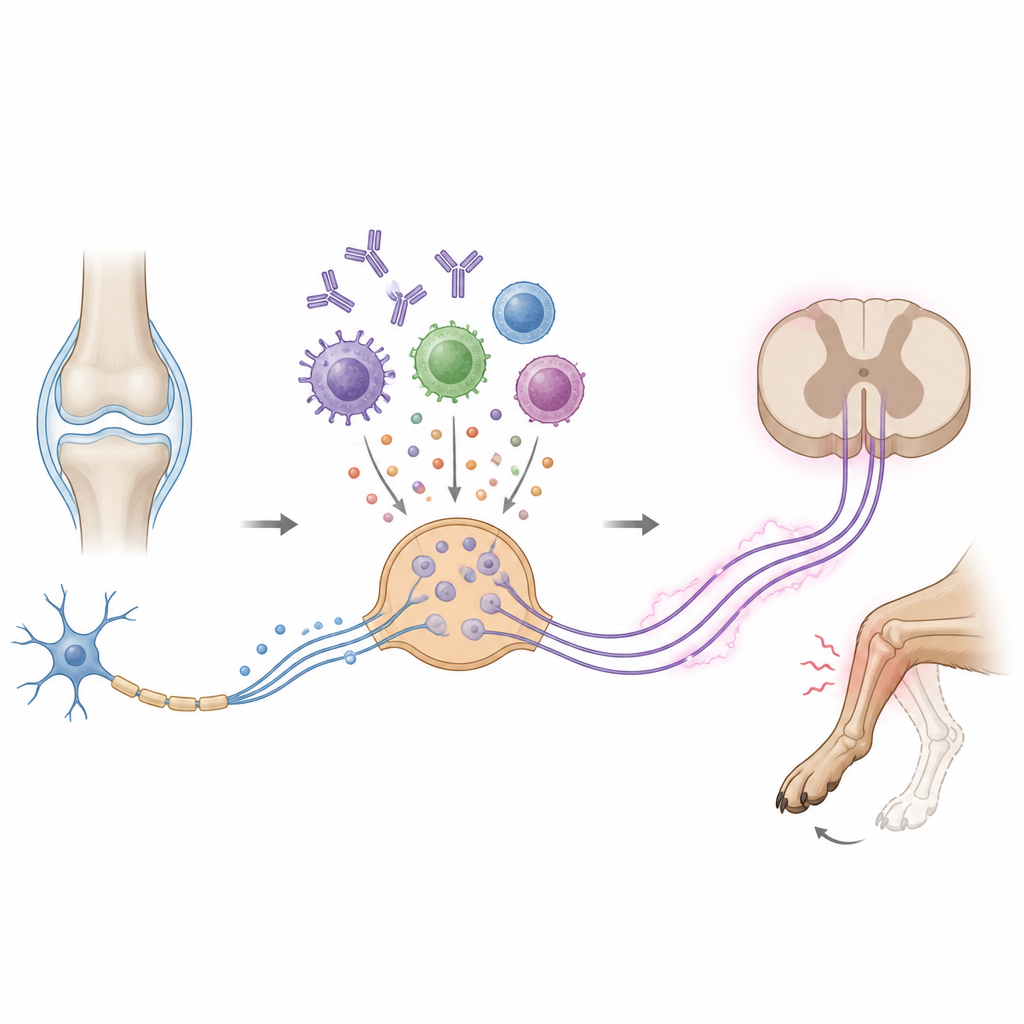
In people, joint soreness often shows up months or years before full‑blown rheumatoid arthritis. To mimic this, the team used mice given human‑like antibodies that attack cartilage. The animals quickly developed tenderness to light touch and cold in their paws, clumsier grip, and trouble holding their weight, and these problems began hours before visible joint swelling and lingered long after the swelling faded. Careful tests showed that many types of sensory nerve fibers, especially slow C‑fibers, became unusually easy to trigger and fired more signals than normal in response to gentle pokes.
Pinpointing the key pain‑signaling nerve type
Not all sensory nerves carry the same messages. Using genetic tools and tiny flashes of light, the researchers could turn selected nerve types on or off in living mice. They discovered that a specific group of C‑fiber nerves that innervate the joints and express a marker called GFRA3 were both necessary and sufficient for arthritis pain. When these nerves were gently boosted, normal touches became painful in arthritic mice; when they were silenced, joint pain, touch sensitivity and cold sensitivity all melted away, while normal pain sensing in healthy animals was largely preserved. This suggests that a defined nerve subtype acts as the main conduit for arthritis‑related pain.
The hidden storm inside spinal ganglia
The next mystery was why these joint‑sensing nerves stayed so irritable. The team focused on structures called dorsal root ganglia, clusters of nerve cell bodies that relay information from the limbs to the spinal cord. Soon after antibody treatment, these ganglia experienced a brief but intense “cytokine storm” as immune cells poured in and blood vessel and support cells released many signaling molecules. By sequencing RNA from tens of thousands of individual ganglion cells over time, the researchers saw that one family of immune messengers kept standing out: type 1 interferons, better known for fighting viruses.
A long‑lived pain switch in nerve cells
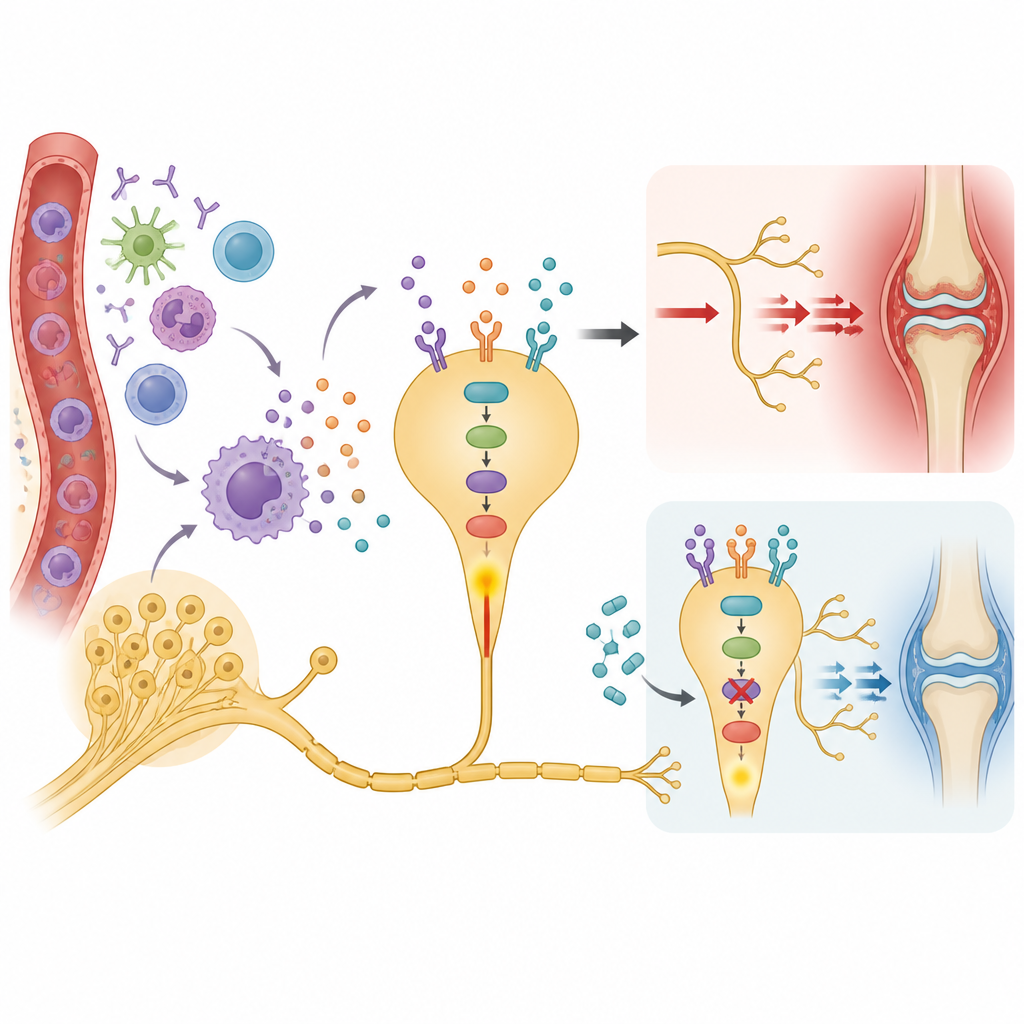
Type 1 interferons acted on receptors that were present on nearly all sensory neurons in mice, and also on human sensory neurons taken from donors with and without painful rheumatoid arthritis. In both species, dorsal root ganglia from individuals with arthritis pain contained more interferon and stronger activity in a specific internal pathway involving proteins called MNK1, MNK2 and eIF4E. Rather than changing which genes are turned on, this pathway alters how existing messages are translated into proteins, in effect “retuning” nerve cells. Electrical recordings from mouse neurons exposed to interferon showed that they fired more easily and more often, exactly what one would expect from nerves that now signal pain too readily.
Turning down the volume on arthritis pain
Encouragingly, blocking different steps in this interferon‑driven pathway calmed the sensitized nerves and eased pain behaviors in mice, even when arthritis was already well established. Antibodies that blocked the interferon receptor, a pill that targets an upstream enzyme called TYK2, and experimental drugs that inhibit MNK1/MNK2 or eIF4E all reduced touch and cold sensitivity, joint tenderness, and problems with grip and limb use. These treatments did not necessarily cure the joint inflammation itself but did disconnect it from ongoing pain, pointing to a way to treat suffering without suppressing the entire immune response.
What this means for people living with arthritis
This work suggests that persistent pain in rheumatoid arthritis is not just a leftover scar of damaged joints, but the result of a continuing conversation between immune cells and a small set of joint‑sensing nerves. A virus‑fighting signal, type 1 interferon, is repurposed to keep these nerves in a hyperactive state via the MNK–eIF4E route. For patients, this raises the possibility that carefully targeting this pathway could one day offer pain relief that is more precise, longer lasting and less dependent on broad immune suppression.
Citation: Su, J., Zhang, MD., Kupari, J. et al. Persistent interferon signaling causes sensory neuron plasticity and pain before and during arthritis. Nat Neurosci 29, 1095–1108 (2026). https://doi.org/10.1038/s41593-026-02234-y
Keywords: rheumatoid arthritis pain, type 1 interferon, sensory neurons, dorsal root ganglion, MNK eIF4E signaling