Clear Sky Science · en
The prefrontal cortex controls memory organization in the hippocampus
How the Brain Keeps Our Memories Straight
Why do some experiences automatically remind you of one another, while others stay neatly separate in your mind? This study in mice explores how the front of the brain talks to a key memory area to decide when memories should be linked and when they should be kept apart, offering clues to problems like false memories and certain psychiatric symptoms.
When Memories Help or Get in the Way
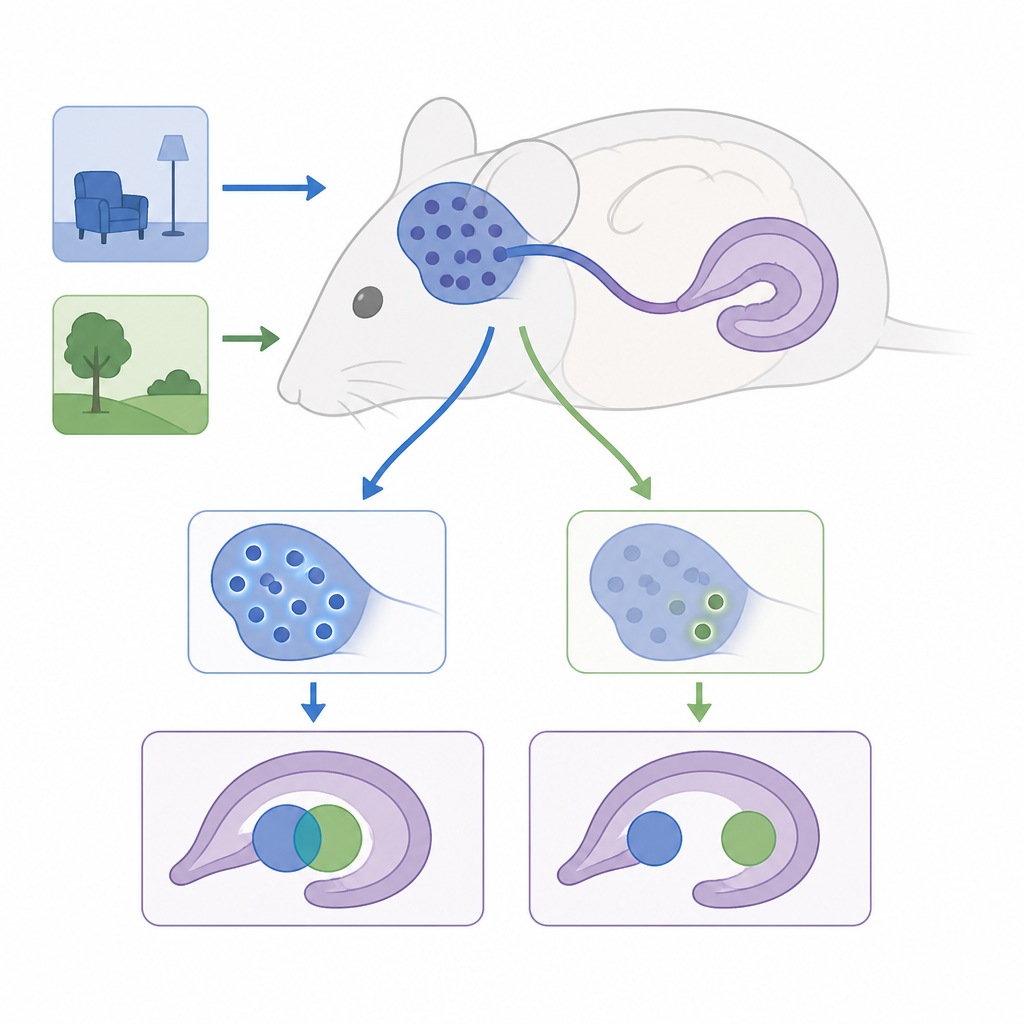
Our memories do not form in isolation. Each new event arrives in a mind already filled with past experiences. Sometimes this is helpful: learning a new route in your neighborhood is easier if it resembles streets you already know. Other times, it can be harmful, as when unrelated events become tangled and lead to mistaken fears or beliefs. The researchers focused on two brain regions that are central to this balancing act. One is the hippocampus, long known as a hub for forming memories of places and events. The other is the ventromedial prefrontal cortex, a part of the frontal lobe thought to hold long-term knowledge and abstract patterns. They asked how these regions work together over time to decide whether two experiences should share the same memory cells or stay distinct.
Timing and Place Shape Memory Links
Using tiny head-mounted microscopes, the team watched activity in frontal neurons while mice explored boxes that differed in appearance and smell. Earlier work had shown that if mice encounter two contexts just a few hours apart, their memories tend to be linked, regardless of how the boxes look. But if the same contexts are separated by a week, they are only linked when the boxes are very similar. Here, the scientists found that the ventromedial prefrontal cortex was especially active when mice explored two clearly different contexts a week apart, a situation in which memories are normally kept separate. In contrast, this frontal activity was lower when the contexts were the same or when experiences were close in time, both conditions that favor integration.
Turning Frontal Control On and Off
To test whether this frontal activity actually controls memory organization, the researchers temporarily silenced ventromedial prefrontal neurons during the second of two experiences spaced a week apart. Later, the mice were shocked in the second context and tested for fear in the first. Under normal conditions, mice treated the first context as safe. But when the frontal area had been turned off during learning, the animals froze in the first context as if it predicted shock, showing that the two memories had been wrongly linked. Imaging the hippocampus revealed why: the same sets of cells were reused for both contexts much more often, indicating that the frontal cortex normally limits overlap between these memory “ensembles” when the experiences are unrelated.
A Hidden Relay and a Cellular Gatekeeper
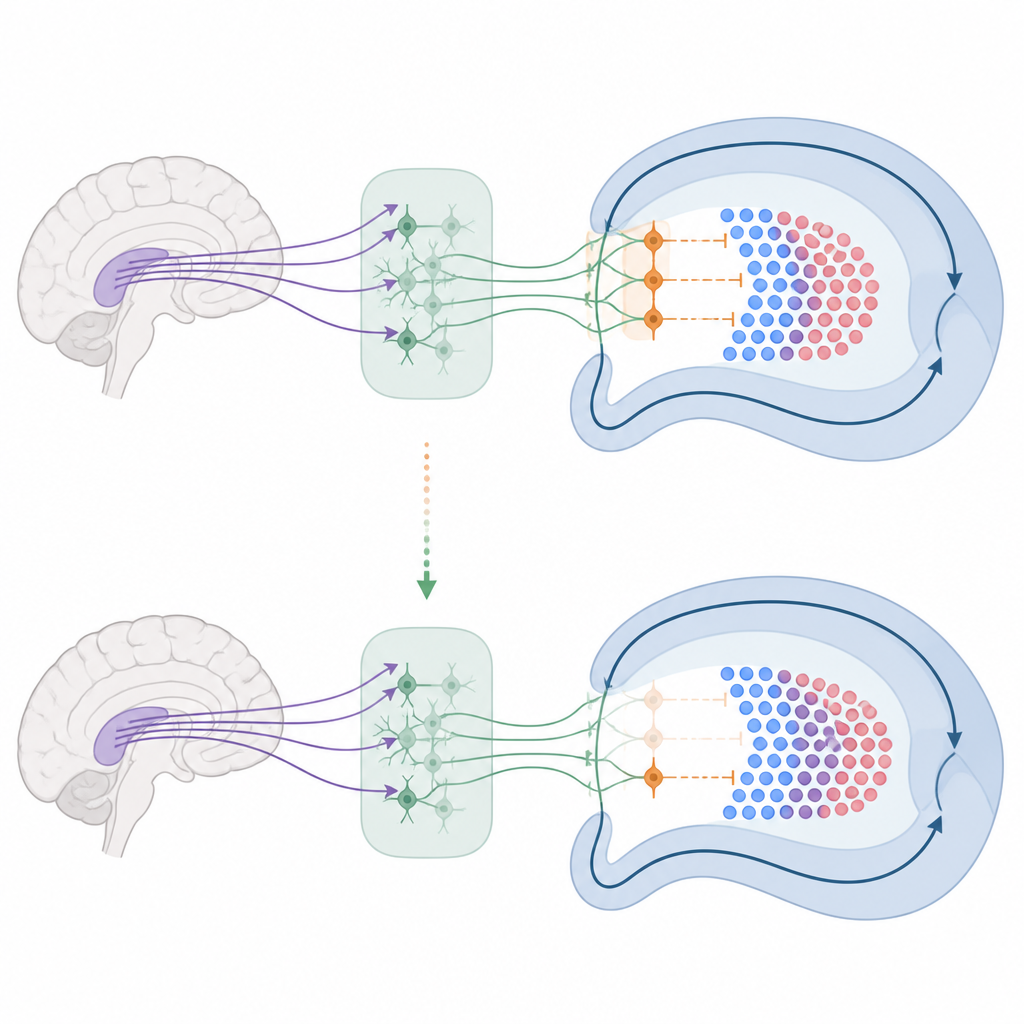
The study then traced the pathway that carries this top-down control. By combining viruses that label and manipulate specific connections, the team showed that projections from the ventromedial prefrontal cortex to the medial entorhinal cortex, a gateway into the hippocampus, are both necessary and sufficient to reshape memory overlap. Silencing just these projection neurons during distant experiences caused extra reuse of hippocampal cells and behavioral linking, while activating the pathway reduced overlap even when conditions normally favor integration. Within the hippocampus, a special class of inhibitory neurons in a layer called the stratum lacunosum moleculare emerged as crucial gatekeepers. These neurogliaform cells became less active when memories were integrated and more active when they were kept apart. Directly dampening their activity increased overlap between memory ensembles, mimicking the effects of cutting frontal or entorhinal input.
Why This Matters for Everyday Memory
Put together, the findings support a picture in which the front of the brain monitors prior knowledge and context, then uses a relay through the medial entorhinal cortex to adjust how the hippocampus assigns new experiences to its cells. This circuit can either encourage two events to share neuronal “space,” binding them together, or recruit fresh cells so that memories remain distinct. For a lay observer, the key message is that memory organization is not just about how strongly we store events, but about which events are allowed to share brain resources. Disruptions to this prefrontal control system may help explain why some conditions feature tangled, unreliable memories, and they point to specific neural circuits that future work might target to help keep our recollections accurate and appropriately connected.
Citation: de Sousa, A.F., Zeidler, Z.E., Almeida-Filho, D.G. et al. The prefrontal cortex controls memory organization in the hippocampus. Nat Neurosci 29, 1191–1202 (2026). https://doi.org/10.1038/s41593-026-02231-1
Keywords: memory linking, prefrontal cortex, hippocampus, entorhinal cortex, neural circuits