Clear Sky Science · en
Orbitofrontal cortex drives predictive filtering of sensory responses
A Brain That Learns to Tune Out
Everyday life is filled with repeating sounds: the hum of a refrigerator, distant traffic, the ticking of a clock. Most of the time, we barely notice them. This ability to gradually ignore familiar, harmless stimuli—called habituation—keeps our senses from being overwhelmed. When this filtering fails, the world can feel painfully intense, as often reported in autism and other conditions with sensory hypersensitivity. This study asks a deceptively simple question: how does the brain learn which sounds to ignore?
From Simple Habits to Smart Predictions
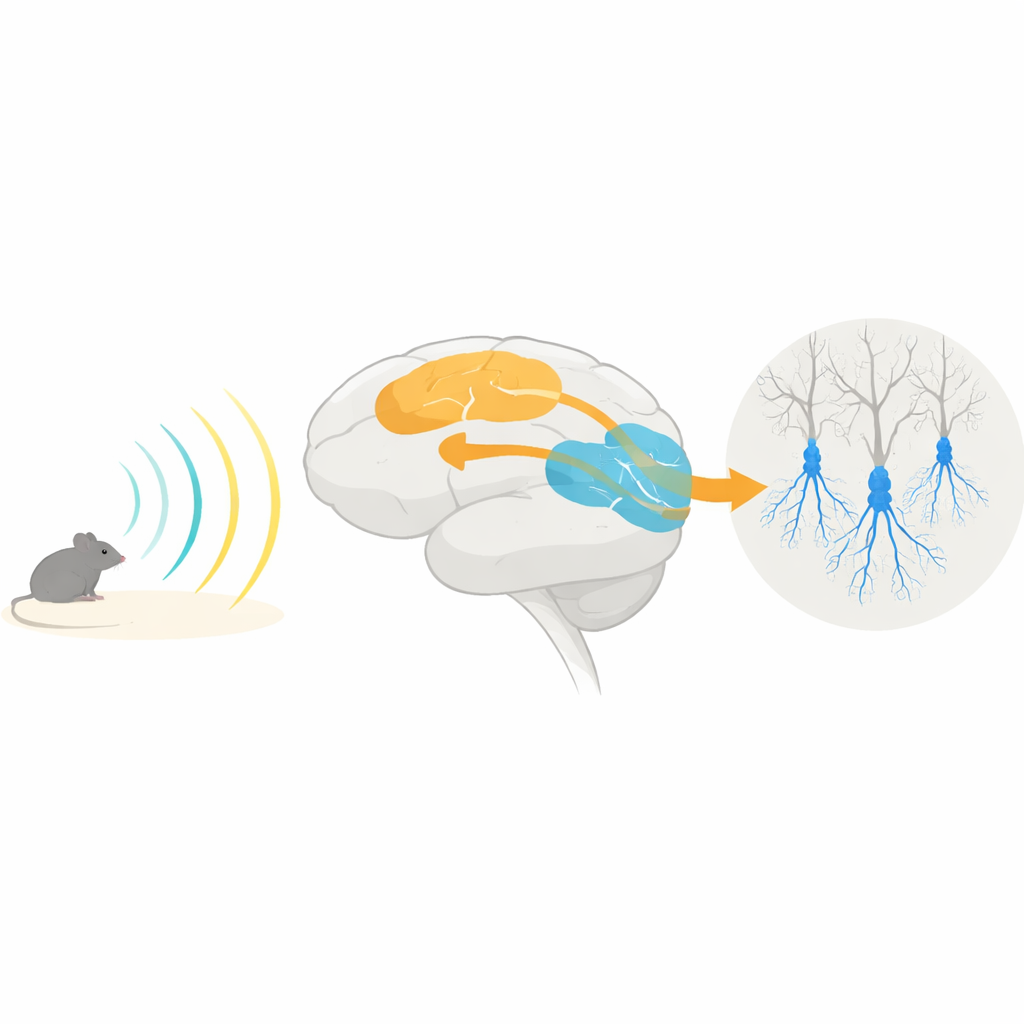
Habituation is often described as the most basic form of learning, as if sensory pathways simply “tire out” with repetition. But many observations do not fit this simple picture. Habituation to everyday sounds can last for days or weeks, depends on context, and breaks down under anesthesia. These clues suggest that more sophisticated brain systems are involved, using internal models of the world to predict which inputs are safe to ignore. The authors focused on two competing ideas. One is the “predictive negative image” hypothesis: higher brain areas learn to anticipate repeated stimuli and send signals that cancel out their expected impact. The other is the “novelty” hypothesis: unfamiliar events briefly gain an extra boost from top-down signals, and responses fade only when this novelty-driven amplification wanes.
Watching the Hearing Center Change Over Days
To compare these ideas, the researchers repeatedly played the same pure tone to awake mice over several days while tracking thousands of individual neurons in the primary auditory cortex, the brain’s first major sound-processing area. They found two distinct kinds of change. Within each day, responses quickly dropped across the first few trials, mainly at sound onset, reflecting a fast, bottom-up form of adaptation. Across days, however, a slower form of habituation emerged: activity during the sustained part of the tone gradually weakened, and inhibitory signals grew stronger. This long-term change was not explained by general drowsiness or shifts in arousal, as pupil measurements showed that responses on later days were smaller than on day one regardless of how large the pupil was. The across-day component therefore pointed to a slower, top-down process shaping how sound is filtered.
A Frontal Brain Region Learns the Sound and Pushes Back
The team next hunted for where these top-down signals originate. Using anatomical tracing, they found that the orbitofrontal cortex (OFC)—a frontal region best known for encoding expectations and values—sends strong projections to the auditory cortex, especially to a class of inhibitory cells called somatostatin-expressing neurons. When the OFC was temporarily silenced after several days of sound exposure, something striking happened: the previously weakened responses in auditory cortex rebounded, while the activity of those somatostatin cells fell and other neurons became more responsive. Silencing OFC before any exposure, in contrast, did almost nothing. This pattern supports the predictive negative image idea: after learning, frontal circuits send prediction signals that actively suppress expected sounds, and turning off this prediction unmasks the original strong responses.
How the Brain Builds a “Negative Image” of Sound
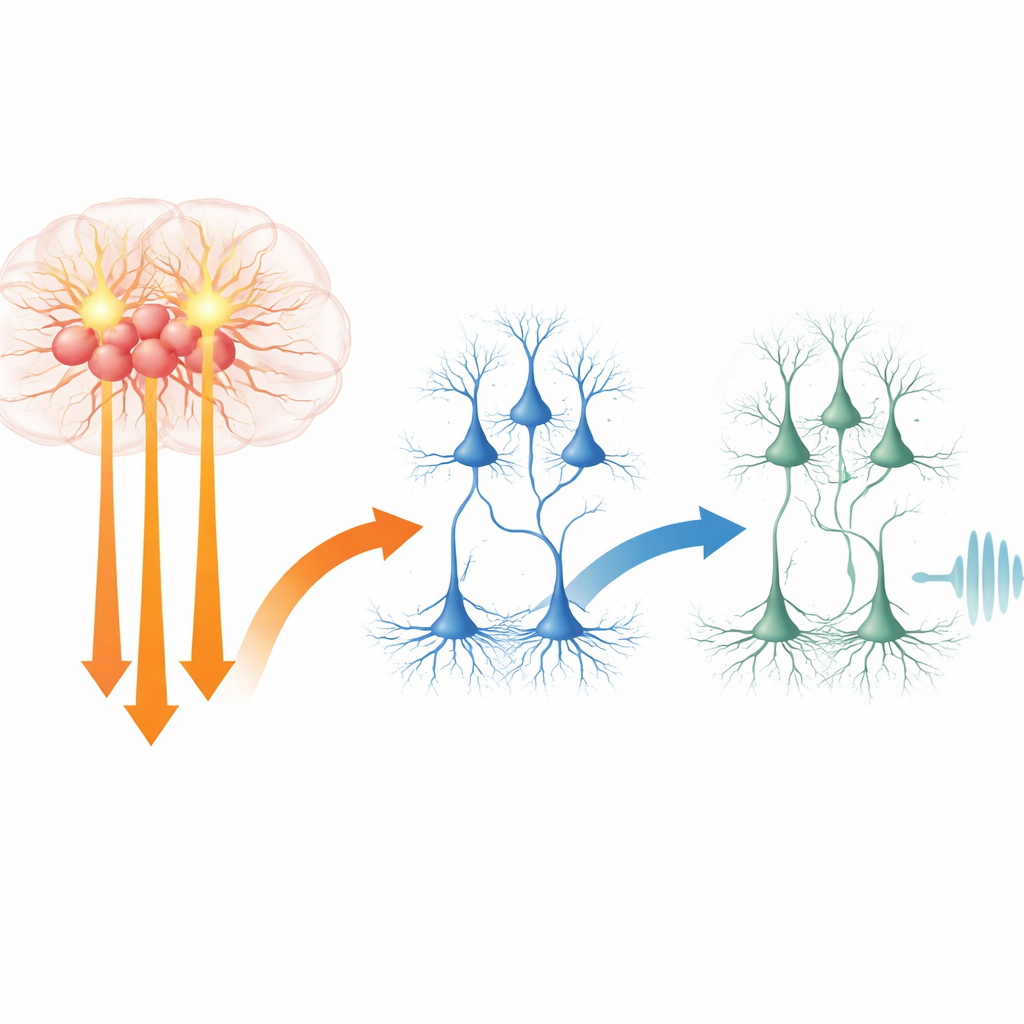
To see whether the OFC truly carries predictive information, the authors imaged the activity of its fibers projecting into auditory cortex during days of repeated sound. Over time, these inputs became more active—especially during the later portion of the tone—mirroring the slow build-up of habituation. Recording directly from single neurons showed that this strengthening was specific to OFC and not seen in nearby frontal regions. Artificially activating the OFC-to-auditory pathway was sufficient to dampen auditory responses, confirming that this feedback can impose filtering. Crucially, when two different tones were used but only one was repeated across days, OFC projections strengthened specifically for the repeated tone, and auditory neurons reduced their responses only to that sound. Silencing OFC after learning selectively restored responses to the familiar tone but had little effect on the rarely heard one. Together, these results reveal a sound-specific predictive signal that targets inhibitory circuits to cancel expected inputs.
Fine-Tuning the Filter with Plastic Inhibitory Cells
Building a reliable filter also requires local changes in the auditory cortex itself. The researchers tested this by disrupting a key molecular mechanism for synaptic plasticity, the NMDA receptor, either in all cortical neurons or selectively in specific inhibitory cell types. Removing these receptors broadly in auditory cortex weakened long-term habituation without simply reducing basic hearing. More tellingly, deleting them only in somatostatin cells also blunted habituation, while removing them from a different inhibitory class (VIP cells) did not. This indicates that somatostatin neurons do not just relay frontal predictions; they also adjust their own connections over time, allowing the “negative image” of a familiar sound to grow stronger and more precise.
Why This Matters for an Overwhelming World
Put together, the study shows that habituation is not merely sensory fatigue but an active prediction process. The orbitofrontal cortex learns the pattern of repeated sounds, sends a matching signal down to the auditory cortex, and engages plastic inhibitory circuits to cancel out the expected input. In everyday terms, the brain draws an internal outline of unimportant noises and subtracts it from what we hear, freeing attention for things that are new or meaningful. When this long-range predictive system is weakened—as may occur in autism and other disorders—the world’s background sounds may never fully fade, contributing to sensory overload. Understanding this frontal-to-sensory “filtering loop” thus offers a concrete neural target for future efforts to ease hypersensitivity and restore a calmer perceptual experience.
Citation: Tsukano, H., Garcia, M.M., Dandu, P.R. et al. Orbitofrontal cortex drives predictive filtering of sensory responses. Nat Neurosci 29, 888–900 (2026). https://doi.org/10.1038/s41593-026-02217-z
Keywords: sensory habituation, predictive processing, orbitofrontal cortex, auditory cortex, sensory hypersensitivity