Clear Sky Science · en
Neuronal tuning aligns dynamically with object and texture manifolds across the visual hierarchy
How the Brain Sees More Than Just Things
When you glance at a busy street, your brain instantly extracts meaning from a jumble of cars, faces, leaves and shadows. But individual brain cells do not just light up for neat categories like “car” or “face.” They often respond to many unrelated images, leaving scientists puzzled about what these cells really care about. This study uses advanced image-generating artificial intelligence to let single neurons “design” their favorite pictures, revealing how the brain balances sensitivity to detailed textures with recognition of whole objects.
Two Different Visual Worlds
The researchers worked with two powerful image generators, each with a different visual “accent.” One, called DeePSim, is especially good at producing rich textures and patterns, but its images often lack clear, recognizable objects. The other, BigGAN, is trained to create sharp, photo-like pictures filled with distinct items such as animals and tools. By treating these generators as alternative ways to carve up the space of possible images, the team could ask whether brain cells align more with a texture-centric or an object-centric view of the world.
Letting Neurons Pick Their Own Pictures
In macaque monkeys, the scientists recorded activity from neurons along the ventral visual pathway—a chain of brain areas that helps turn raw sight into object recognition. They focused on three stations: V1 (early visual cortex), V4 (an intermediate area) and PIT (posterior inferotemporal cortex, a high-level area). During experiments, each neuron’s firing rate guided a closed-loop search through each generator’s image space. In rapid sequences, the neuron was shown synthetic images; the ones that triggered more spikes nudged the generator toward similar images in the next round. Over many generations, this “evolution” produced highly activating images in both the texture and object spaces. 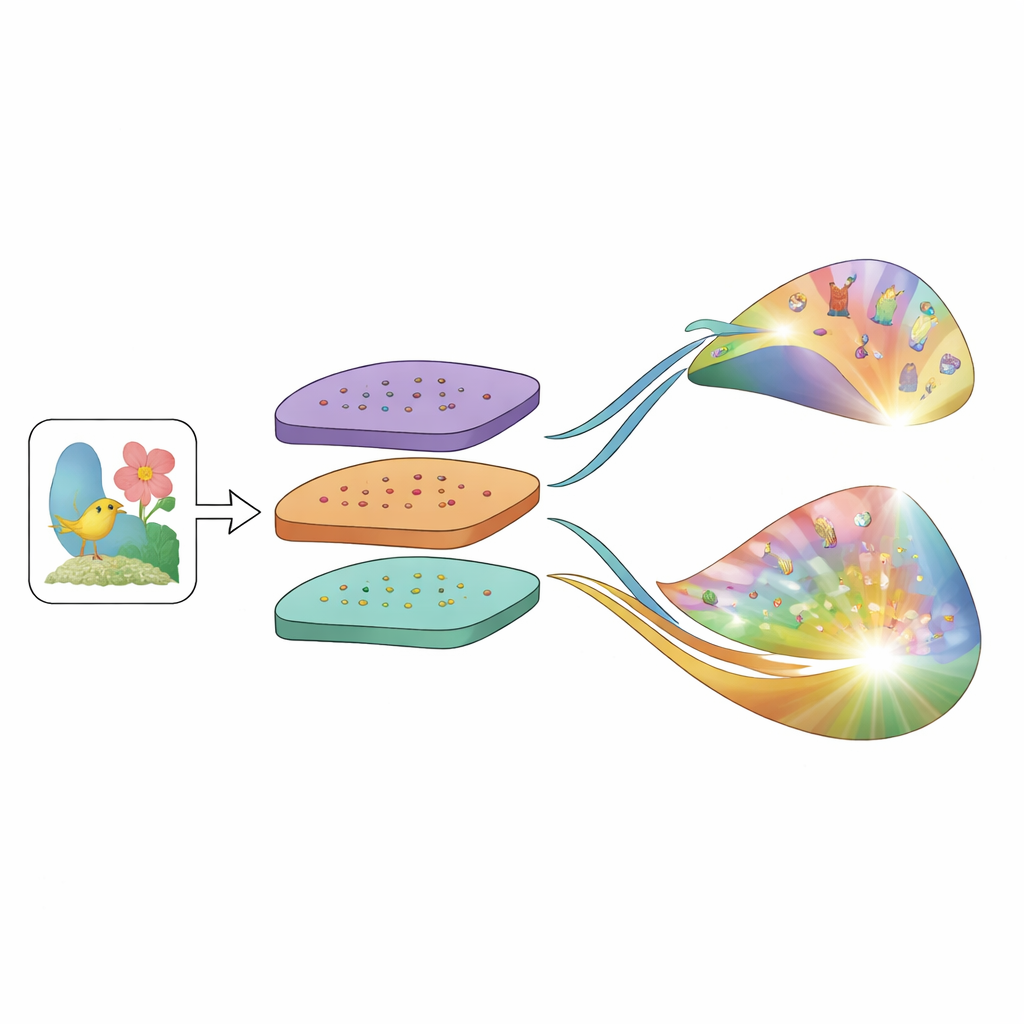
Hidden Local Features, Not Just Whole Objects
Surprisingly, when a neuron optimized images in the texture-focused space and in the object-focused space, the final pictures often looked globally different but shared a specific local motif—such as a curved edge or colored patch—at a similar location. Analyses using deep neural networks confirmed that these paired images were more alike, in feature space, than images optimized for different neurons. Spatial maps showed that the neuron’s activity was best predicted by particular regions within the images, suggesting that many cells respond to recurring local building blocks that can appear across very different scenes, rather than to a single, rigid object template.
Shifting Balance from Textures to Objects
The team then asked how easily neurons in each brain area could “climb” to a strong response within each image space. In early areas V1 and V4, optimization in the texture space succeeded more often, climbed faster and reached higher peak responses than in the object space, revealing a clear texture bias. In PIT, however, neurons performed well in both spaces: they could be driven strongly by either texture-like or object-like synthetic images, and optimization speeds became comparable. Looking at response timing added another twist. In PIT, texture-based images tended to boost early responses, whereas object-based images more strongly engaged later, sustained firing, hinting that object-focused processing emerges more slowly in time.
Maps of Preference in Object Space
To probe the fine shape of these preferences, the researchers carried out “Hessian tuning” experiments in the object generator’s latent space. After a neuron had reached a strong response to an optimized object-like image, they systematically sampled images along many directions around that point. When optimization had truly found a high peak, the neuron’s firing typically formed bell-shaped curves along these directions, rising and then falling as images moved away from the preferred one. When optimization had not reached a strong peak, tuning curves often looked more like ramps. This shows that whether a neuron appears to have a narrow favorite or a gradual preference can depend on how thoroughly we search the enormous space of possible images. 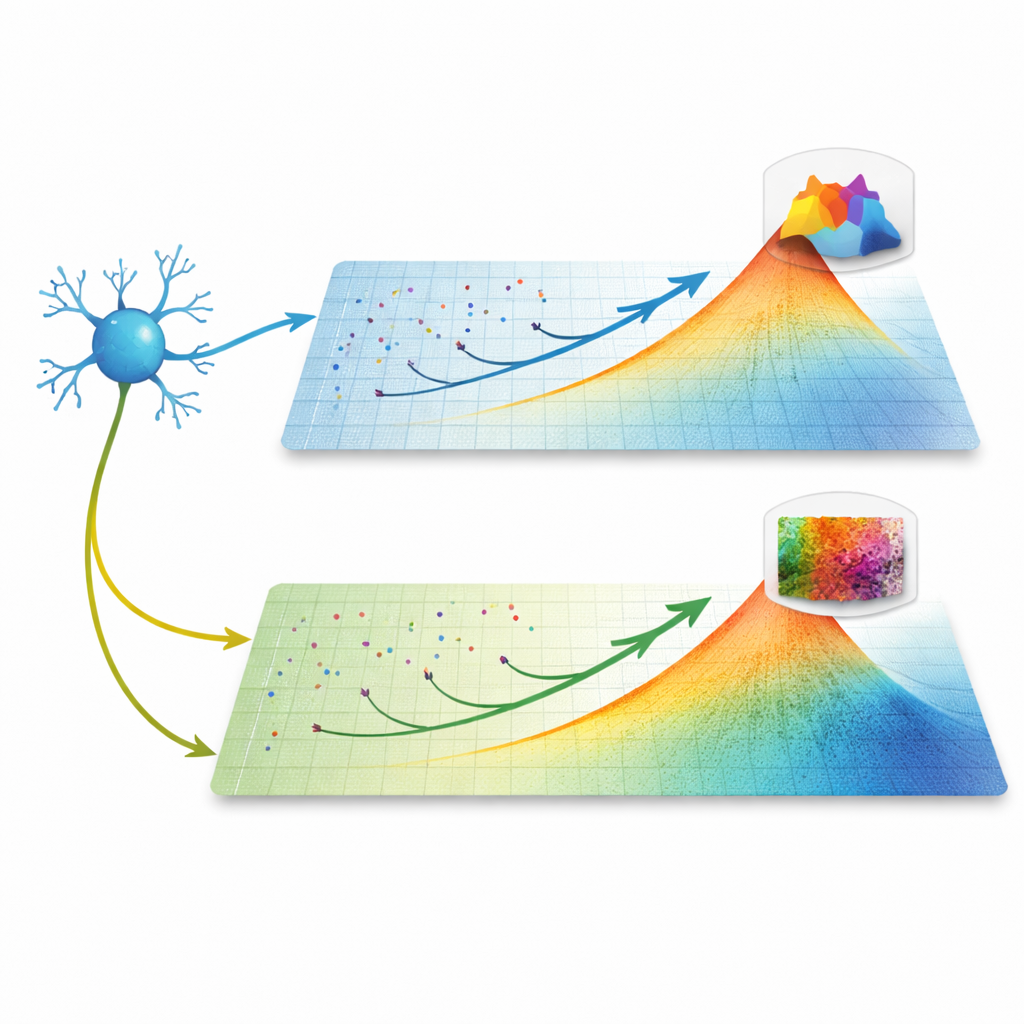
What This Means for Understanding Vision
Overall, the study paints a picture of the ventral visual pathway as a flexible system that starts out favoring textures and gradually gains an equally strong handle on object structure. Rather than coding whole objects as indivisible units, neurons seem to prioritize reusable local features that can be combined into many different scenes. High-level PIT neurons can align with both a texture-based and an object-based description of the visual world, a versatility that current artificial networks still struggle to match. For a lay observer, the key message is that our brains are not simply “object detectors”: they are sophisticated pattern engines that can read meaning from both fine-grained textures and whole shapes, switching emphasis over space and time to support the rich visual experience we take for granted.
Citation: Wang, B., Ponce, C.R. Neuronal tuning aligns dynamically with object and texture manifolds across the visual hierarchy. Nat Neurosci 29, 864–875 (2026). https://doi.org/10.1038/s41593-026-02207-1
Keywords: visual cortex, object recognition, texture processing, generative models, neuronal tuning