Clear Sky Science · en
Predicting referral need for febrile children in low-resource community settings in South and Southeast Asia
Why fevers in children can be frightening
For parents, a child with a high fever can be terrifying, especially in villages where the nearest hospital may be hours away. Health workers in these settings must decide, often with limited tools, which children can safely stay at home and which ones might be at risk of life threatening illness and need urgent referral. This study explores how simple bedside checks and affordable tests could make those decisions more accurate, saving lives while avoiding unnecessary, costly trips to distant hospitals.
Everyday fevers, rare but deadly turns
Most fevers in young children are caused by infections that clear on their own. Yet a small fraction quickly spiral into conditions such as severe pneumonia or sepsis, which can be fatal without hospital care. In many low resource communities across South and Southeast Asia, families face long journeys, lost wages and treatment costs if a child is referred. At the same time, missing a child who is about to deteriorate can have tragic consequences. Current World Health Organization guidance relies on visible danger signs like convulsions or extreme tiredness, but these have proved unreliable and vary between observers. The authors set out to build better ways to judge risk at the first point of contact in the health system.
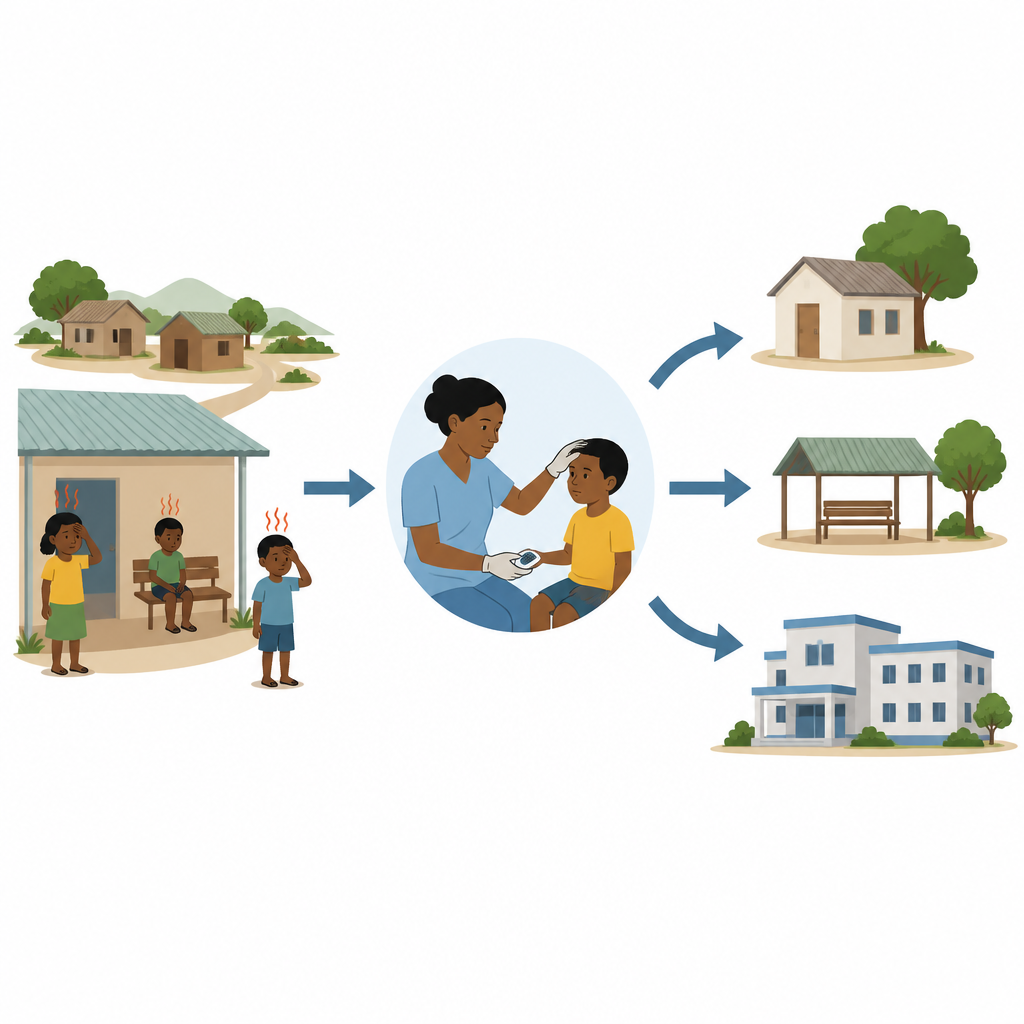
Following thousands of sick children across five countries
Researchers enrolled 3,405 children aged between 1 month and just under 5 years who arrived at seven hospitals in Bangladesh, Cambodia, Indonesia, Laos and Vietnam with recent onset fever. These hospitals serve largely rural populations and were chosen to represent the types of places where families first seek help. Staff carefully recorded simple clinical information, such as heart rate, breathing rate, level of alertness, vomiting and convulsions. They also measured oxygen levels in the blood using a fingertip device and, in a subset, levels of molecules in the blood that reflect how strongly the immune and blood vessel systems are reacting to infection.
Building a traffic light style decision tool
The team used these data to design and test several prediction models. One relied only on basic clinical checks. Others added either pulse oximetry, a measure of blood oxygen, or a blood marker called soluble TREM1 (sTREM1), which signals strong immune activation. A fourth model combined both tests. Each model estimated the chance that a child would die or need organ support, such as mechanical breathing or medicines to support the heart, within two days. The researchers then imagined a simple traffic light approach: children with very low predicted risk could be sent home (green), those with high risk should be sent to a higher level hospital (red), and those in between should be closely observed or followed up (amber).
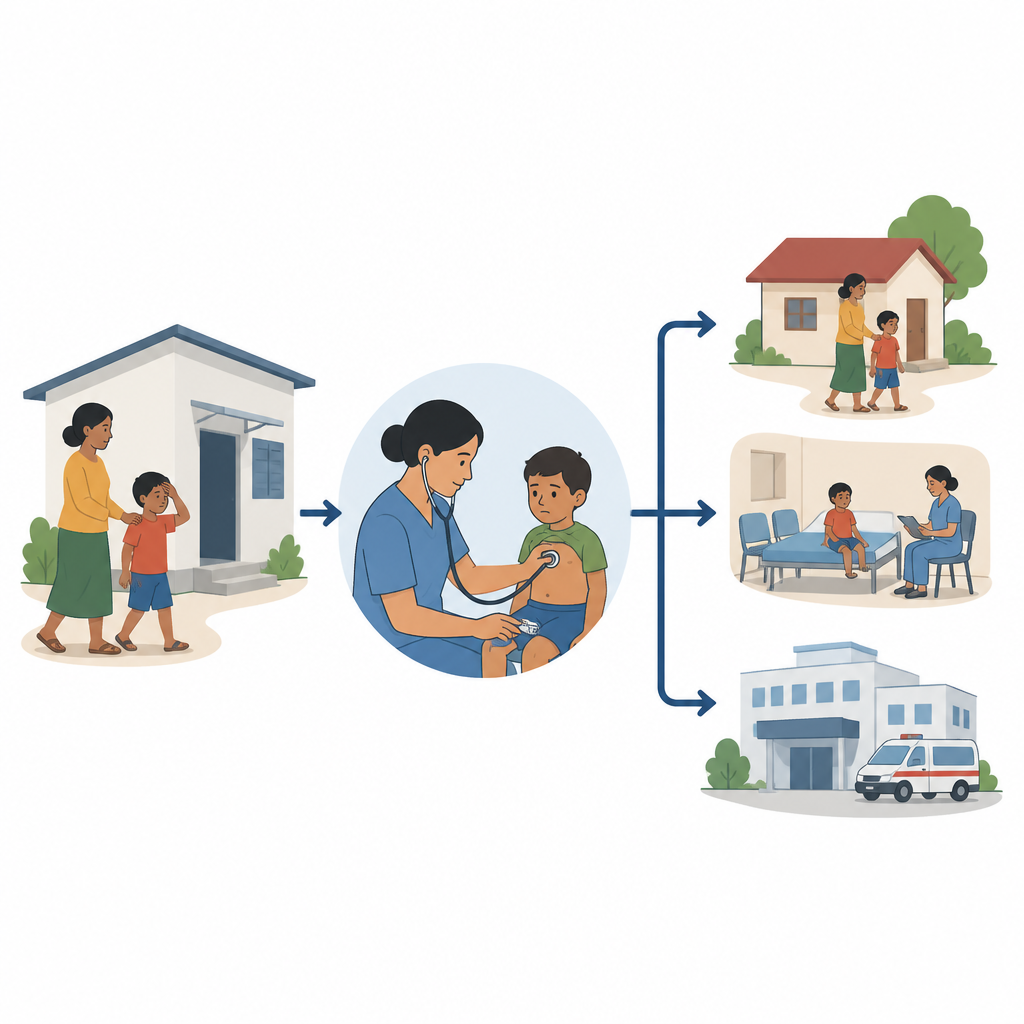
Better targeting of scarce hospital referrals
All new models outperformed the existing WHO danger sign criteria. The clinical model alone was already more accurate, but it still missed about one quarter of children who went on to become severely ill. Adding pulse oximetry or sTREM1 greatly improved the ability to rule out serious disease, correctly identifying around nine out of ten children who would later need life saving support while recommending far fewer referrals. The pulse oximetry model, in particular, tripled the precision of referrals, meaning that a much higher share of children sent to hospital truly needed critical care, and it did so while cutting the overall referral rate to a fraction of that generated by WHO danger signs.
Balancing safety, cost and practicality
The study also examined how these tools might affect health system costs. Using data from Bangladesh, the authors estimated that integrating pulse oximetry or sTREM1 testing into triage would be cost saving compared to current practice, when measured by the cost per year of healthy life preserved. The pulse oximetry model offered the best balance of accuracy and affordability, especially where referral is expensive, while the sTREM1 based approach may be more practical for lightly trained community workers if combined with rapid tests they already use. The models were particularly strong at picking up the youngest children with pneumonia, who carry a high risk of death, although some older children and those with more subtle illness could still be missed.
What this means for families and frontline clinics
To a lay reader, the key message is that combining careful observation with a small set of simple measurements can greatly improve decisions about which febrile children need urgent hospital care in low resource settings. Rather than relying on dramatic warning signs that often appear late, these tools use patterns in common signs and a quick check of blood oxygen or a single blood marker to quietly flag trouble earlier. If confirmed in real world trials, such traffic light style triage could help rural clinics send the right children to hospital at the right time, reduce unnecessary and costly journeys for families and strengthen trust in community based care.
Citation: Chandna, A., Koshiaris, C., Mahajan, R. et al. Predicting referral need for febrile children in low-resource community settings in South and Southeast Asia. Nat Med 32, 1907–1916 (2026). https://doi.org/10.1038/s41591-026-04338-1
Keywords: febrile children, pulse oximetry, child triage, low resource settings, severe infection risk