Clear Sky Science · en
A deep joint-learning proteomics model for diagnosis of six conditions associated with dementia
Why a Simple Blood Test for Brain Health Matters
Dementia is not one single disease but a family of brain disorders that often overlap, making diagnosis slow, costly and uncertain. This study asks a hopeful question: could a single blood test, interpreted by artificial intelligence, help doctors spot several different brain conditions linked to dementia at once, long before severe memory loss appears?
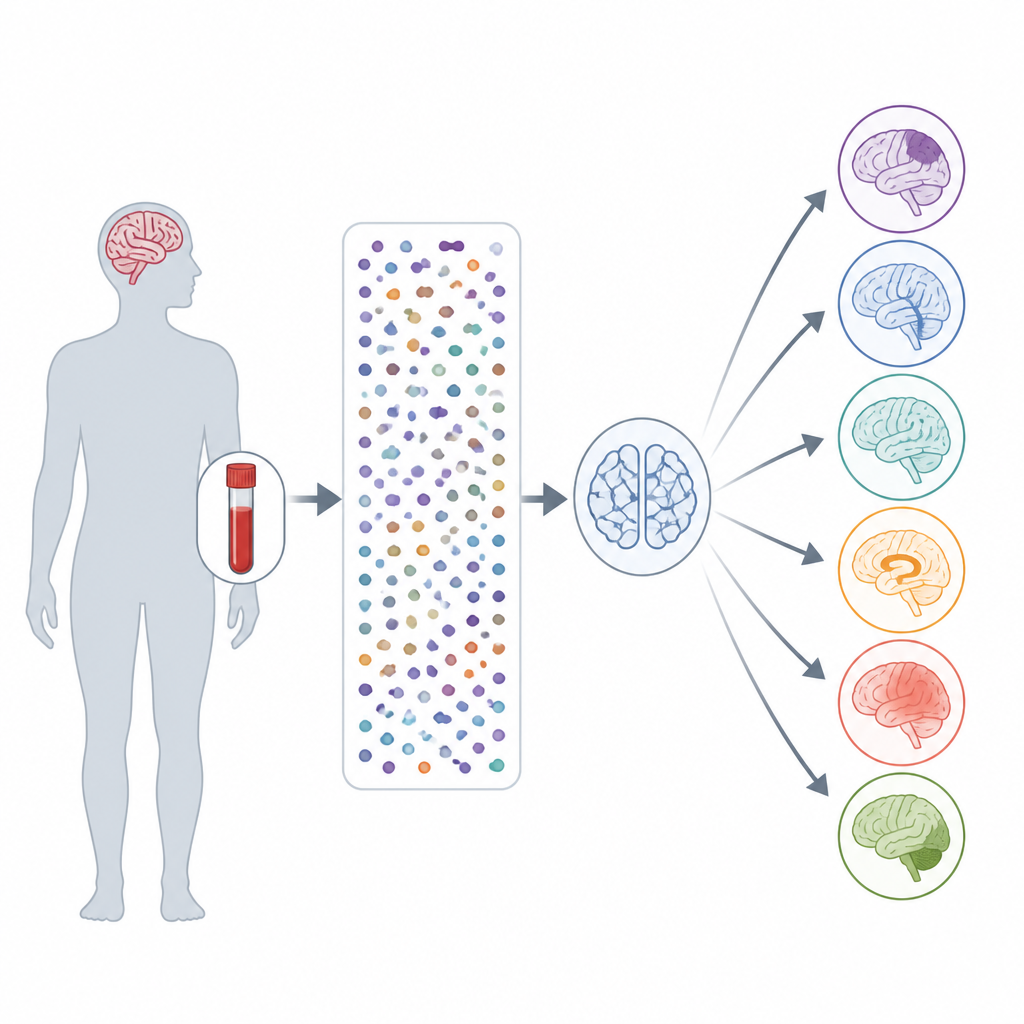
Turning a Blood Sample into a Brain Health Snapshot
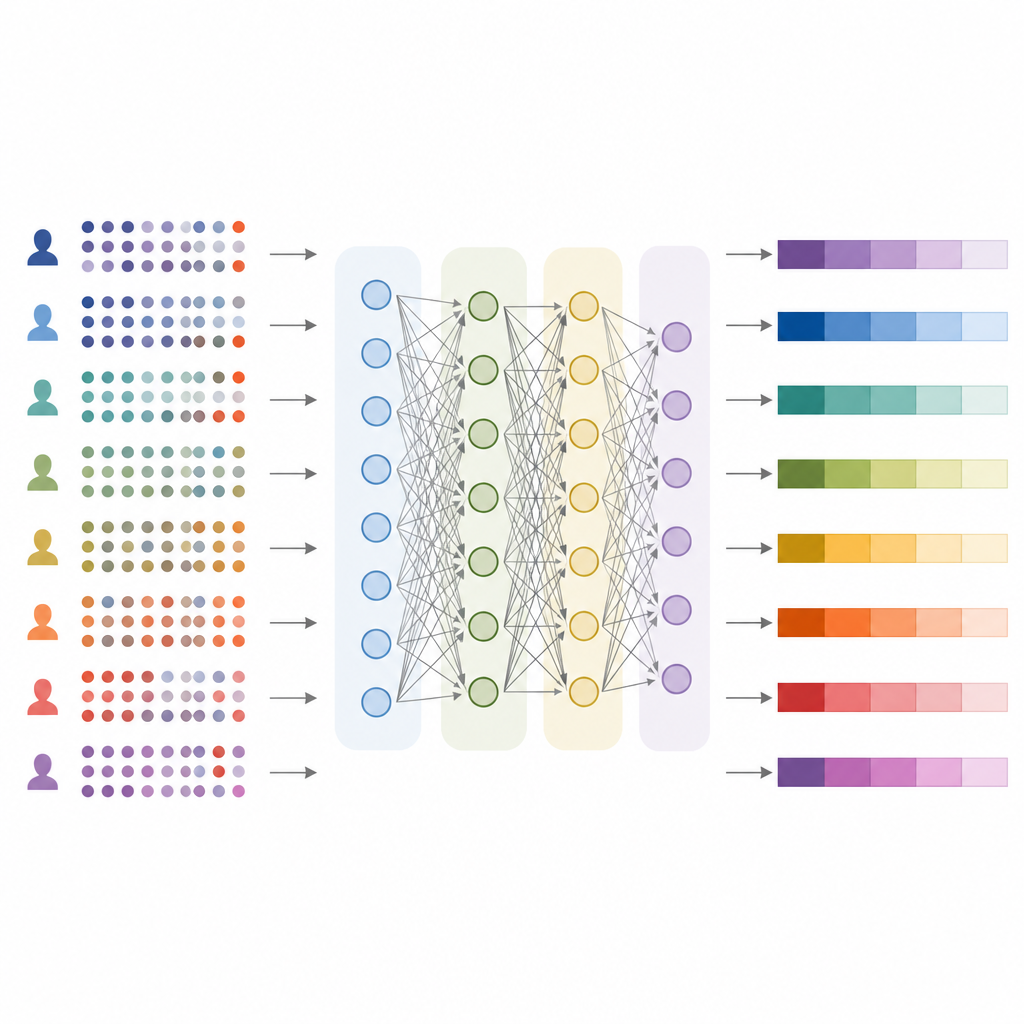
The researchers built a system called ProtAIDe-Dx that looks at thousands of proteins floating in a person’s blood and uses them to estimate the chance of six conditions tied to dementia: Alzheimer’s disease, Parkinson’s disease, frontotemporal dementia, amyotrophic lateral sclerosis, past stroke or mini-stroke and normal cognition. Instead of scanning the brain or collecting spinal fluid, the approach relies on a standard blood draw and a laboratory technique that can measure more than 7,000 proteins at once. A deep-learning model is then trained to recognize patterns in these proteins that tend to show up in people with each condition.
How Well the Blood-Based AI Test Performs
The team trained and tested ProtAIDe-Dx on blood samples from more than 17,000 people collected at 19 sites worldwide. The system never saw information about age, sex, clinic, diagnosis or thinking scores during training; it only used the protein patterns. Even so, it correctly distinguished people with certain diseases from healthy controls in most cases. Accuracy was highest for amyotrophic lateral sclerosis and Parkinson’s disease, where correct balanced classification was above 90 percent, and remained above 70 percent for all six conditions. The model’s scores for Alzheimer’s disease tracked with known risk factors: people carrying more copies of the APOE ε4 risk gene and those with poorer memory test scores tended to receive higher Alzheimer’s probabilities.
Revealing Hidden Mixtures of Brain Diseases
Because ProtAIDe-Dx outputs a probability for each of the six conditions, it can flag people whose blood patterns suggest more than one underlying problem. When the researchers plotted each person on a map defined by these probabilities, clusters emerged that reflected clinical diagnoses but also revealed important overlaps. For example, some people labeled as having Alzheimer’s disease fell into regions dominated by stroke or Parkinson’s patterns, and an amyotrophic lateral sclerosis subgroup sat near frontotemporal dementia. These groups showed distinct clinical features and protein signatures, hinting at mixed or atypical disease biology that traditional diagnoses miss. The model could also highlight protein networks tied to general brain resilience or vulnerability, not just to a single disorder.
Testing the Tool in a Real-World Memory Clinic
The scientists next tried ProtAIDe-Dx in an independent memory clinic cohort of nearly 1,800 people, where detailed brain scans and spinal fluid tests were available. Even though the clinic’s data were not used to train the system, its probabilities still lined up with many disease-specific brain markers. Higher stroke-like probabilities tracked with more white matter damage on MRI, while high Alzheimer’s probabilities matched elevated tau markers and thinning in brain regions that shrink in the disease. When ProtAIDe-Dx was combined with standard measures such as age, simple thinking tests and a handful of blood and imaging markers, doctors could more accurately distinguish Alzheimer’s disease, Parkinson’s disease, frontotemporal dementia and stroke than with routine clinical tools alone.
What This Could Mean for Patients and Doctors
ProtAIDe-Dx is not yet accurate enough to replace brain scans or spinal taps, and it still struggles to generalize perfectly across different hospitals and testing sites. But it already offers something new: a single, minimally invasive blood test that can give a fast, probabilistic view of several brain conditions at once, while also pointing to the specific proteins that shaped each person’s result. This could help doctors decide who needs more advanced testing, spot mixed pathologies that might explain confusing symptoms and one day guide more tailored treatment. The work suggests that rich protein patterns in blood carry meaningful signals about brain health and that artificial intelligence can help unlock them for use in everyday dementia care.
Citation: An, L., Pichet Binette, A., Hristovska, I. et al. A deep joint-learning proteomics model for diagnosis of six conditions associated with dementia. Nat Med 32, 1852–1864 (2026). https://doi.org/10.1038/s41591-026-04303-y
Keywords: dementia diagnosis, plasma proteomics, Alzheimer’s disease, artificial intelligence, blood biomarkers