Clear Sky Science · en
An international mega-analysis of psychedelic drug effects on brain circuit function
Why mind-bending drugs matter for the brain
Psychedelic drugs such as LSD and psilocybin are moving from the counterculture into clinics, where they are being tested as treatments for depression, addiction, and anxiety. Yet scientists still struggle to explain what these substances actually do inside the human brain. This study pulls together brain scans from around the world to reveal a common “fingerprint” of how classic psychedelics reshape communication among major brain systems, offering clues to both their promise and their limits.
A global effort to see the whole picture
For years, research teams have run small, isolated brain-imaging studies of psychedelics, often reaching conflicting conclusions. To cut through this confusion, the authors formed an international consortium and combined 11 resting-state fMRI datasets collected in five countries. These scans captured the quiet, background chatter among brain regions when volunteers were under the acute influence of psilocybin, LSD, mescaline, N,N-dimethyltryptamine (DMT), or ayahuasca, or after receiving placebo. By running all of the images through the same preprocessing pipeline, the team could fairly compare results across different scanners, drugs, and study designs.
How brain networks talk to each other on psychedelics
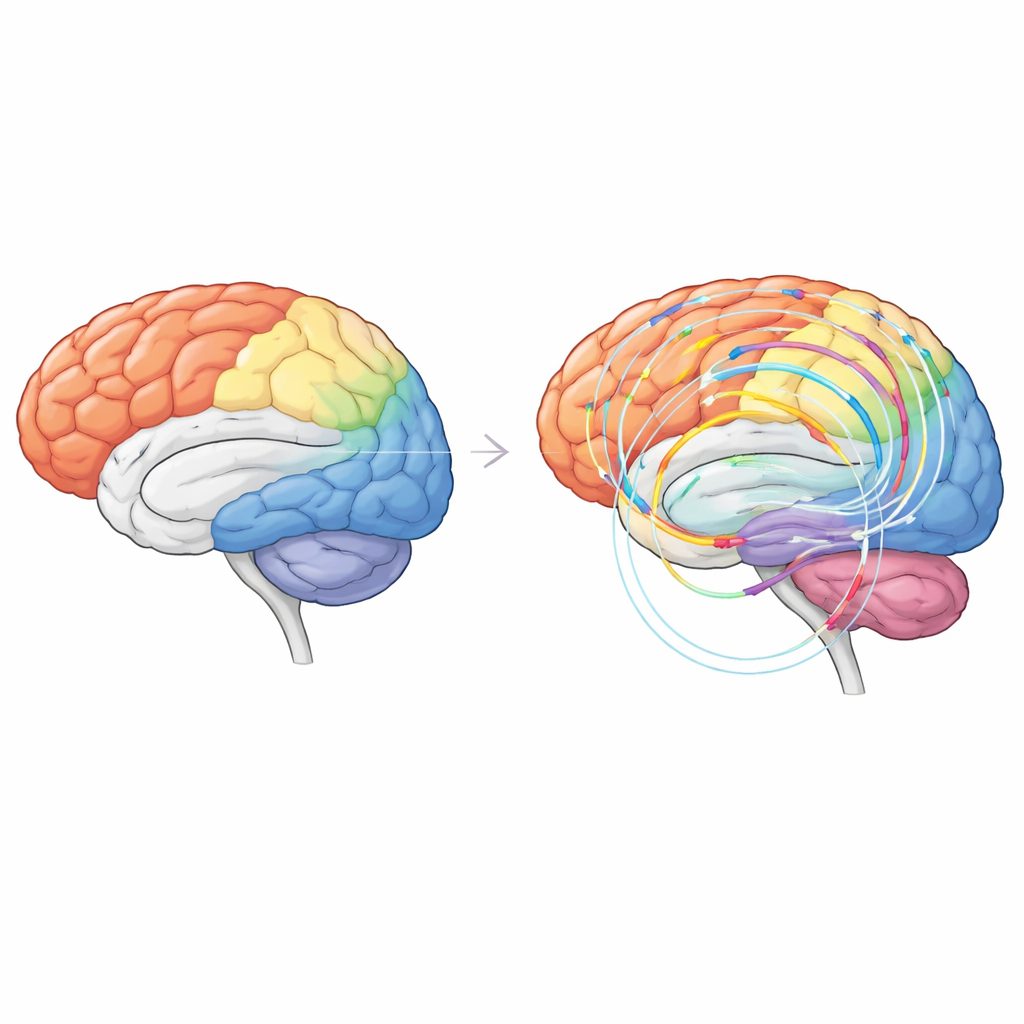
The researchers focused on “functional connectivity,” essentially how strongly activity in one region tracks with activity in another over time. They divided the cortex into networks that handle basic sensations and movements, and others that support complex thought, self-reflection, and emotional meaning. Across most drugs and datasets, a striking pattern emerged: psychedelics increased connectivity between high-level association networks and lower-level sensory and motor networks. At the same time, key deep structures such as the caudate and putamen, which help link perception to action, showed stronger coupling with these sensory systems. In other words, brain systems that are normally somewhat segregated became more interwoven during the psychedelic state.
Inside networks, a subtler and selective reshaping
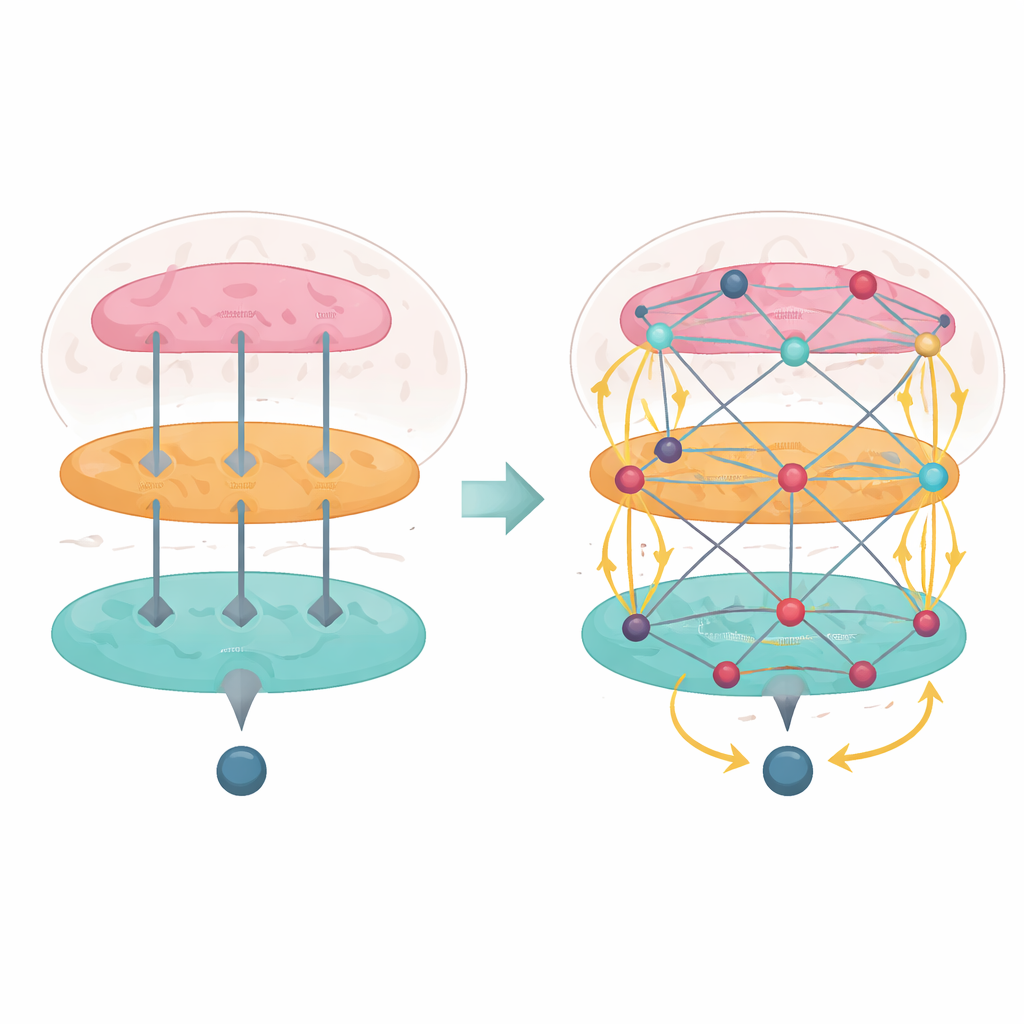
Earlier reports had suggested that psychedelics broadly “disintegrate” the usual organization within networks, especially the default-mode system often tied to our sense of self. By applying a Bayesian modeling approach—one that estimates both the size of an effect and the uncertainty around it—the authors found a more nuanced picture. On average, connectivity within networks did decrease, but the changes were modest and far from uniform. The most consistent reductions appeared in networks handling vision and movement, while higher-order systems showed smaller and less reliable shifts. This probabilistic analysis revealed that some dramatic-looking group averages from past work likely reflected noisy or inconsistent effects rather than robust rewiring.
Shared signature across different psychedelic drugs
Despite differences in chemistry, dose, and timing, several classic psychedelics converged on a similar network-level pattern. Psilocybin and LSD, supported by the largest samples, displayed nearly overlapping changes: stronger long-range links between sensory and association networks, and enhanced connections between sensory cortex and the dorsal striatum. Mescaline broadly fit this profile but with somewhat weaker or more selective effects. DMT showed an amplified version of the same shifts, although small sample sizes made exact estimates uncertain. Ayahuasca—which combines DMT with other active components—stood out as the most idiosyncratic, likely reflecting both its pharmacology and limited data.
What this means for consciousness and therapy
Put simply, the study suggests that classic psychedelics do not just scramble the brain; they selectively loosen its usual hierarchy. Regions that typically sit at the top, orchestrating abstract thought, become more tightly coupled to regions that process raw sights, sounds, and bodily signals. Deep hubs that help translate perception into action also join this intensified conversation. This cross-network “opening up” may help explain experiences such as vivid sensory blending, a softened sense of self, and the psychological flexibility reported in therapeutic trials. By providing a carefully quantified, cross-drug map of these changes, the work offers a solid foundation for future studies aiming to harness psychedelic states safely and effectively.
Citation: Girn, M., Doss, M.K., Roseman, L. et al. An international mega-analysis of psychedelic drug effects on brain circuit function. Nat Med 32, 1543–1554 (2026). https://doi.org/10.1038/s41591-026-04287-9
Keywords: psychedelics, brain networks, functional connectivity, resting-state fMRI, psychedelic therapy