Clear Sky Science · en
Isatuximab, carfilzomib, lenalidomide and dexamethasone in newly diagnosed multiple myeloma: a randomized phase 3 trial
Why this new cancer treatment approach matters
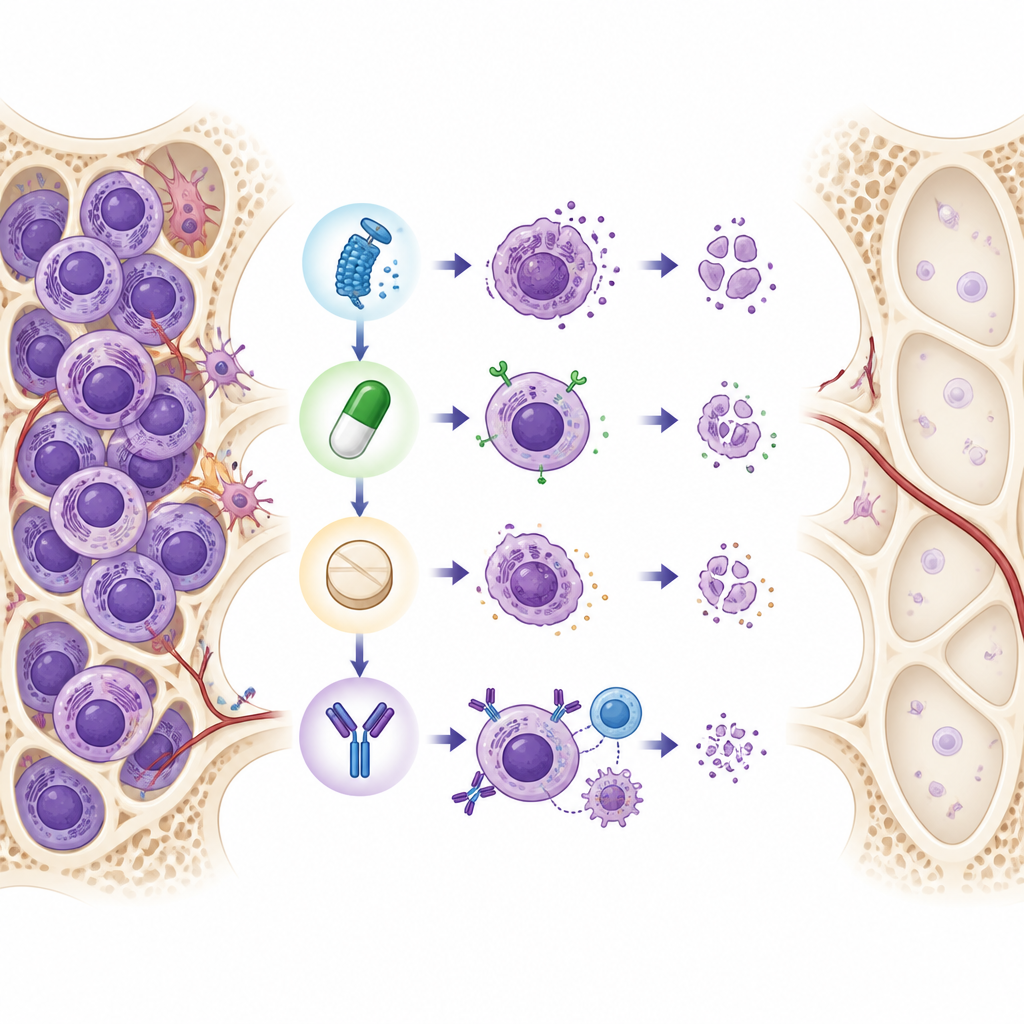
Multiple myeloma is a blood cancer that, while now often treatable for many years, is still very rarely curable. Doctors are searching for combinations of drugs that can wipe out nearly every last cancer cell early on, because patients who reach this deep level of response tend to stay well longer. This study tested whether adding a modern antibody medicine called isatuximab to an already powerful three-drug backbone could give transplant-ready patients with newly diagnosed myeloma a better chance at such deep, lasting control of their disease without adding too much extra risk.
A closer look at the treatment recipes
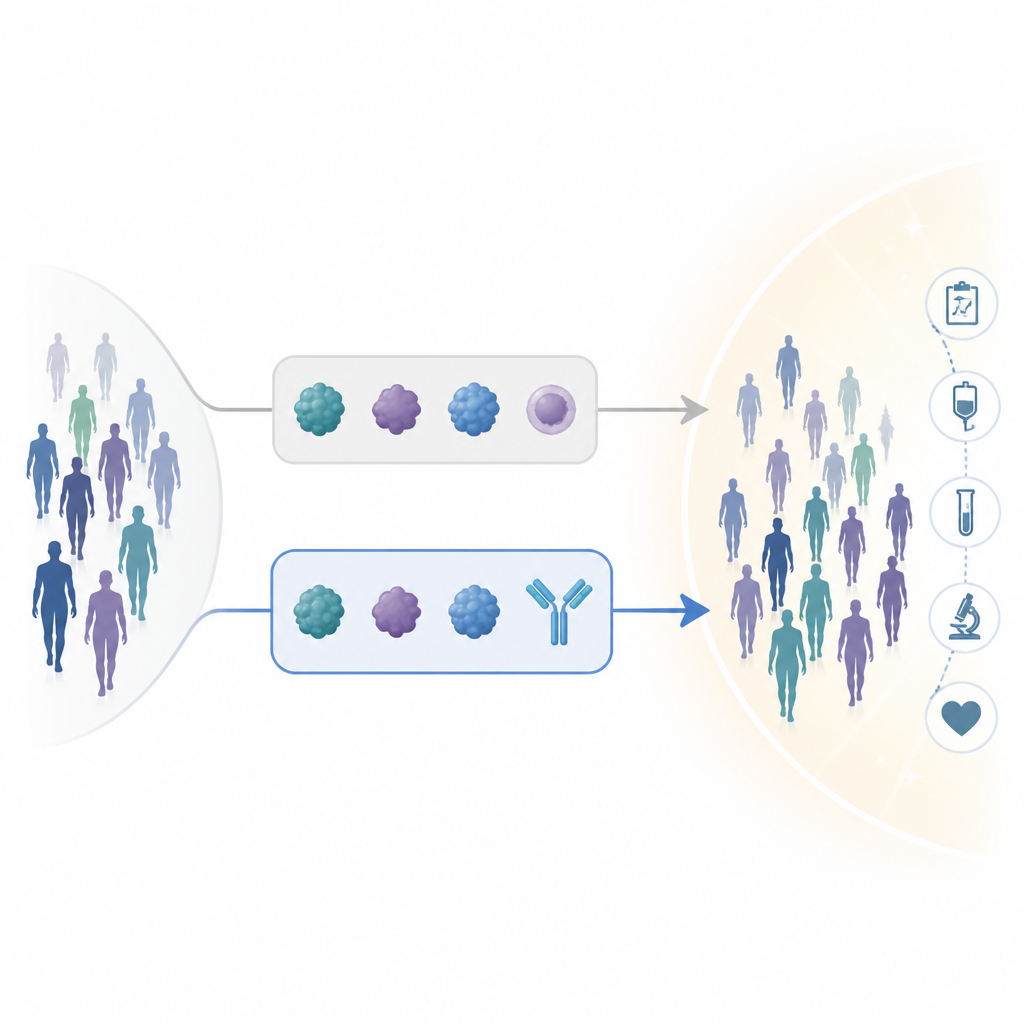
All 302 participants in this European trial were relatively fit adults up to age 70 whose myeloma was newly diagnosed and suitable for high-dose chemotherapy followed by a stem-cell transplant. Everyone received a standard three-drug regimen built from a targeted cell “shredder” (carfilzomib), an immune-boosting pill (lenalidomide), and a steroid (dexamethasone). Half the patients were randomly assigned to add isatuximab, an antibody that binds a surface marker on myeloma cells and flags them for immune attack. Both groups followed the same journey: several cycles of initial treatment, stem-cell collection, high-dose chemotherapy with transplant, then additional treatment phases to consolidate and “lightly” continue therapy.
Measuring cancer traces down to tiny levels
Rather than waiting years to see which group stayed in remission longer, the researchers focused on how many patients had no detectable cancer cells using very sensitive genetic testing of bone marrow, known as measurable residual disease, or MRD. They looked at two cut-offs: one that can spot roughly one cancer cell among one hundred thousand normal cells, and an even stricter one that aims at one in a million. These tests were performed after induction therapy, after transplant, after full-dose consolidation, after prolonged light consolidation and again a year later, to see not only how many patients became MRD-negative but also how many could sustain that status over time.
Deeper responses with the antibody add-on
Across the trial, adding isatuximab led to more patients reaching very low or undetectable levels of myeloma. After transplant plus full-dose consolidation, about three quarters of patients on the four-drug combination had no detectable cancer at the standard MRD cut-off, compared with roughly two thirds on the three-drug regimen. At the stricter one-in-a-million level, the difference was wider: around two thirds versus about half. Importantly, these deep responses appeared quickly, often within the first four treatment cycles, and continued to improve through the later phases. One year after light consolidation, just over half of patients in the isatuximab group still had undetectable disease at the strict level, compared with just over one third in the control group, suggesting a more durable benefit.
Benefits seen even in higher-risk patients
Myeloma is not a single disease; some patients carry genetic changes that make their cancer more aggressive and harder to control. In this study, the advantage of the four-drug regimen was seen across many predefined subgroups, including people with so-called high-risk or ultra-high-risk features. In those with multiple high-risk genetic changes, the share of patients maintaining very deep MRD negativity for at least a year was roughly three times higher with the antibody-containing treatment than with the three-drug approach. Interestingly, the depth and durability of response for high-risk patients on the four-drug regimen approached that of standard-risk patients, hinting that stronger initial treatment may partly offset otherwise unfavorable biology.
Safety profile and what comes next
Adding a fourth drug always raises concerns about extra side effects. Overall, serious non-blood-related problems, treatment stops and deaths linked to side effects were similar in both groups. Low white blood cell counts were more frequent with isatuximab, but this did not translate into a marked increase in severe infections. Rates of heart and vessel problems and nerve damage were low and comparable, and most patients in both groups were able to proceed to stem-cell transplant and complete the planned treatment phases. At the time of reporting, most patients had not yet relapsed, so the data on how long they remain free from disease are still immature and will require several more years of follow-up.
What this means for people with myeloma
To a layperson, the main message is that starting treatment with a four-drug mix that includes an antibody appears to clear myeloma cells more thoroughly, and keep them suppressed for at least a year, without major new safety concerns. While we do not yet know exactly how much this will lengthen life or delay relapse, deep and sustained MRD negativity is widely viewed as a strong early signal of better long-term outcomes. These findings support using isatuximab with carfilzomib, lenalidomide and dexamethasone as a promising front-line option for eligible patients, especially those with higher-risk disease, and help broaden the toolbox of intensive myeloma treatments that can be tailored to individual needs.
Citation: Gay, F., Roeloffzen, W., Dimopoulos, M.A. et al. Isatuximab, carfilzomib, lenalidomide and dexamethasone in newly diagnosed multiple myeloma: a randomized phase 3 trial. Nat Med 32, 1773–1782 (2026). https://doi.org/10.1038/s41591-026-04282-0
Keywords: multiple myeloma, isatuximab, minimal residual disease, carfilzomib regimen, autologous stem cell transplant