Clear Sky Science · en
Multi-ancestry genome-wide association analyses of refractive error augment genetic discovery and polygenic prediction
Why our eyesight stories matter
More than half of the people on Earth need glasses because their eyes do not focus light perfectly. This study looks deep into our DNA to understand why some people become nearsighted or farsighted, why some develop very high levels of myopia that threaten sight, and how this knowledge could one day help doctors spot those at greatest risk much earlier in life.
Common eye problems in everyday life
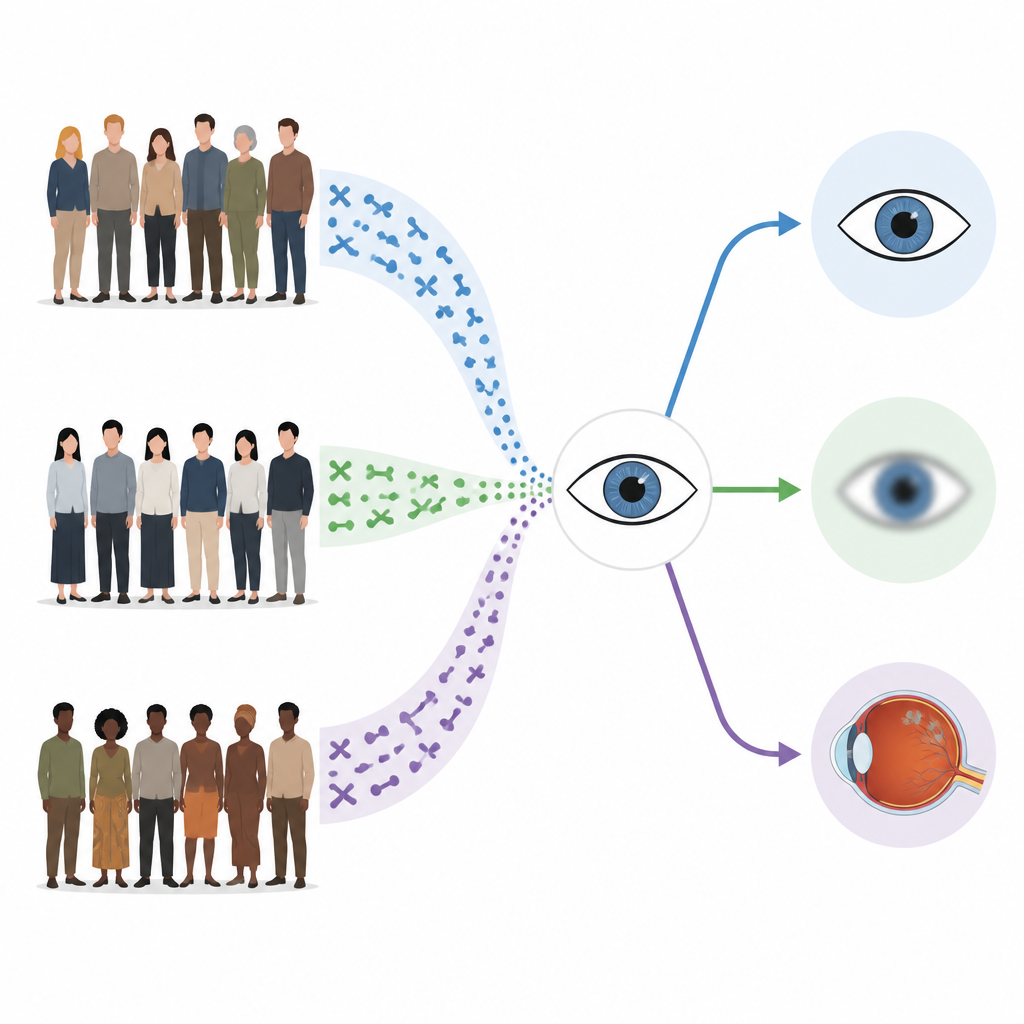
Refractive errors are the technical name for familiar conditions like myopia (shortsightedness), hyperopia (farsightedness) and astigmatism. They arise when the shape of the eye and the focusing power of the clear front window do not match, so images fall in front of or behind the retina instead of on it. Mild forms mostly mean blurred vision that glasses or contact lenses can fix. But very high myopia can stretch and weaken the eye, increasing the chance of cataract, retinal detachment and even blindness. With myopia expected to affect one in ten people at very high levels by 2050, especially in parts of Asia, understanding who is at risk is both a medical and social priority.
Bringing together DNA from around the world
The researchers combined genetic data from more than 1.7 million people of European, East Asian and African ancestry. Instead of focusing on one country or group, they carried out separate analyses within each ancestry and then a cross ancestry meta analysis to find patterns shared around the globe. They uncovered 932 spots in the genome where tiny DNA differences are linked to how eyes focus, including 241 that had not been connected to refractive error before. Some signals were common in all groups, while a few were specific to one ancestry, reflecting how human history has shaped the mix of genetic variants carried by different populations.
Zooming in on eye genes
Finding a region of DNA is only a first step. To get closer to the actual biological switches involved in eye growth, the team applied several layers of analysis that combined genetic hits with data on gene activity in tissues, including the eye and brain. By cross checking results from ten complementary methods, they highlighted 23 genes with strong evidence of a role in eye development. Many of these are already known from rare eye disorders or animal experiments to influence how large the eye grows or how its tissues form, which supports the idea that common differences in the same pathways also nudge everyday variation in vision.
Turning many tiny effects into a risk score
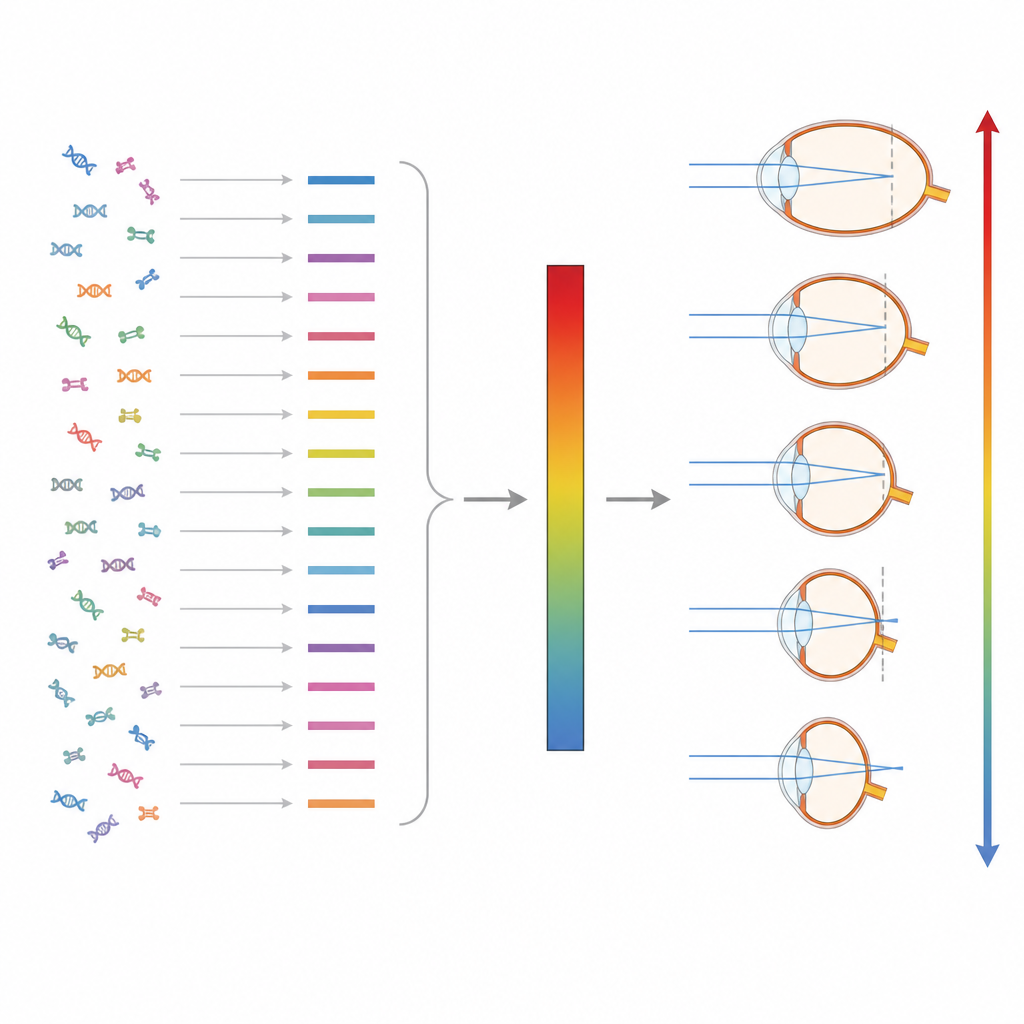
Each single DNA change has only a small impact on vision, but together they can add up. The researchers built a polygenic risk score, a single number that summarizes the combined effect of hundreds of thousands of variants across the genome. Using advanced statistical methods that also consider how important each stretch of DNA is in general, their score explained about one fifth of the variation in focusing error among people of European ancestry. People with the lowest scores were much more likely to have myopia and especially high myopia, while those with the highest scores tended to be farsighted. Across the range of scores, there were large differences in how early people started to wear glasses and how their eyesight changed from childhood to the teenage years.
Sharing predictions across populations and with daily life
The team tested how well their genetic score worked not only in independent European groups, but also in people with South Asian, East Asian and African ancestry. As expected, accuracy dropped when applying a score built mainly from European data to other groups, but it still captured useful information. By combining genetic data from all ancestries, the researchers further improved prediction in non European groups. They then compared the score with a simple measure familiar to any glasses wearer: the age when someone first needed correction. For forecasting very high myopia, the genetic score alone performed almost as well as this age of onset, and using both together gave the best results. They also found that education level and time spent outdoors, two known environmental risk factors, seem to influence vision in a non straightforward way that may interact with genetic background.
What this means for our future eyesight
This work greatly expands the list of genetic variants linked to common focusing problems and shows that a DNA based score can meaningfully separate people into lower and higher risk groups for myopia and high myopia, even from birth. While it is not yet a tool for routine eye clinics, it points toward a future where a simple genetic test, combined with questions about lifestyle and early vision checks, could help identify children who would benefit most from closer monitoring and early preventive care.
Citation: Cheng, FF., Liu, X., Mi, H. et al. Multi-ancestry genome-wide association analyses of refractive error augment genetic discovery and polygenic prediction. Nat Genet 58, 1030–1039 (2026). https://doi.org/10.1038/s41588-026-02576-0
Keywords: myopia, refractive error, polygenic risk score, eye genetics, vision prediction