Clear Sky Science · en
Systematic design of combination therapy by targeting master regulators of coexisting diffuse midline glioma cell states
Why this study matters for childhood brain cancer
Diffuse midline glioma is a rare but almost always fatal brain tumor in children. One reason it is so hard to treat is that it is not one uniform mass, but a patchwork of different kinds of cancer cells that respond differently to drugs. This study shows a new way to map those hidden cell types and match each of them with specific medicines, with the goal of building smarter drug combinations that keep the whole tumor in check longer.
Inside a single tumor, many kinds of cancer cells
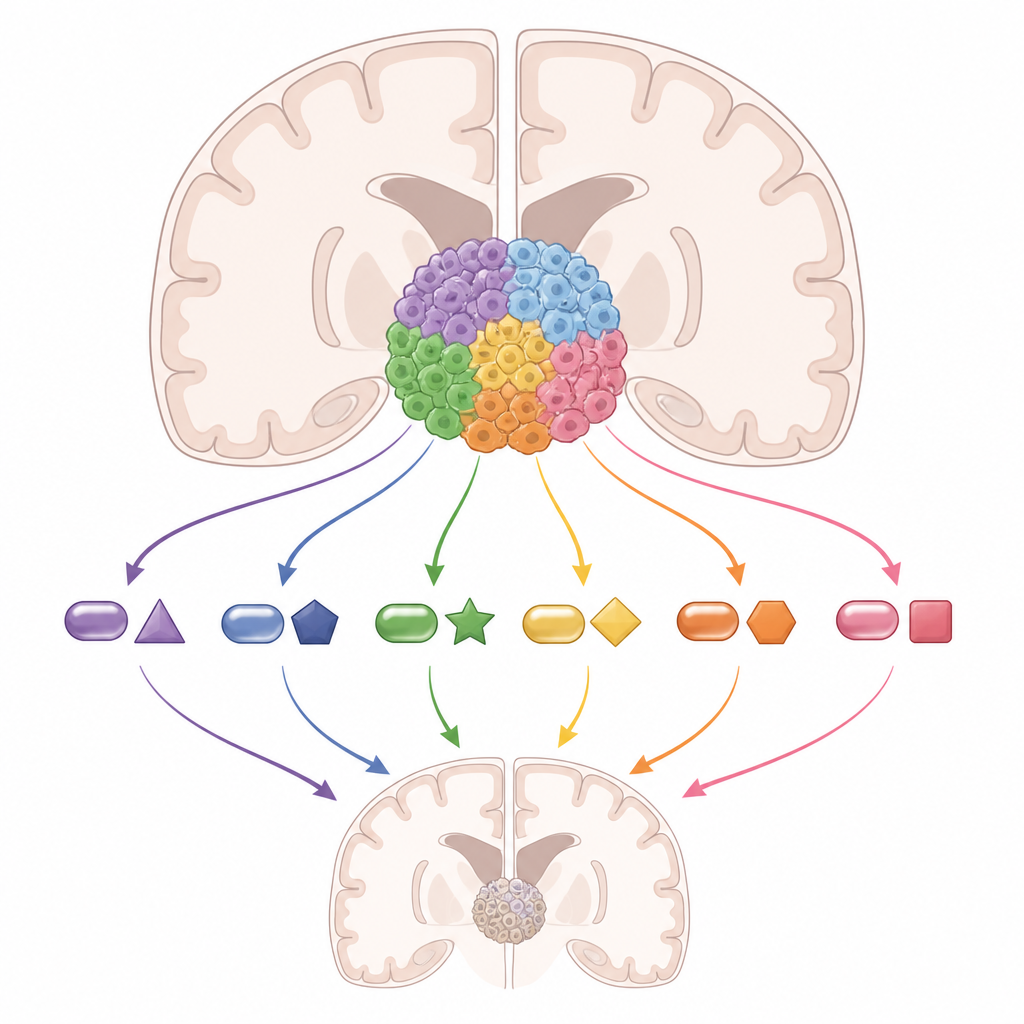
Using single-cell RNA sequencing, the researchers examined thousands of individual cells from children’s diffuse midline gliomas. Instead of finding one cancer cell type, they uncovered seven recurring "cell states" that resemble normal support cells in the brain, such as oligodendrocyte precursors and astrocytes, as well as cycling, fast-growing cells. Each state is controlled by its own small set of "master regulator" proteins that act like conductors for the cell’s gene activity, pushing cells toward growth, survival or more mature behavior. These master regulators were conserved across tumors from different patients and locations, showing that the same core cell states appear again and again in this disease.
Finding the tumor’s control switches
To test whether these master regulators are truly crucial for the cancer, the team used CRISPR–Cas9 gene editing to turn off hundreds of regulatory proteins in diffuse midline glioma cell lines. Many of the proteins flagged by their computer analysis turned out to be essential for cell survival, confirming that they act as control switches for the tumor. Importantly, some of these dependencies were shared across many tumors, while others were specific to certain genetic backgrounds or locations in the brain. This suggested that targeting master regulators could attack both common and patient-specific weaknesses in the cancer.
Matching existing drugs to hidden cell states
The next challenge was to find real medicines that could flip these control switches. The researchers treated glioma cells with 372 cancer drugs and recorded how each drug changed the activity of thousands of proteins. Rather than simply looking at whether cells died in a dish, they asked a more mechanistic question: which drugs reversed the activity pattern of the harmful master regulators in each cell state. This analysis nominated a short list of approved or late-stage drugs predicted to hit oligodendrocyte-like states, astrocyte-like states or both. Examples included avapritinib and trametinib for dominant oligodendrocyte-like cells and ruxolitinib, venetoclax and larotrectinib for minority astrocyte- or oligodendrocyte-like cells.
Testing single drugs in realistic tumor models
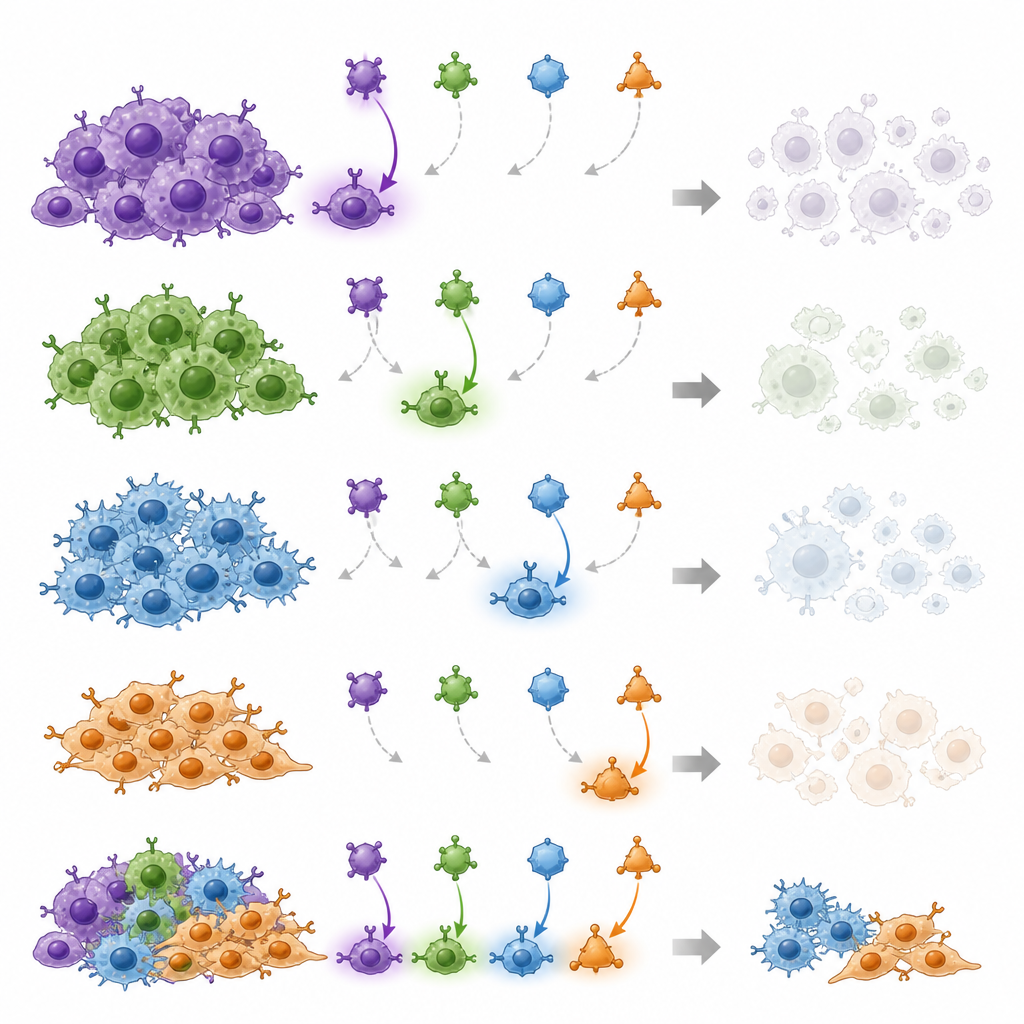
Because ordinary cell cultures do not capture the full diversity of tumor cell states, the team turned to mouse models in which human or mouse diffuse midline glioma cells grow as three-dimensional tumors, including in the brainstem. These in vivo tumors faithfully recreated the same mixture of cell states seen in patients. When mice were treated with the predicted drugs, single-cell profiling before and after treatment showed that eight of nine agents selectively depleted exactly the cell states they were designed to target. Drugs aimed at the most abundant oligodendrocyte-like cells slowed tumor growth and extended survival, while those aimed at astrocyte-like or other minority states had more modest effects on their own.
Combining drugs to cover all the bases
The real power of the approach emerged when drugs targeting different cell states were given together. In a syngeneic brainstem tumor model, combinations such as avapritinib with ruxolitinib, or avapritinib with larotrectinib, controlled tumors better than either drug alone and significantly prolonged survival. One pair nearly tripled median survival compared with untreated animals and increased it by about half compared with the better single drug. Notably, some drugs that did little alone became clearly beneficial in combination, supporting the idea that the tumor’s overall response depends on how all its cell states are hit, not just the majority population. Classic in vitro tests that look for direct synergy in a single cell type failed to capture this benefit, highlighting the importance of considering tumor heterogeneity.
What this means for future cancer treatment
This work outlines a general recipe for building combination therapies: first, use single-cell data to identify the main cell states and their master regulators; second, find drugs that can reverse those regulators’ activity; and third, combine agents that each target different coexisting states. In diffuse midline glioma, this framework produced several clinically feasible drug pairs with strong evidence of benefit in animal models, and it could be extended using routine bulk RNA sequencing for individual patients. While much remains to be done before these combinations reach the clinic, the study offers a practical path toward taming highly mixed tumors by treating their internal diversity rather than ignoring it.
Citation: Calvo Fernández, E., Tomassoni, L., Zhang, X. et al. Systematic design of combination therapy by targeting master regulators of coexisting diffuse midline glioma cell states. Nat Genet 58, 1112–1125 (2026). https://doi.org/10.1038/s41588-026-02550-w
Keywords: diffuse midline glioma, tumor heterogeneity, combination therapy, single cell analysis, precision oncology