Clear Sky Science · en
A direct black-hole mass measurement in a little red dot at high redshift
A tiny red speck with a huge secret
On first glance, the object known as Abell 2744−QSO1 is just a faint reddish dot in a distant galaxy cluster image. Yet careful observations with the James Webb Space Telescope reveal that this tiny speck, seen when the universe was less than a billion years old, hides an enormous black hole that seems to have formed before its surrounding galaxy had time to grow. Understanding how such a heavyweight arose so early sheds light on how the first cosmic structures took shape after the Big Bang.
Peering at a magnified dot in the early universe
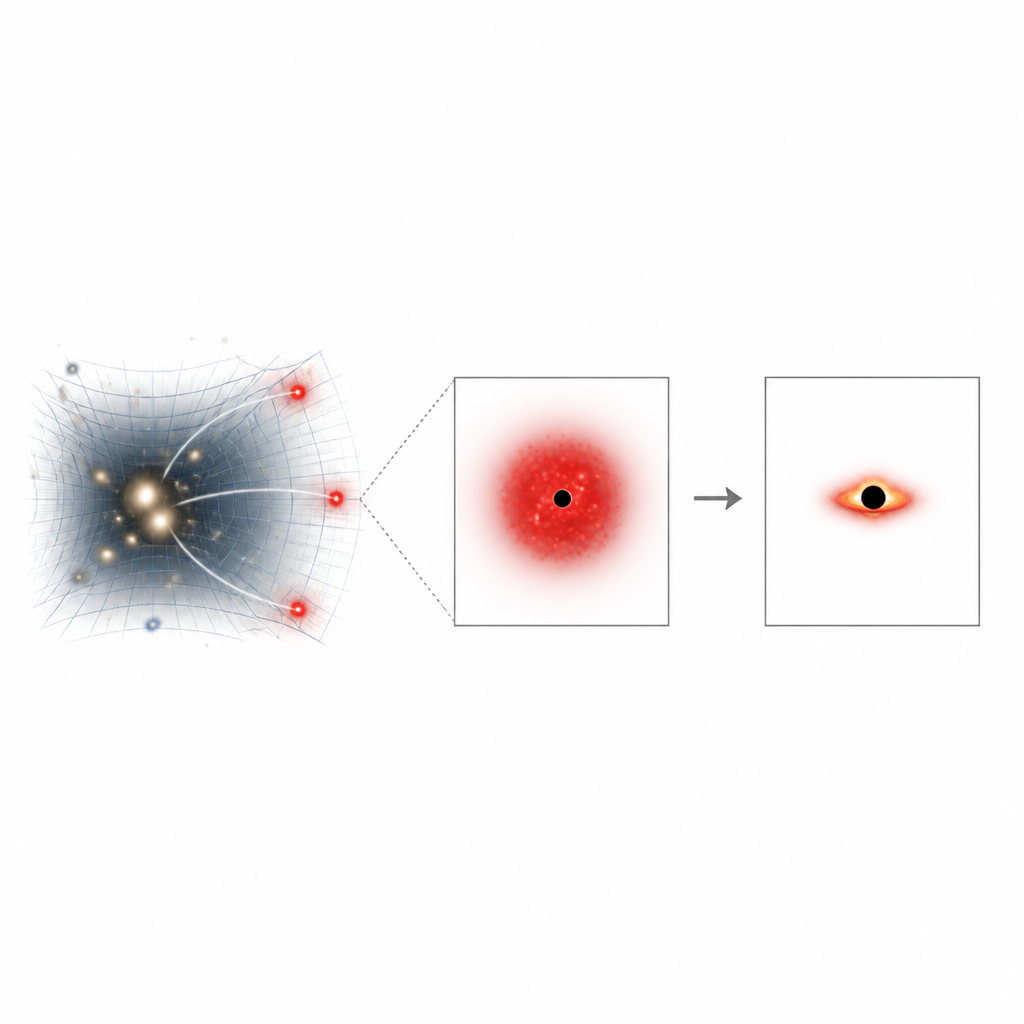
QSO1 belongs to a recently discovered class of faint, compact sources nicknamed little red dots. These objects show signs of feeding black holes but are unusually small and reddish in visible light, making them hard to explain with standard models of active galaxies. In this case, nature provides help: QSO1 lies behind the massive Abell 2744 galaxy cluster, whose gravity acts like a lens, stretching and brightening the background source into three separate images. This lensing effect magnifies the region around QSO1 enough that JWST can begin to dissect what is happening on scales of only a few hundred light years.
Tracing motion around an invisible heavyweight
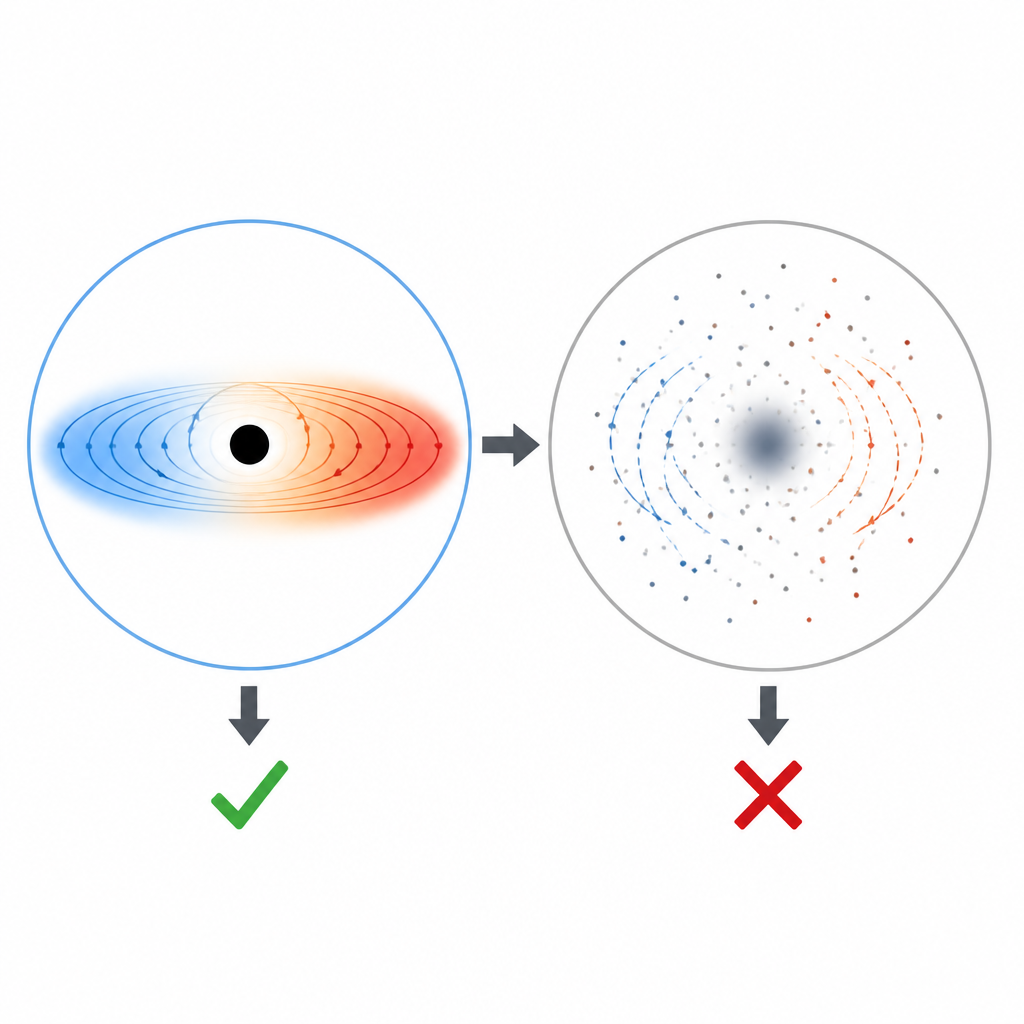
The team used JWST’s Near Infrared Spectrograph to map how gas moves in and around QSO1. They focused on narrow emission from hydrogen, which traces relatively calm gas. Across the tiny source, they detected a gentle but clear gradient in velocity, as if one side of the gas were moving toward us and the other side away. By carefully measuring how the apparent position of this gas shifts at different velocities, a technique called spectroastrometry, they reconstructed how fast gas orbits at various distances from the center, building a rotation curve far below JWST’s usual resolution.
Ruling out a dense star cluster
With these data in hand, the researchers compared two possibilities for what creates the observed motions. One is a single compact mass, like a black hole, dominating the gravity in the central region. The other is a very dense cluster of stars, similar to the nuclear star cluster at the center of our Milky Way, or a more diffuse ball of stars, gas, or dark matter. When they fitted detailed three dimensional models of the gas motions, the rotation pattern strongly favored a central pointlike mass. Any extended cluster that could reproduce the data would have to be far more compact and massive than the most extreme star clusters known, implying unrealistically high stellar densities.
A nearly naked black hole
The best fitting models indicate a black hole with a mass of tens of millions of Suns. Importantly, this dynamical measurement agrees with earlier, more indirect estimates based on the widths and brightness of broad emission lines, strengthening the use of those methods even at very high redshift. At the same time, the rotation curve leaves little room for additional mass in ordinary stars within a few hundred light years. The team estimates that the surrounding galaxy contains less than half the stellar mass of the black hole itself, making QSO1 the most extreme case yet of a black hole outweighing its host.
A giant seed from cosmic dawn
Such a heavy black hole living in a nearly pristine, star-poor environment poses a challenge for theories of how the first black holes formed. Conventional scenarios, in which black holes slowly grow from the remnants of the first stars or from direct collapse in gas rich halos, struggle to reach the observed mass without also building a much larger galaxy. The authors argue that QSO1 looks like a massive black hole seed caught in its earliest growth phase, with the black hole taking the lead and the galaxy lagging behind. This rare object offers a direct glimpse of black hole primacy at cosmic dawn, and a crucial test for ideas about the origin of the universe’s largest gravitational monsters.
Citation: Juodžbalis, I., Marconcini, C., D’Eugenio, F. et al. A direct black-hole mass measurement in a little red dot at high redshift. Nature 653, 1017–1021 (2026). https://doi.org/10.1038/s41586-026-10579-4
Keywords: supermassive black hole, little red dot, JWST, early universe, black hole seeds